Showing posts with label hypnosis. Show all posts

Friday, November 5, 2021

Seeking Truth at a Circus

JFK Jr. or somebody
    You got rats on the west side, bed bugs uptown, or at least it frequently seems so in the UFO subculture. Let's take a look at why cynicism is often justified and the genre continues to be about as appealing to self-respecting academics as a town full of money grabbers. Shadoobie. 

Anjali

    Anjali staked her claim to ufology immortality when she arrived on the scene with a DC press conference. She proceeded to inform the world, or a few dozen of us paying attention, that she knew where some alien-like higher life forms were hanging out, and that she would assemble a team of researchers to document it. Anjali essentially called next on Disclosure.

Absurd on its face, that such circumstances could be occurring without significant attention from the FBI and similar intelligence agencies, the narrative was quite disjointed in many ways. The story relied heavily on a lot of mumbo jumbo about digging into a mountain to access beings who aren't entirely physical and so on and so forth, but these are not really the most problematic aspects of the Anjali saga. 

Arguably more concerning is that the story was embraced by many, some discussing it as potentially true, while others used it as an easy target of severe criticism. The common denominator from one extreme to the other, as represented on various UFO podcasts and video channels, was often the apparent means to increase one's popularity and reach by carrying on about Anjali.

Mental Health Issues

    Anjali's story is not particularly unique in its enabling by hypnosis conducted by Barbara Lamb. This should be a serious red flag, as should the fact symptoms of emotional trauma and various psychological conditions are virtually indistinguishable from behavior commonly exhibited and even celebrated in the UFO subculture. 

UFO enthusiasts, and particularly those who subscribe to beliefs contact is occurring with intelligent non-human beings, heavily avert from the psychological implications. This might be considered particularly hypocritical, in the manner the mental health field is ignored and rejected much in the same way ufologists complain their perceived field of study is not taken seriously. The fact of the matter is, at the very least, a percentage of people reporting such circumstances as portrayed by Anjali are confused for any number of reasons, all of which are further inflamed by the UFO circus. A circus, I might add, consisting in part of deluded people and those who ride their coattails.

Four Years

      December 2021 will mark four full years since chronic UFO sensationalists Leslie Kean and Ralph Blumenthal got their AATIP story published in the Times. Much of the key elements of the piece remain unconfirmed (The DIA states the estimated completion date for AATIP- and AAWSAP-related FOIA requests is Dec. 30, 2022). Moreover, TTSA did not achieve its extraordinary stated and implied goals. I am extremely confident if four years ago we asked anyone swooning from the story what they hoped would be the status at this point in time, they would not have said they'd just love if Elizondo were still suggesting more patience is required.

Nonetheless, a contingent of UFO Twitter accounts, bloggers, and so on continue to at least feign ongoing enthusiasm. A competent argument can be made the rhetoric is substantially less a representation of popular opinion (or reality) as much as a successfully executed public relations campaign that effectively created minor social media influencers. 

Adding insult to injury is the fact some of the former TTSA personnel continue to be referenced as experts and invited to participate in activities in which they appear entirely unqualified. The history of ufology includes numerous circumstances of incorrectly labeling research as scientific. In at least some instances this is an attempt to gain otherwise unearned respect. We would be wise to hold claimed scientific investigation up to the rigors of transparency and measurable progress its definition demands.

Lil' Help?

     UFO investigators and trend setters have long claimed to want acceptance from the scientific community, but their actions suggest otherwise. They frequently engage in activities and cultivate followings that virtually ensure rejection from respected science professionals. 

It is my understanding the current psychological paradigm does not recommend confronting severely traumatized and confused people with contradictions that may be serving as mental coping mechanisms. Such dynamics would be more widely understood by a community if it spent a fraction of the time it invests in searching for truth on YouTube actually consulting the work of qualified professionals. The point being it's not a wise endeavor to take up the hero's journey of playing along with Anjali or any number of people with similar stories, and academics with sincere interests in valuable and responsible research are quite aware.

Likewise, self-respecting researchers who value career paths and integrity are going to minimize involvement with grandstanding personalities whose assertions lack substance. It's not the topic of UFOs in itself that causes the much discussed stigma, it's also largely due to organizations such as TTSA treating the situation more as a political campaign than ever publishing anything of value. 

Similar may be said about self-described journalists who are more aptly described as UFO cheerleaders. Intelligent and capable scientists, historians and researchers are simply not going to take up residence in the crosshairs. 

So, you may ask, if so much of it is hype and sensationalism, why follow it at all? That is a reasonable question and one with which the subculture may one day catch up, but mostly hasn't yet. There are a number of reasons your attention and beliefs are prized, and the reasons change from one player to another. The reasons are subject to change from one specific instance to another as well. These, and the implications spanning from war games to spy games and grifters to emotionally damaged people, may be the only answers ever to be conclusively mined from the UFO circus. 

Sunday, March 14, 2021

Police Use Hypnosis in Texas

     The Texas Department of Public Safety put an end in January to 40 years of using hypnosis to investigate crimes, The Dallas Morning News reported. The announcement Texas Rangers will cease the shocking practice came in the wake of a two-part series, "The Memory Room," outlining the hypnosis program and published by the newspaper last April. The News reported officers used the debunked technique to send dozens of men and women to prison and some to their deaths.   

The Rangers employed hypnosis in attempts to obtain evidence for investigation. It was not clear to what extent it was used as an interrogation technique. The program raises many concerns due to the vulnerability of a hypnosis subject to be coerced and influenced.

The circumstances are darkly reminiscent of the saga of Navy Petty Officer Daniel King, as described in the Hoffman Report. King was held by the Naval Criminal Investigative Service from 1999-2001 on suspicion of spying. His detainment involved brutal interrogation sessions and the use of hypnosis. The young man was ultimately released and the case became the subject of an ethics review. A liaison for the American Psychological Association called the actions of the hypnotist "ethically very marginal."

The infamous use of hypnosis as a memory enhancer is well known in the UFO genre. Despite the practice having been conclusively discredited by qualified memory experts, it continues to find ill advised support among alien abduction advocates.

UFO proponents using hypnosis as an investigative tool can be traced back to the 1960's case of Betty and Barney Hill. Although Dr. Benjamin Simon employed hypnosis as a treatment for trauma with the couple, and did not take the resulting mental imagery literally, the sessions were misrepresented by others as compelling evidence for alien interaction. 

As one mental health professional explained to us here at The UFO Trail, "After speaking directly with Dr. Simon, I felt duped by the UFO community and media. There was misrepresentation of Dr. Simon's conclusions in the Hill case. These false conclusions were widely continued on in movies, books, etc. I was very disappointed and discounted the case as a result of hearing the truth from the practitioner."  

UFO researcher Dr. Leo Sprinkle used hypnosis as a means to try and extract what he supposed were suppressed memories of aliens. As described by Adam Gorightly in his new book, Saucers, Spooks and Kooks, Paul Bennewitz would secure his car from alien influence by lining the windows with tin foil for the vehicle to be used as a safe space for Sprinkle to hypnotize Myrna Hansen. Some of the resulting mental imagery from the 1980 case was promoted so widely it continues today to be incorrectly taken for granted as factual about alien abduction and surrounding circumstances. Suffice it to say the Sprinkle-Hansen activities should not be considered mentally healthy, much less effective or helpful treatment for trauma.

Budd Hopkins
The cow was then out of the barn, and so-called researchers such as Budd Hopkins, David Jacobs, and John Carpenter relied virtually exclusively on hypnotic regression as an investigative technique. They gave little more than lip service to the welfare of the individuals being hypnotized. The haphazard sessions offered easy to manufacture, plentiful sources of otherwise mostly nonexistent evidence. Related ethical failures are thoroughly documented in my book, The Greys Have Been Framed. The work of Carol Rainey is salient on the topic, including her article, The Priests of High Strangeness, as well as posts she contributed to The UFO Trail.     

The Dallas Morning News reported Texas Rangers performed at least 1,700 hypnosis sessions since the 1980's. Public records obtained by the outlet indicate eight sessions were conducted by officers last year, including an October attempt to investigate a kidnapping. Three of the eight sessions were related to murder investigations. 

While the Rangers had the most prolific hypnosis program in Texas, its shelving does not necessarily signify the end of the troubling law enforcement practice. Over 800 officers have been approved statewide to implement hypnosis since the 1980's. Most states have banned or significantly restrict hypnosis use by police officers and prosecutors. Texas is likely the only state with an active certification program for officers to learn hypnosis and hosts probably the only police organization in the country with investigative hypnotists.

Tuesday, February 23, 2021

Adam Gorightly Discusses 'Saucers, Spooks and Kooks'

    Adam Gorightly just released a brand new book, Saucers, Spooks and Kooks: UFO Disinformation in the Age of Aquarius. He is a longtime writer and researcher of UFO-related shenanigans, and I recommend giving a read to his latest offering from Daily Grail Publishing. 

The book dives into the often dubious tales that make up the UFO genre, taking particular aim at the circumstances surrounding the alleged underground alien base of Dulce, New Mexico. Adam tracks the stories to their origins, and shares insights about his personal interactions with characters who inhabit and cultivate those tales.

I asked Adam if he would field a few questions for a blog post. My questions are followed by his responses below. He also provided the accompanying images. 

    What made you decide to write Saucers, Spooks and Kooks, and what was most important to you about it?

    It was a project that evolved over time, starting with an article I was writing over ten years ago titled “My Breakfast with Tal”, which detailed my account of breaking bread with the one and only Tal Levesque. An enigmatic and somewhat shadowy character, he was a key player in promoting the Dulce Base story/mythos starting back in the late 1980s.

As things progressed, I started delving deeper into the many claims associated with Dulce Base, many of which Tal, and a handful of others, had seemingly seeded, and in some cases, it appeared, created out of whole cloth. Over time, the project evolved into a longer article with the working title “Deconstructing Dulce”. I set out to pick apart the entire Dulce Base story, in essence deconstructing all the elements, in an attempt to separate fact from fiction, and untangle the many seemingly spurious stories associated with Dulce. Many in ufology unfortunately have taken those stories as gospel over the ensuing years. So the article kept growing to the point where it ultimately became book length in order to cover all the aspects of the story, and the many players, in ufology and the intelligence community, who had helped form the Dulce Base narrative.

One of the key allegations in the Dulce Base story concerned a secret treaty between reptilian aliens and the U.S. Government in which ET technology had been exchanged in return for test subjects to be used in an alien-human hybrid breeding program. Rumors have long circulated that cattle mutilations were also somehow involved in these experiments, the ultimate goal of which was to allegedly create human-alien hybrids to preserve and revive a dying ET race.

As the story goes, a heroic security officer named Thomas Castello led a revolt against the Dulce Base alien bad guys and the end result was a shoot ‘em up that ultimately left sixty-six Dulce Base workers dead. Castello had at his disposal a “flash gun” that allowed him to take out a few of these dastardly aliens and hightail it out of Dulce, thereafter becoming a whistleblower on the run. This legendary battle, straight out of a sci fi B movie script, became known as “The Dulce War”.

    In Saucers, Spooks and Kooks, you trace the origins of several urban myth-like beliefs to Paul Bennewitz and Myrna Hansen, and their fateful interactions of the 1980s. How much of what came to be popularly accepted about alleged aliens would you say is directly related to Hansen and her influence on Bennewitz?

    Myrna Hansen was one of the first so-called alien abductees, way before the term became fashionable. Her encounter, or whatever you want to call it, occurred in early May of 1980, when she and her son Shawn, while driving in Eagle Nest, New Mexico, allegedly witnessed a cow get sucked up on a beam into a spaceship. Shortly after, they were also sucked up into the craft where all sorts of insanity ensued, first with the ETs dissecting the helpless heifer in front of their horrified eyes, and then Hansen was placed into a trance and underwent some sort of medical procedure.

Following her encounter, a terrified Hansen contacted the state police office in the town of Cimarron to inform them of her crazy encounter with knife wielding cow cutting aliens, and in turn the Cimarron office referred her to New Mexico state trooper Gabe Valdez. He worked out of Dulce, and had by this time acquired the reputation as the go-to guy for cut-up cows and unexplained lights in the sky. It was Valdez who put Hansen in touch with Paul Bennewitz, a private government contractor specializing in avionics who among other things was an APRO member. Through Bennewitz’s APRO connections he was able to enlist the services of Leo Sprinkle, a University of Wyoming professor who had been investigating UFO cases using hypnotic regression for over ten years. Sprinkle would conduct a number of hypnotic regressions with Hansen at Bennewitz’s home, and more specifically inside of Bennewitz’s Lincoln Town Car, which he had covered the windows with aluminum foil as a means to disrupt an alien beam he believed was attempting to interfere with Sprinkle’s hypnotic regression of Hansen.

Curiously enough, Sprinkle conducted hypnotic regressions back in 1973 with another lady named Judy Doraty, who recounted a similar tale as Hansen’s regarding ETs and cattle mutes getting sucked up into a space craft, so how much of this was crosspollination or contamination (i.e. investigators/regression therapists leading alleged witnesses to a certain conclusion) is still an open question. It should be noted that Bennewitz, in addition to his fascination with UFOs, also had an abiding interesting in the cattle mutilation phenomenon, and so the two—UFOs and cattle mutes, it could be presumed—became intertwined in his mind and this worldview leaked out on to those with whom he interacted.

Hansen’s regressions included a smorgasbord of standard alien abduction tropes, such as a victim being sucked up into a ship on a Star Trek styled tractor beam, then placed in a trance and undergoing medical procedures related to reproduction and the test tube creation of alien-human hybrids. Hansen, it was alleged, had been implanted with a monitoring device, a so-called “alien implant” as they became known in the lore, and she experienced “missing time.”

As the Sprinkle/Hansen regressions probed ever deeper into the recesses of her beleaguered brain, it was revealed, or she remembered or confabulated (take your pick), being transported to a secret underground facility. During a medical examination, a metallic object was allegedly implanted in the base of her skull, apparently as a means for the aliens to later track her and beam her with malevolent messages, which is the reason why Bennewitz went to all the trouble of constructing a tin foil beanie which he placed over the windows of his car during the hypnotic regression sessions.

At one point during her underground base misadventure, Hansen recalled escaping the clutches of her captors and encountering multiple vats of liquid containing the remains of human and animal body parts. Bennewitz somehow deduced that this underground facility where Hansen saw all this stuff was located near Dulce. All of these elements of the story ultimately became incorporated into UFO lore as we now know it. The term alien “greys,” as far as I have been able to glean, was another trope that came straight out of the Bennewitz Affair.

    As you explained in the book, the Bennewitz Affair came to involve Richard Doty and William Moore. I particularly appreciated your documentation of the origins of the unreliable Majestic 12 documents and their relation to Moore and his associate, Jaime Shandera. What do you think is most important for people to understand about that chain of events?

    One critical factor that’s important to consider when attempting to unravel the origins of the MJ-12 Papers was that in 1981, three years before the MJ-12 papers surfaced, Bill Moore was working on a book project with Bob Pratt, a National Enquirer reporter who covered the flying saucer beat for the magazine. This book project, originally titled MAJIK-12, was a fictionalized account based on supposedly true UFO related information relayed to them by none other than AFOSI special agent Richard Doty, who was identified by Moore in a draft version of this book as “Ronald L. Davis”. MAJIK-12, or alternately MJ-12, was short for Majestic 12, who as most of your readers probably know, was supposedly a super-secret government group involved in investigating UFO sightings and the retrieval of crashed flying saucers and aliens, dead and alive.

Although the Moore/Pratt book project ultimately fell by the wayside, the proposed title MAJIK-12  suggested that Bill Moore was aware of something called MAJIK-12 or Majestic-12 at least three years before a mysterious envelope landed on his research partner Jaime Shandera’s doorstep, sent anonymously with no return address, postmarked Albuquerque, New Mexico. This postmark seemed a huge hint to some that Richard Doty was behind this caper, as during that period Doty was stationed at Kirtland AFB in Albuquerque. The envelope contained a roll of 35mm film that when developed revealed photos of what became known as the MJ-12 papers.

Prior to the emergence of the MJ-12 papers, Moore and another research partner, Stan Friedman, speculated about the existence of just such a group as MJ-12, and had even compiled a list of its most probable candidates. Moore later shared these names with Doty in the hopes that he might be privy to information that would confirm their list of MJ-12 candidates. When the MJ-12 papers surfaced, they did indeed include on their roster some of these very same MJ-12 candidates that Moore and Friedman had previously speculated were members of the group, such as Roscoe Hillenkoetter, first director of the CIA (1947-1950), and James Forrestal, who was Secretary of Defense during that same period, thus seemingly providing confirmation to Moore and Friedman that they’d been on the right track. Others would suggest that Doty cooked up the whole caper, and through a feedback loop provided Moore, Shandera and Friedman with what exactly they were looking for regarding information that seemed to confirm the Roswell UFO crash, that just happened to be the subject of the book Bill Moore and Charles Berlitz published in 1979, The Roswell Incident. It has been conjectured that Moore had a hand in counterfeiting the documents, with or without the help of Doty. However, it’s never been conclusively proven who hoaxed the documents, although the FBI determined that they were not authentic, or in their words, “bogus.”

FBI conclusion of the MJ-12 docs: "bogus"

In the same manner that the MJ-12 docs mysteriously showed up on Shandera’s doorstep, a similar event occurred in 1994 when UFO researcher Don Berliner received an anonymously sent envelope that contained a roll of undeveloped 35mm film. Once developed, the photographs revealed a 29-page document called SOM 1-01, Majestic-12 Group Special Operations Manual, a purported military manual related to flying saucer crash retrievals.

SOM-01-1 also included a reference to “Kirtland Air Force Base, New Mexico” which some suspected was a wink and a nod that it may have been another Richard Doty snow-job. Nonetheless, SOM-01-1 has continued to be embraced by some of the more prominent voices in ufology, such as Linda Howe, who at the Citizens Hearing on Disclosure (a pretend Congressional hearing held at the National Press Club in 2013), claimed that SOM-01-1 had “stood the test of time” —which of course it had done nothing of the sort, and only added to the stack of other seemingly spurious MJ-12 related documents that have littered ufology over the years.

    You wrote about several instances in which members of the military supply UFO researchers with doubtful information, accompanied by promises of future revelations. Ultimately, the big reveal does not materialize and the rug is pulled out from under the researcher. Please tell us a little about one such event.

    In the early 1970s, film producer Robert Emenegger was on the business end of one such promised “big reveal” (that ultimately turned out to be a dud) when he and his co-producer/partner, Allan Sandler, were approached by U.S. Air Force officials with an offer to cooperate and share information for a proposed documentary on UFOs. According to their Air Force contacts, this would be an all hands on deck affair, with the support of each branch of the military who would provide  Emenegger and Sandler access to UFO files in addition to the promised crown jewel: 16mm footage of a UFO landing with ETs, allegedly filmed at Holloman Air Force Base in 1971.

After spending considerable time and resources developing the project, with repeated promises of the saucer landing footage for their documentary, Emenegger and Sandler ultimately had the rug pulled out from under their feet, and were left empty handed as the Air Force failed to deliver the promised goods, and this early version of so-called “UFO Disclosure” went kaput. Emenegger and Sandler’s UFO documentary was eventually released years later, under the title of UFOs: It Has Begun but its impact was obviously diminished greatly from a credibility standpoint after the Air Force pulled out of the project. That's assuming, of course, that the Air Force actually possessed the material they promised for the film.

A similar “UFO Disclosure” head fake happened with Linda Moulton Howe a decade later, when in 1983 she was tapped to produce an HBO special with the proposed title UFOs: The E.T. Factor. During this period, Howe had been investigating the claims of Paul Bennewitz for possible inclusion in her documentary, and along the way she came to the attention of Richard Doty, then assigned to Kirtland Air Force Base. Doty took Howe under his dubious wing, and  gave her a glimpse of some supposedly classified documents related to flying saucer crash retrievals and the astounding revelation that there was actually a little ET in captivity at a military base somewhere. Doty informed Howe if she played her cards right she might even have an opportunity to interview the little fella. In addition, Doty told Howe that government intelligence officers had in their possession film footage of a UFO landing at a military base, as well as other photos and classified materials she could use. After several months of stringing Howe along, Doty informed her that he’d been removed from the case, and passed her on to other intelligence contacts that likewise strung Howe along for a period of several months, but never produced the promised UFO footage. This delay eventually caused HBO to opt out of the project, leaving Howe dangling in the wind.

As for the main motivation behind these capers, one can speculate in a lot of different directions, one of which was that Doty was attempting to discredit and misguide Howe’s UFO research, and ultimately undermine her HBO documentary, as well as to find out what information she had on Bennewitz and the counterintelligence program aimed at him, of which Doty was an operative.

    You explained a lot about the Dulce mythos and the people who spread it. In your research and experience, what did you think was most interesting about all that?

    The evolution of the mythos, and how it came about in the first place, is what I find most intriguing. There are different elements to the story, including what has become known in UFO lore as “The Dulce War”, which I mentioned earlier, where supposedly this security guard at the base named Tom Castello helped form a resistance movement. Some of his fellow human co-workers then got themselves into a dust up with the aliens and came out on the losing end of the skirmish. When the dust had cleared, as the legend goes, sixty-six Dulce base workers perished, although Castello was able to escape on account of his trusty “flash gun.”

So where did this story come from? As far as I can tell, it originated in a December 2, 1981 letter that Paul Bennewitz sent to U.S. Senator for New Mexico Pete Domenici stating that “sometime late 79 or first of 80 an argument insued [sic] over weapons and the military abandoned [Dulce base]; the final circumstance of the men unknown…” In a September 11, 1984 interview, Bennewitz told UFO researcher Jim McCampbell that: “In 1979 something happened and the base was closed. There was an argument over weapons and our people were chased out, more than 100 people involved…” Although Bennewitz didn’t implicitly state that there was an actual battle between humans and aliens at Dulce, his comments about some type of conflict, or of the humans abandoning the base,  appeared to have been enough to plant the seed that later blossomed into “The Dulce War.”

1981 letter from Bennewitz to Sen. Domenici

Nearly a decade later, “The Dulce War” story was fleshed out with the more detailed account concerning Tom Castello and his fellow resistors that appeared in “The Dulce Papers”. Variations of this story have also cropped up concerning a similar battle/confrontation occurring at Area 51.

In the mid-1990s, the Dulce War story resurfaced or was repurposed by a mentally unstable fellow named Phil Schneider who for a time became a star on the patriot and UFO lecture circuit, basically repeating the Tom Castello story with himself inserted into the heroic role of Castello, including the whole shoot ‘em up with dastardly aliens routine.

    There seem to be a lot of common themes that run between each of these stories, such as Dulce, Area 51, SERPO, and events surrounding Paul Bennewitz. Please share some of your thoughts on that.

    I would also add Roswell and the MJ-12 Papers to that mix, and the same recurring cast of characters who promoted these stories that are featured in my book, among them John Lear, Tal Levesque, Richard Doty, Bill Moore and a handful of others that formed this nexus of “influencers.” Bill Moore would later disavow many of these claims, and ostensibly remove himself from this nexus of characters, who he said were pushing false stories that had ultimately driven Paul Bennewitz bonkers.

John Lear, who admittedly had ties to the intelligence community, was an avid MJ-12 Papers promoter, while at the same time, during the mid-1980s, he was leaking information to the media about a secret stealth aircraft testing program at Area 51. The specter of stealth technology was forever lurking on the edges of these tall tales related to Dulce Base, Kirtland and Area 51, part of what appeared to be an effort to shape the overall narrative and muddy the waters about what was actually going on at these military testing sites.

As for SERPO, Richard Doty had a large role disseminating that story, dating back to when he appeared as “Falcon” in the nationally televised special that aired in 1988 called UFO Cover-up Live!. According to Doty (a la “Falcon”), the U.S. government had participated in an exchange program, with the aliens basically giving our astronauts the keys to one of their saucers, and having them travel to their planet, while in exchange the aliens stayed on Earth for a number of years sharing their vast intergalactic wisdom with the Earthlings, which was fundamentally the same story as SERPO.

    What would you tell UFO researchers new to the fray who attempt to navigate these stormy seas?

    Well, I think the people who need to hear it the most would probably care the least about what I have to say, but if they did, I’d suggest looking back in the annals of ufology and examining its past. Do that before jumping aboard any particular UFO shark, because there seems to be nothing new under the sun when it comes to a lot of these recurring themes that continually crop up in UFO lore. 


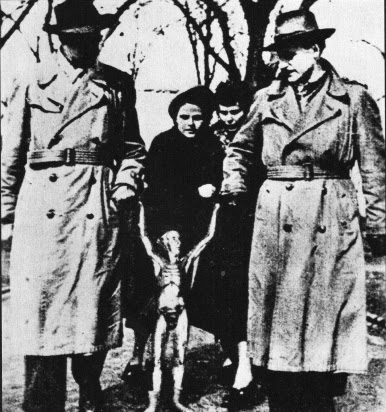
Ufology has the tendency to retread and repurpose many of the same stories, or elements of the same stories, time and again. A perfect example of this is the so-called Silverman photo, which first surfaced in the German newspaper Neue Illustrierte on April 1, 1950, with the title "Der Mars-Mensch" which showed a strange looking three-foot tall fellow apparently from Mars. A few days later, Neue Illustrierte admitted that the Martian story was an April Fool’s hoax, but that didn’t stop the photo from spreading through the UFO subculture in the years to come.

The infamous Silverman photo
Saucer historian Isaac Koi has compiled a timeline of the Silverman photo and the publications in which it appeared. The first book to feature this photo was Major Donald Keyhoe’s Flying Saucers from Outer Space (1953), which made no mention of the Neue Illustrierte hoax, but claimed that the photo depicted U.S. government agents escorting an ET known as “Aluminum Man”, who was covered with an aluminum spacesuit that protected him from cosmic rays. In Space-Craft from Beyond Three Dimensions (1959), W. Gordon Allen referenced that the creature in the Silverman photo had crawled out of a crashed saucer near Mexico City.

Most recently, Harold Povenmire in UFO's and Alien Abduction Phenomena: A Scientific Analysis (2016) published a colorized version of the Silverman photo promoting it as the real deal, although what “scientific analysis” he conducted is unclear. Thanks to Povenmire, this new iteration of the Silverman photo soon began worming its way through social media, as a new generation of true believers clicked and shared to their heart’s content.

Monday, June 15, 2020

UFO Research Integrity

Logic suggests explanations requiring the least number of hypothetical scenarios are often most feasible. Smart money goes with the most likely, least complex models when ranking possibilities.

In UFO circles we frequently lose sight of most likely explanations. Part of the reason may be because so much time is devoted to imagining the extraordinary. We tend to gravitate towards believing what we hear the most, no matter how often it may be properly framed as supposition. It's difficult to keep things in perspective when a 15-second disclaimer is followed by an hour of podcast speculation. Squeaky wheels get oil, even when delivered through sources such as fictional movies and television shows.

We often suspect the existence of hidden agendas - conspiracies, if you will - within the UFO genre because it can be so difficult to accept select researchers and organizations are as incompetent and credulous as they appear. Did the Roswell Slides promoters truly think that mummified Native American was a crash-landed visitor from the stars? Did Dr. Steven Greer really think that Atacama skeleton was an alien and did he and Dr. Garry Nolan honestly not understand the ethical concerns that would arise over their handling of itDid Robert Bigelow and a team of consultants think there was scientific merit in hiring "security guards" to reportedly play with alleged voice phenomena and conduct similar occult practices? (That last scenario was apparently funded by your tax dollars.) 

Could they have all sincerely had such poor judgement? Such reasonable questions abound.


The infamous Roswell Slides telltale placard

We might consider that, from a perspective of assessing research integrity, answers to the above questions don't really make that much difference. The integrity of research is weakened when investigators fail to respect and adhere to universally recognized protocols and codes of ethics. No matter what their agendas, their research is not reliable if they must incorporate numerous hypothetical scenarios into forming their arguments. We really don't need to know what personally motivated David Jacobs and if he is as obliviously incompetent as he seems in order to accurately identify his ethics failings and resulting poor quality of research. This means we don't learn anything of value, at least not about alleged paranormal experiences, from such material, and we are at high risk of absorbing and exposing others to incorrect information. Meanwhile, people are harmed and justifiably offended in the process of such examples as named thus far.

Paul Carr is a spacecraft systems engineer who facilitates several science-friendly podcasts. In response to request for comment on research integrity, Carr replied that he considers virtues of UFO research to include patience, humility, integrity and skepticism. Carr directs Aerial Phenomena Investigations (API), a UFO research group with a track record of commitments to evidence-based investigation and ethical treatment of UFO witnesses. He says the two go hand in hand.

"UFO research primarily deals with human memories," Carr stated, "and it has become clear to us at API that while the ethical treatment of witnesses and an open, honest, and careful approach to collecting and analyzing data are not the same thing, they are both members of a healthy body of research practice. Whatever threatens to corrupt one also threatens the other. Willful abuse of facts and fallacious reasoning readily metastasizes into abuses of innocent persons. This isn't something that just happens to organizations. It is a choice they make.

"It's not that we won't make mistakes - we will. It's what you do and how you change after a mistake is made that is the best marker of integrity."


Perhaps Robert Bigelow and his various teams assembled over the years have been unjustly saddled with conspiracy theories. It is possible they are simply as credulous as they seem to want us to believe. 

Substantial resources were poured into a Utah ranch. Claims of extraordinary creatures, portals to other dimensions, and various sensational happenings, the vast majority of which purportedly defied any kind of significant documentation, became the stuff of legends. Maybe the involved credentialed researchers sincerely do not understand the inherent problems in expecting others to embrace their unverified claims. Maybe they are truly that blinded by belief.

The Typhoid Mary-like innocence of claimed ignorance meets large problems when issues of fully informed consent arise. This was not only the case at the Skinwalker Ranch, as former security guards expressed concerns over their apparent unwitting involvement in state-funded research, but was a key component of the infamous Carpenter Affair as well.

Maybe John Carpenter, Robert Bigelow, John Alexander, John Schuessler and others were truly oblivious to the ethical minefield of covertly supplying Bigelow's National Institute for Discovery Science (NIDS) with information discussed between therapist and clients. Data and recordings of hypnosis sessions from some 140 case files were obtained for about 100 bucks apiece. Maybe some of the people involved in facilitating and concealing the transaction just didn't see publicly addressing the circumstances and voicing objections as feasible options. Obviously not, given their stances of mostly silence and aversion to questions. 

Perhaps some of them honestly believed the potential research gains outweighed the liabilities and betrayals. Maybe they honestly misunderstood and vastly overestimated the minimal scientific value of a collection of hypnosis-induced accounts of alien abduction. Such missteps are magnified when the parties claim to be conducting scientific study, as was the case.

Such scenarios, regardless of motive and intent, border dangerously on mad scientist territory. Codes of ethics are designed, in part, to deter researchers afflicted with delusions of self-importance from sacrificing human welfare during an incorrectly perceived pursuit of historic breakthroughs. This widely eludes much of the UFO genre and particularly its pro-hypnosis segment. Virtually anything appears deemed worth the cost of chasing an alien abduction carrot which has consistently remained out of reach.

"The importance of ethics in research integrity is that it creates the ground level from which all of your work is built," explained Dr. Christopher Cogswell, who holds a PhD in Chemical Engineering and co-hosts a popular podcast which explores fringe topics from reasoned perspectives. "If the ground isn't stable, then everything else you generate or say becomes built on a shaky foundation, which can easily be toppled by the first critical look at your methods and history. It is OK to be wrong or make a mistake, we are all human. But to continue despite evidence of mismanagement, error, or unethical practice makes your entire body of work suspect and tinged with that lens."  


We could carry our line of considerations to its chronological next steps, the Advanced Aerospace Threat Identification Program (AATIP) and the resulting To The Stars Academy (TTSA). Maybe intelligence professionals such as Luis Elizondo and Christopher Mellon are simply overly enthusiastic about the UFO topic and don't understand the problematic nature of trying to turn film clips into proof of the extraordinary. Perhaps Elizondo was simply too inexperienced at UFO investigation to adequately assess an extremely questionable case he and the seemingly ultra credulous Tom DeLonge highlighted on cable television. Maybe there's just an overwhelming amount of UFO history for Elizondo to learn, and maybe it simply never occurred to him to secure receipts that could answer questions about his background before he went to TTSA and started making claims he was apparently unprepared to adequately address if questioned. 

Maybe shelling out 35 grand for Art's Parts will prove brilliant. Perhaps the group's collection of alleged metal alloys, UAP fragments, or whatever the current going designation is will lead to paradigm-shifting discoveries. And, if not, maybe it all happened for no other reasons than none of the TTSA personnel knew any better. 

An obvious problem with AATIP is it consisted of Robert Bigelow and some of his perpetual cast members. This is not necessarily a negative thing in itself, but from a perspective of integrity of research, it is only prudent to question the effectiveness of the work of investigators who spent decades apparently more dedicated to belief than time-tested protocols. That's the case, anyway, if we are to believe their past indiscretions, as already described, resulted entirely from simple error. Again, it doesn't matter from an integrity of research standpoint whether they are incompetent or have ulterior motives when the outcome chronically produces nothing of significant scientific value.

As may have been the case with issues surrounding the security personnel at Skinwalker and the exploited hypnosis subjects of John Carpenter, perhaps it was poor understandings and lack of foresight that contributed to the Bigelow-facilitated covert funneling of DIA funds into MUFON. Maybe Bigelow, Schuessler, and none of the involved parties realized the problematic nature of an intelligence agency funding a 501(c)(3) UFO organization while concealing the fact from the rest of its governing board members and the public at large.  


Some of the boys in the Remote Viewing band. And NIDS.
And Skinwalker. And BAASS. And AATIP. And TTSA.

This isn't about people who may possibly be influenced by false memories or misidentify an exotic aircraft. We're not discussing individuals who experience some kind of event(s) they don't understand and go in search of answers. We're talking about credentialed scientists and professional intelligence personnel who in some cases subscribe to irresponsibly unsupported beliefs and flawed research methodologies, sometimes while under the commission of United States government grant funds.

It seems more than clear to this writer that, if we give all these people the benefit of the doubt and take them at their implied word, we should fully expect to scrutinize their opinions at length and have their research claims painstakingly verified before fully accepting them. Such investigators apparently, at best, suffer from recurring episodes of rather astoundingly poor judgement. 

The good news is we don't have to rely on personalities and popularity as tools for assessing research. Its merit or lack thereof should be self-evident.  

The fact will always remain that should some yet to be proven assertions turn out to be correct, they're indeed not established yet. Just because the future may show something to be accurate, that does not in any way mean you should currently exempt it from reasonable fact-checking. That's how we find out if it's true.

It is important we know the difference between facts and claims asserted by investigators, hold them accountable, and commit ourselves to respecting ethical standards and best practices as recognized by the professional research community. Integrity of UFO research, and ultimately what people believe is flying around up there, depend on it. 

Monday, June 8, 2020

Book Review: 'Captured by Aliens?' by Nigel Watson

The latest publication from Nigel Watson is well-sourced and far-reaching as we have come to expect from his work. Captured by Aliens? A History and Analysis of American Abduction Claims explores well over a century of reports of strange flying objects and their most peculiar crews in the United States.

The famous Betty and Barney Hill abduction case serves as the backdrop for analysis. Readers with casual interest as well as those well-read on the case will find this a worthy work. Watson covers much in detail, including Air Force reports and physical evidence analyses.

The author sets the stage by considering UFO events leading up to the fateful New Hampshire night of 1961. The dive into events surrounding Maury Island and Kenneth Arnold are quite intriguing, particularly the threads followed on Fred Crisman and Clay Shaw.

Watson spends significant portions of the book exploring aspects of reported alien abductions. Select cases are described, as well as a general outline of common occurrences of alleged abductions.

Watson periodically reminds readers of the dubious nature of the abduction beast. Challenging Budd Hopkins's persistent claims of a wealth of photographic, medical and physical supporting evidence, Watson writes, "As we have seen, there is no video or physical evidence for alien abductions, and other forms of evidence are based on anecdotes or generalizations rather than hard facts or data."

This is not to suggest, however, that the author does not give the abduction devil its due. Whatever we are to ultimately make of the reported encounters, it is clear there are potentially relevant implications. As one psychology expert considered, the fairly common theme of abductions occurring while on long drives could be of interest to neuroscientists.

If there is something this reader would like to have seen the author cover more thoroughly, I would appreciate more critical review of the activities of investigators who were largely responsible for forming the public perception of alien abduction. A substantial amount of documentation has been published by many sources on the unethical actions of abduction gurus. The author chose not to address these circumstances for the most part, although concerns about hypnosis as a memory enhancer were repeatedly expressed, as were objections to non-professional hypnotists leading the fray. The lack of further addressing ethical concerns may be due in part to the book being a revised version of Watson's 2009 self-published work, The Alien Deception: An Exploration of the Alien Abduction Phenomenon, according to the opening pages. 

Watson does indeed reference critical review undertaken by writer and researcher George Hansen. Watson also notes, "Ironically, Budd Hopkins, the very person who helped establish the concept of abduction has published ever-more fantastic accounts that even his followers find hard to accept at face value, and he has thereby eroded the validity of his original concepts."

However, aspects of the claims of Hopkins and other investigators are referenced without offering counterpoints. For instance, Hopkins's claims are noted pertaining to similarities of symbols which abductees purported to see during encounters and subsequently sketch later. The claim by Hopkins of their consistent similarities was effectively challenged by Carol Rainey with video footage to demonstrate its extremely questionable authenticity, including Hopkins qualifying the handling of the symbols was his attempt to "stack the deck".

In Watson's defense, he does not suggest Hopkins and other investigators were necessarily correct, but simply cites their claims as a means to establish what abductees seem to often report. Interestingly, investigators themselves may be among the most challenging hurdles to competently analyzing the abduction phenomenon: we are often at the mercy of their interpretations and agendas, absent access to the witnesses and what scarce data may exist. We don't know what happened, we know what they said someone else said happened, accounts often obtained through hypnosis and, at absolute best, a biased lens. It could be added that in some relevant instances this assessment of investigators is extremely generous and forgiving.

Watson takes a deep and thorough dive into the role media played in public perception of flying objects and their purported occupants. Confirmed hoaxes carried out by newspapers, recurring over generations, are covered, as are relevant aspects of film, television, and radio. The implications are evident.

The author's interest in UFOs and related reports inspired him to obtain a degree in psychology. Watson therefore dedicates a chapter to its significance, and acknowledges how discussion of psychological issues is often met with heavy resistance from investigators and experiencers alike. He clearly endorses treating people respectfully, while clarifying the situation is much more complex than simply labeling someone sane or insane.

The risk of offending researchers or abductees is not a legitimate reason to neglect delving deeper into their accounts, Watson ultimately argues. He adds, "In the long term, a less emotionally charged view of their experiences is likely to be of more help to them than soothing platitudes."

Watson dedicates the final chapters to analyzing the Hill case and alleged alien abduction, considering the contradictions in logic, and discussing social implications. The Hill case continues to be fascinating to both believers and skeptics.

Captured by Aliens? represents hundreds of hours of research and decades of knowledge acquired by Nigel Watson. The citations are clear and abundant. It is a useful research tool as well as a significant work on mapping social aspects of the alien abduction phenomenon, particularly the Hill case.

Captured by Aliens? A History and Analysis of American Abduction Claims is 215 pages. It is published by McFarland & Company, Inc.

Saturday, April 11, 2020

Leah Haley, MUFON and NIDS

Following is from Chapter 13 of my 2015 book, The Greys Have Been Framed: Exploitation in the UFO Community. I find reflecting on it now to be timely and interesting.


Pensacola Beach, a short distance from Eglin Air Force Base

Leah Haley and the 139
[T]his is not a 'witch hunt' or any kind of a personal anything against John Carpenter. This is about those 140 abductees that have been screwed and used by John and to insure that there is never a repeat performance. I hope that you can appreciate the importance of pursuing this as vigorously as is necessary.
This nasty business has now been confirmed by Bigelow himself, Walt Andrus, Dr. [John] Alexander of NIDS, and about seven of the abductees whose files were sold. This [is] no Mickey Mouse, “Ok now we all know about it so let's forget it because we're all human” kind of thing. This isn't about “cheating on the wife” or “pilfering office supplies from work,” John [Carpenter] has violated the trust, privacy, and right to anonymity of 140 abductees.
No good. That kind of bullsh*t has to stop, and stop now.
- John Velez to Budd Hopkins, UFO UpDates List

On a Saturday morning in March of 2011, I drove my Ford down the sunny streets of Pensacola, Florida. I located an address where I was expected in what turned out to be a neighborhood with an inviting appearance, and I came to a stop in front of a corner lot hosting a pleasant looking brick house. After double checking the address, I parked in the driveway, gathered some equipment and walked up a sidewalk shaded by oak trees to the front door. I considered how things are not always as they appear as I rang the bell at the seemingly typical home of a woman directly involved in a very not so typical chain of events that consistently created more questions than answers.

Leah Haley opened the door. We were soon in her den, seated across from one another discussing extremely questionable activities that had long plagued the UFO community.

Haley became a relatively high profile figure within ufology during the 1990's as an alleged alien abductee. I first contacted her in 2009 due to my growing interest in cases that seemingly overlapped with elements of the intelligence community. In addition to her possibly anomalous experiences, she reported numerous interactions with people who behaved in very questionable manners. She described how one such person directly claimed to have approached her on behalf of intelligence officials. Her story was filled with people appearing to have hidden agendas and conflicts of interest, whoever they worked for and whatever their motives may have been. She subsequently authored books on her experience in ufology, and by the time she and I began corresponding, Haley no longer believed extraterrestrials were involved in her story at all: Her research led her to conclude that human beings were conducting mind control-like experiments and operations, and that some of the people who were targeted, including her, had misinterpreted the circumstances as alien abduction.

I have come to confidently conclude Haley's saga included exploitation, manipulation and ulterior motives. That is the case regardless of what specific explanations may apply to the circumstances.

Sitting in her den that Saturday morning, we talked about her fragmented memories of a childhood UFO sighting in Alabama, and how years later the memories led her to seek assistance from the UFO community. We talked about how she became involved with ufology hypnotists, and how, after writing Budd Hopkins, he referred her to John Carpenter. It was subsequently during a 1991 trip to Missouri to meet with hypnotist Carpenter and his assistants that Haley explained how she was approached at the airport in Springfield by a stranger. The man suspiciously asked out of the blue if her travels had anything to do with her interest in extraterrestrials. That occurred long before she became outspoken on the subject of UFOs, and a minimal number of people should have known – or cared – she was in town to be hypnotized by Carpenter.

Pensacola

Haley and I talked about how she got involved from her former home in Mississippi with the UFO scene in Gulf Breeze, a community of substantial significance in ufology located near Pensacola. That, in turn, resulted in two now previous board members of the Mutual UFO Network accompanying her on a 13-mile hike across Eglin Air Force Base.

On September 24, 1992, Leah Haley, along with USAF Ret. Lt. Col. Donald Ware and USAF Ret. Col. Robert Reid, set out across the south end of Eglin, which borders the Gulf of Mexico. They hiked from Navarre east across the base to Fort Walton Beach in search of the site where an alien spacecraft had been allegedly downed by American military personnel – with her aboard. That fantastic notion, dubbed the beach incident, resulted from the hypnosis sessions conducted by Carpenter, yet another member of the MUFON Board of Directors at the time. Ware later acknowledged it was he who incredibly suggested they search the base shoreline for the crash site and undertake the puzzling expedition.

The sun sets on Pensacola
Haley and I talked about how, a few months prior to the hike with Ware and Reid, she interpreted herself to have received a telepathic message stating her alien abductors were from Sirius. She later discovered Sirius to be a star in the constellation Canis Major. In her 2003 book, Unlocking Alien Closets, pages 19-20, Haley documented experiencing what she interpreted as a second telepathic message the very next day, March 13, 1992, following the transmission referencing Sirius.

“My communicators told me to check out the beach incident; they indicated that it had occurred Thursday morning, August 4, 1988, on Navarre Beach,” Haley wrote.

She discovered Navarre Beach to be near Pensacola and border Eglin Air Force Base. The circumstances directly contributed to her further involvement with the Gulf Breeze UFO community, Donald Ware and the subsequent hike across Eglin.

[...]

At one point in our interactions I asked Leah if she was aware of Martti Koski. She responded she never heard of him. I inquired about Koski, a Finnish citizen who claimed to have been a victim of MKULTRA-type mind control experimentation while visiting Canada, because he reported hearing unexplained voices – that told him his abusers were from Sirius. His case was cited in Martin Cannon's 1990 work, The Controllers: A New Hypothesis of Alien Abduction.

“Koski, for example,” Cannon wrote, “was at one point told that the doctors afflicting him were actually 'aliens from Sirius.'"

Further food for thought includes a September, 1991, Flying Saucer Review submission, The Extraordinary Case of “Elizabeth Richmond”. Explored in the article were events surrounding the alleged UFO-related experiences of a woman assigned the pseudonym Elizabeth Richmond, who apparently resided in Pensacola. Her reported anomalies included telepathic contact involving a message about aliens from Sirius.

“During later meditation sessions there was apparently some telepathic contact,” the authors wrote. “Elizabeth was told that their home-planet belonged to the star Sirius...”

While I found such circumstances intriguing, my interest admittedly spiked when I noted this: The authors were Donald Ware and Robert Reid. I checked with Haley to make sure there was not some kind of mix up in which Ware and Reid were actually writing about her as “Elizabeth Richmond,” which, Leah confirmed, they indeed were not. She further indicated she was previously unaware of the article and its contents.

Were we to believe MUFON directors residing in Greater Pensacola knew at least two people during the early 1990's stating they interpreted themselves to have received telepathic messages claiming to have been transmitted by aliens from Sirius?

MUFON Contradictions

Whatever we are to make of the many curious circumstances that make up the Haley saga, they do not change the fact that a great deal of consideration could be given to the actions of people involved in the case, whatever those actions might indicate. At the least, issues of ethics and exploitation arise. That is the fact no matter how adamantly one may choose to argue the validity of Haley's conclusions about her experiences or one potential explanation or another.

As I blogged about the case, primarily between 2011 and 2013, I frequently observed people seeming to be either unable or unwilling to absorb and discuss the social significance of the chain of events and its implications to ufology as a whole. Interested parties often seemed unable to get past arguing about the legitimacy of alleged alien abduction or the feasibility of relatively recent mind control operations in order to meaningfully discuss what I interpreted to be issues that offered better opportunities for deeper, more focused study. At the least, Haley's case offered opportunities to identify details of specific incidents and the players involved. I'd go as far as to say, in hindsight, I confidently suspect a significant segment of the UFO community prefers to keep attention aimed at nebulous concepts, arguing about beliefs that can't be conclusively resolved, rather than drilling down through that which is actually available for closer examination.

Tom Deuley
A fourth MUFON board member, US Navy Ret. Lt. Commander Tom Deuley, questioned Haley's motives and judgment in statements published in the March 5, 1995, edition of The Tampa Tribune-Times. The engineer and former National Security Agency employee stated that MUFON did not embrace Haley's story of alien and military abductions when he was quoted for an article addressing her then-upcoming speaking engagement. “We feel very embarrassed” about “such ridiculous stories,” Deuley commented on behalf of MUFON, adding that “it doesn't help the serious scientific work being done.” Such statements might be considered an understandable public stance to express – if they had been accurate.

While throwing Haley under the bus, Deuley completely failed to disclose it was his own MUFON colleagues – fellow board members, no less – who played primary roles in shaping and encouraging her perceptions in the first place; perceptions cultivated via such means as hypnosis and a very peculiar field trip across an Air Force facility in search of the crash site of an alien spaceship. Deuley apparently failed to disclose extents of MUFON involvement with Haley while literally describing her statements as ridiculous. He represented the stance of the organization as rejecting such claims, when, in fact, a much more accurate description of the situation would have been that its board members were actively involved in manufacturing them.

Readers even vaguely familiar with the Mutual UFO Network should be well aware of its long established tendencies to embrace and promote such beliefs, contrary to what Deuley informed the newspaper reporter. As a matter of fact, in 1995, during the very time in which The Tampa Trib ran the story with Deuley's comments, the MUFON UFO Journal was regularly carrying a pro-alien abduction column authored by John Carpenter. Abduction Notes, as it was titled, clearly endorsed and promoted claims of abduction of both the alien and military variety. In a column published in the February, 1995, edition of the Journal, a matter of just days before the March 5 newspaper article went to press at The Tampa Trib, Carpenter specifically promoted “the reality of UFO abductions” while referencing such material as Whitley Strieber's Communion and Budd Hopkins' Intruders.

For Deuley to assert that MUFON attempted to discourage spreading such stories in favor of promoting “serious scientific work” was obviously, to put it kindly, incorrect. For the MUFON director to frame the events in such a manner while simultaneously omitting mention of board members' direct involvement and literal participation in Haley's story, which he described the organization as identifying as embarrassing and ridiculous, was, to put it politely, not an accurate representation of the circumstances. History would soon show us that Deuley's failure to provide The Tampa Trib with more accurate context of the circumstances was only a trailing indicator of what would prove to be much deeper and systemic MUFON problems directly related to transparency, protocols and ethics.

The Carpenter Affair

In 1995, hypnotist, Licensed Clinical Social Worker and MUFON Director of Abduction Research John Carpenter was publishing columns in the MUFON UFO Journal. He was advocating quality services and compassionate treatment for alleged alien abductees, including what he described as the emergence of “a promising network of abduction support groups” led by “trustworthy individuals.” He would later state he was at that same point in time conducting what he attempted to justify as “data sharing” with controversial ufology philanthropist Robert Bigelow: Carpenter was supplying Bigelow and his associates at the now dissolved National Institute for Discovery Science (NIDS) information from and copies of case files of alleged abductees without their knowledge or consent.

John Carpenter
The circumstances would become known as the Carpenter Affair, and, according to documents and statements obtained from multiple sources which included Carpenter himself, copies of the case files of 140 alleged alien abductees were released. The files were shared without the informed consent of the individuals who were hypnosis subjects of Carpenter, and some had paid him for the sessions, including Leah Haley. Additional materials released apparently included audiotapes of hypnosis sessions.

Carpenter received a reported $14,000 from Robert Bigelow in exchange for the “data sharing.” He framed the compensation as reimbursements for his time and expenses, while others interpreted him to have sold case files.

“'[M]y data sharing was spread over three years around 1995,” Carpenter stated during a January, 2012, email exchange I conducted for a blog post at The UFO Trail.

“Other researchers were approached with the same proposal, and some of them may have shared data, too,” he added, but declined twice to elaborate further on the alleged involvement of other researchers.

Carpenter consistently defended his actions. He repeatedly described his hypnosis and alien abduction investigation activities as serious scientific research conducted with the best of intentions.

“It was an honor to have great minds study this important information, quietly, discreetly, and respectfully,” he wrote of the hypnotically induced narrations and their release to Bigelow and associates.

“If you were so confident your motives and intentions were honorable,” I asked during the 2012 email exchange, “why did you not ever just ask Leah if it would be okay to share her file with an interested party? After all, she was obviously an ambitious truth seeker, considering her activities and levels of commitment. Why didn't you just ask her?”

“She was already publicly sharing, speaking, and publishing more details of her case than I ever thought of sharing,” Carpenter replied, “and I wasn't sharing anything publicly - only discreetly and privately with scientists - that's what researchers do.”

Even if we were to entertain that statement – evasive and condescending as it may be - as a sincere description of Carpenter's interpretation of his actions in the case of Leah Haley, it doesn't explain his justification for bypassing informed consent in releasing the files of the other 139. They weren't all speaking publicly about details of their experiences and hypnosis sessions, were they? Furthermore, it's quite arguably beside the point from a number of perspectives, and suffice it to say Haley saw the situation substantially differently than Carpenter tried to rationalize it.

MUFON Complicity

In a two-page statement (see below) included in a 2001 complaint filed to the Missouri Division of Professional Registration, Haley explained how Carpenter originally presented himself as acting in the capacity of a mental health professional and repeatedly assured her that all information discussed would be kept confidential.

“Had I known that John [Carpenter] would sell my case files or disclose information he did not have permission to disclose, I would never have gone to him,” Haley wrote in the prepared statement.


What we can reasonably discern about the Carpenter Affair is that during the 1990's Carpenter supplied data to Bigelow and payment was made. The exchange was indeed discreet, as Carpenter described the circumstances, if not covert. It was not until investigator Gary Hart, acting on information provided to him by alleged abductees who told him of what they termed a file sale, picked up the trail in 1999 and more widely published the details. According to Hart, his tipsters were concerned about both the breach of confidential information as well as the MUFON willingness to enable the circumstances while failing to take corrective measures.

Hart took the role of principal reporter of the Carpenter Affair and in 2000 submitted a formal complaint to the Mutual UFO Network. The organization still took no apparent action. MUFON allowed Carpenter to remain in a leadership capacity and continued to encourage self-described abductees to seek his services.

Hart then filed a complaint in 2001 to the Missouri Division of Professional Registration, where Carpenter was licensed as a social worker. The agency enacted a five-year probation period on Carpenter's license. The action reportedly resulted from Hart's complaint. Carpenter vacated his position as MUFON Director of Abduction Research that same year, 2001, and the probation period was completed in 2006.

MUFON staple John Schuessler
I picked up the Carpenter Affair story while blogging about the Haley case. Gary Hart subsequently left comments about the saga at The UFO Trail, and I then contacted him for more information. The result was the 2013 blog post, The Carpenter Affair: For the Record, which contained several documents submitted and specific points addressed in the complaints filed to the Mutual UFO Network and the Missouri Division of Professional Registration.

Among the points of Hart's complaint I identified as most relevant was the apparent MUFON complicity in the chain of events. MUFON founding member and participant on the board of directors John Schuessler was simultaneously sitting on a NIDS advisory committee during the time in question, the 1990's. It became increasingly apparent that factions of the MUFON hierarchy not only attempted to cover up the Carpenter Affair, but had in all reasonable likelihood been aware of its circumstances all along. Larry Bryant, MUFON Director of Governmental Affairs at the time, expressed such concerns in a 2000 formal statement on the matter:

Since a cloud of alleged impropriety now hangs over the Executive Committee (of MUFON) for its having taken so long to act upon its months-long knowledge of the 'Carpenter Affair', I hereby call upon all members of the Executive Committee to resign forthwith from their Committee positions, from their membership on the MUFON Board of Directors, and from their MUFON general membership - all in the interest of helping restore the public's confidence in the purpose, operation, management, and integrity of this organization...
In addition, you Executive Committee members owe all of us in the entire field of UFO research not only a full, written explanation as to who on the MUFON Board originally knew of the 'Carpenter Affair' (and when they knew it) but also a published apology for their having embargoed or otherwise downplayed that knowledge at the expense of the rest of the Board. If we have a lesson to be learned from this debacle, how about this one: Enforced silence never can be the ally of truth!

Hart made it abundantly clear that, after submitting his complaint to MUFON, representatives for the organization expressed neither concern about the matter nor interest in pursuing it.

“Immediately after filing my MUFON complaint I was told in no uncertain terms that MUFON had no intention of taking the complaint seriously and actually doing an investigation, so I investigated the case further and made a proper report/complaint to the state licensing board,” Hart informed me in 2013.

He added, “Perhaps the most important point in all of this is that MUFON's ethics code was all for show. They had and apparently still have no intention of holding anyone, even a board member, to their code of ethics.”

Other key points contained in Gary Hart's investigation included implications of sexual relations commonly taking place between investigator/hypnotists and alleged alien abductees. Carpenter, for instance, reportedly married two of his former clients, one of which was a hypnosis subject represented in the 140 files released to Bigelow and his NIDS associates.

Hart reported in his complaint that Carpenter's activities rendered his body of research worthless due to the “exceptionally dysfunctional behavior” documented as having occurred between Carpenter and some of his abductee contacts. Given the circumstances, Hart continued, professional researchers could no longer determine what was truth or fiction within Carpenter's abductee accounts and conclusions. Hart's work further suggested such questionable activities were common among investigators of alleged alien abduction.

Conditions of the probation enforced upon Carpenter's license were specified in State Committee for Social Workers v. John S. Carpenter, a 2001 public document available on the website of the Missouri Division of Professional Registration. Stipulations included he submit to a psychosocial evaluation as part of a treatment program for an impaired professional. He was then required to inform the State Committee of any counseling or care recommendations that might result, as well as furnish progress reports on a quarterly basis. Carpenter was also required to provide the Committee with performance evaluations completed by his employer twice per year, among additional stipulations.

The Players

Robert Bigelow
Several attempts were made at various times to obtain comments on the Carpenter Affair from relevant parties. Multiple requests for permission to submit questions were sent to Robert Bigelow and his representatives. No responses were received.

John Carpenter was emailed in preparation for blog posts in 2012 and again in 2013, and he was willing to provide statements in each of the two circumstances. He maintained his lack of negligence and defended his actions, in spite of acknowledging he indeed provided Bigelow and associates with copies of the files and that payment was made. He consistently denied they were sold, however. In 2013 I requested he specifically comment on how he could deny the allegations he sold case files in the context of statements he wrote in a 1996 letter to Bigelow. A copy of the letter was included in Hart's complaint, and I provided Carpenter a copy when I requested comment.

“Personally, I want to thank you, Bob, for your assistance regarding the 140 cases I mailed to you. That helped pay some bills,” Carpenter wrote to Bigelow in the letter (see below).

“The remainder has been what we have been living on since last December at the rate of $600-$800 per month... What has really hurt this year – after I began copying and sending files – was the elimination of my bonus/incentive pay program at work.”


In response to request for comment on his remarks contained in the 1996 letter, Carpenter stated in an email received October 15, 2013, “I am now and always have been in complete possession of all original case files, approximately 140 in number. Mr. Bigelow paid me for my time, expense, and labor in making some copies that his elite science panel could review in order to understand the abduction phenomenon more fully.”

John Carpenter may describe his activities as he chooses, yet the fact will remain it is not difficult to understand why some people would interpret the circumstances as selling the case files and betraying the trust of the parties involved. An argument could also be made the specific purpose of the compensation is irrelevant as compared to the significance of the file release itself.

Part of a 1994 regional MUFON newsletter,
establishing Carpenter framed his hypnosis
activities as paid professional services,
a point later denied by his attorney

[...]

MUFON International Director from 2000 to 2006 and founding member John Schuessler was part of that “elite science panel” Carpenter referenced. Schuessler sat on the NIDS Scientific Advisory Board.

I emailed him on multiple occasions and requested permission to pose a few questions about the Carpenter Affair, clarifying that his comments were requested for inclusion in blog posts. No responses were received.

Former member of the MUFON Board of Directors Donald Ware and the organization parted ways, and Ware went on to direct the International UFO Congress from 1993 to 2010. He and I exchanged emails in preparation for my February, 2012, blog post, The Leah Haley Case: The Eglin Expedition.

Donald Ware
Ware explained that he suggested undertaking the hike across Eglin in 1992 based on the description of the alleged crash site, alluding to details which arose during a July, 1991, hypnotic regression session conducted by Carpenter with Haley.

“I told her there is about 100 miles of the sugary white sand along our coast,” Ware wrote, “but the most likely place for the military people to be there so soon would be the 13 miles of restricted Eglin AFB beach between Navarre and Ft. Walton Beach.”

[...]

In a July, 2000, email to the once popular listserv and website UFO UpDates List, John Velez indicated that Col. John Alexander and Robert Bigelow himself, along with some of the suspected abductees in question, were among those who had confirmed that “files were sold.” Career intelligence officer, non-lethal weapons expert and CIA consultant Col. Alexander was a staff member of NIDS at the time.

It was for such reasons that I emailed the colonel in the weeks preceding the 2012 Ozark UFO Conference, where Alexander was scheduled to speak, and requested permission to interview him at the event for a blog post to be published at The UFO Trail. In an email dated March 2, 2012, Col. Alexander responded that he “would be happy” to meet with me, and recommended I get with him at the conference to schedule a time. However, when I approached Alexander in person at the conference the next month, April, he declined to be interviewed due to what he described as my interests in conspiracies.

Since our interactions in 2012, I have emailed Col. Alexander and requested comment for blog posts on various occasions. Sometimes he offers direct statements and other times he is more vague.

In August of 2013 I emailed Alexander and informed him I was hoping he would provide comment on some issues surrounding the Carpenter Affair. I particularly asked what interests he may have had in the 140 files. I also asked if he would please explain, in his opinion, why his former employer, Robert Bigelow, desired to obtain the 140 files and, in effect, finance Carpenter's ongoing activities. Comment was requested on any knowledge he might have of other researchers offered similar agreements, as asserted by Carpenter.

Lastly, I cited James Carrion's January, 2011, allegation that Bigelow, during dealings with MUFON, moved funds on behalf of an undisclosed financial “sponsor” that Bigelow only revealed to John Schuessler, but not the rest of the MUFON board. I asked Col. Alexander if he could offer comment on Carrion's allegation, and if there was anything he might be at liberty to discuss concerning relationships between Bigelow corporations and intelligence agencies.

“You should ask Bigelow if you are interested in old affairs,” Alexander less than transparently emailed in response.

It is possible Alexander's aversion to discussing the Carpenter Affair and related issues, while ironically promoting himself as an intelligence insider both willing and able to explain behind the scenes ufology, may be due at least in part to nondisclosure agreements long reported to be conditions of dancing with Team
Bigelow. Following is an excerpt from an Associated Press article, Millionaire searches for UFOs on ranch in Utah, which references such agreements while exploring Bigelow's interests in the Skinwalker Ranch, published in the October 24, 1996, edition of the Eugene Register-Guard:

Officially, the research is being conducted by the National Institute for Discovery Science, which Bigelow formed last October. Among the scientists involved is John Alexander, former director of non-lethal weapons testing at Los Alamos National Laboratories in New Mexico.
“Our approach is to do good, high-quality research using a standard scientific approach and do what we can to get hard data,” Alexander said from the institute's Las Vegas offices. “One of the missions of the institute is to make information widely available.”
Bigelow himself declined an interview. Alexander would not provide details of how or why the research is being conducted.
[Former owner of the property Terry] Sherman, now employed by Bigelow to maintain the ranch, said he can no longer discuss the activity because of a nondisclosure agreement Bigelow had him sign.

Along with the use of nondisclosure agreements, reports have circulated of Bigelow's direct involvement with intelligence agencies, in addition to his practice of employing their consultants such as Col. Alexander. An individual identifying himself as “Chip” in an interview published in September, 2012claimed to have been employed in security at the Skinwalker Ranch during approximately 2009. Chip indicated security clearances and nondisclosure agreements were prerequisites for employment at the facility, and alleged that he saw copies of a contract between Bigelow interests and the NSA during the time he worked at the ranch.

James Carrion, in his ongoing research, documented contradictions and inconsistencies put forth by NIDS. Carrion reported that individuals, including family members of the former Skinwalker Ranch owners, stated that accounts of supposed high strangeness related to the property were exaggerated or entirely misrepresented. Moreover, while serving as the MUFON International Director, Carrion and an accompanying scientist visited the ranch but were denied access. Carrion further reported that he was among the people interviewed for a background investigation on John Schuessler for a US government security clearance allegedly related to his consulting work for Robert Bigelow.

Elizabeth Chavez Carpenter is a former wife and hypnosis subject of John Carpenter, and her case file was among the 140 released. She contacted me in December, 2013, after reading my posts at The UFO Trail about the Carpenter Affair. Although I had not previously interacted with her directly, I was aware of Chavez Carpenter due to my research of the circumstances and correspondence with Gary Hart. She was among the sources who provided Hart with information contained in his formal complaints, and he described Chavez Carpenter as “truthful in my many talks with her.”

She and I subsequently corresponded, and I considered one of the more interesting aspects of her experience as one of the 140 to be that she actually had a copy of her case file eventually sent to her by standard mail. Chavez Carpenter explained that she contacted John Alexander after identifying him from the NIDS website as someone who could possibly be instrumental in returning her file and audiotapes. She and Alexander then exchanged emails, according to Chavez Carpenter, from May to October of 2000.

She described the colonel as polite in their interactions, adding that he at one point informed her that he would check on the tapes the next time he was at the NIDS offices. In one email from Alexander, she indicated, he asked her if she had yet received anything. In another, Alexander suggested that he had discovered the tapes were not at NIDS – whatever we might suspect that implied.

Chavez Carpenter received her case file in 2001, but knowing that NIDS kept a copy, she concluded. It came in an envelope with no return address, as she recalled.

“I sent three letters to Robert Bigelow requesting to have my case file back along with the audiotapes,” Chavez Carpenter explained. “I did receive the case file, minus the audiotapes.”

She was unsure of the specific chain of events that led to receiving the file in the mail. I asked, for instance, if she thought Alexander was instrumental, as she initially suspected he might be.

“As I look back and reflect on all this, I cannot really say.”

I asked Chavez Carpenter what she thought the reasons were that Robert Bigelow was willing to provide John Carpenter with cash and purchase copies of the case files and related materials.

“We may never know,” she replied.

[...]

[I]n early 2015 the British army announced the formation of the 77th Brigade, a unit of 1500 troops The Guardian dubbed “Facebook warriors.” The soldiers are charged with carrying out unconventional, “non-lethal warfare” and executing psychological operations through the use of social media. Israeli and US armies engage heavily in such operations, with the Israel Defense Forces reporting activity conducted in six languages on 30 platforms, including Twitter, Facebook, YouTube and Instagram.

It would be difficult for me to believe the UFO community did not serve in some capacity in the research and development of such psyops, or, at the least, I would doubt the community was exempt from effects of the evolution of such projects. As a matter of fact, in his hard hitting 2015 piece on how the US intelligence community drove to dominate the world through information control, Why Google made the NSA, investigative journalist Nafeez Ahmed referenced ufology's favorite CIA consultant, Col. John Alexander. Specifically, the targeting of civilian populations for information war.

Addressing a 1989 US Navy brief authored by well-connected Pentagon official Richard O'Neill, Ahmed wrote, “That secret brief, which according to former senior US intelligence official John Alexander was read by the Pentagon’s top leadership, argued that information war must be targeted at: adversaries to convince them of their vulnerability; potential partners around the world so they accept 'the cause as just'; and finally, civilian populations and the political leadership so they believe that 'the cost' in blood and treasure is worth it.”

In the end, the best most of us can do is inventory the facts, carefully differentiating between what we can demonstrate to be true versus what we are told is true. We can then make an honest effort to see what kind of picture emerges when the facts stand on their own, absent unsubstantiated proclamations and stripped of colorful yet distracting costumes.

Leah Haley initially waded into the UFO community in search of credible information. People claimed they were qualified to provide it. Some 14 or more hypnosis sessions and a life altering change of belief systems was facilitated by the board of directors of a purported scientific research organization. Haley put on the brakes and summoned the courage to question the validity of the indoctrinated alien narrative. In her renewed efforts to separate fact from fiction, she found nothing to support an alien presence, yet repeatedly identified circumstances of human-instigated exploitation. She and others who have sought guidance from ufology hypnotists and similar self-described experts will deal with the adverse effects the rest of their lives.

I cannot conclusively say Leah Haley is a victim of covert mind control research as she suspects, but I can confidently say that she and her circumstances were exploited...

Either way, it was her involvement with the people of the UFO community who qualified themselves as able to be of assistance that directly led to the entire traumatic series of events, of which this chapter represents but a small sample. In a manner of speaking, she's right, one way or the other, as her interpretations of reality and memories of past experiences were definitely altered and manipulated. Relevant questions become how intentional was it, who was interested in studying it and for what purposes.

As for me, I'm pretty sure a lot of the excessive window dressing is hung by people bound by nondisclosure agreements and government security clearances which restrict them from discussing classified information. They're promoting hypnotic regression as a memory enhancer, and they are generally - and in some cases extremely - exploiting the public. They're spending decades as key personnel of nonprofit corporations funded by undisclosed sources and operating under false pretenses of prioritizing scientific study, while, in actuality, virtually constantly promoting an entirely unsubstantiated alien presence. If they can ever undress the facts they're disguising beneath multiple layers of elaborate costumes, evasive statements and unresolved contradictions, I'd be more than willing to adjust my assessment accordingly.

In the meantime, I call bullshit.