Showing posts with label People in ufology. Show all posts

Thursday, October 20, 2022

Investigation of Skinwalker Claims Leads to Uintah County Offices

    The beginning of the latest article at Expanding Frontiers Research, titled 'Uintah County Paid Tens of Thousands to PhenomeCon Speakers':

    Financial records obtained from Uintah County indicate it spent over $133,000 on the 2022 PhenomeCon while raising about $124,000 in revenue, compiling a reported debt of some $9,000 for sponsoring the paranormal-themed conference. The inaugural 2021 PhenomeCon likewise tallied over $74,000 in payouts while collecting about $59,000 in revenue, finishing some $15,000 in the hole. Expenses for the two conferences, confirmed to be sponsored by Uintah County, include tens of thousands of dollars in payments to dubious speakers and catered “VIP” meals in which unsupported rumors were spread of dangerous paranormal phenomena. Payouts also include workshops promoting such topics as Remote Viewing and payments for rental car reimbursements. During the 2022 PhenomeCon, payments issued for speaking engagements, consultation services, and appearances at events totaled over $60,000, while hotel chains were paid in excess of $10,000, according to the financial reports.

Expanding Frontiers Research (EFR) obtained the information through public records requests submitted to the Uintah County offices of the Clerk-Auditor and Travel and Tourism. The requests were submitted as part of a joint effort between this writer and EFR Director Erica Lukes, who contributed substantial research to this article.


Monday, October 3, 2022

UFO Trail Projects

    Lots of interesting projects have been coming to fruition around UFO Trail headquarters! If you haven't yet heard, I helped launch Expanding Frontiers Research (EFR), a Utah-based 501(c)(3) nonprofit corporation. We're dedicated to sharing information and resources that most effectively embody best research practices. We also envision expanding on the archive work already undertaken by Erica Lukes and Barry Greenwood. 

You can view the EFR website and have a look around. Be sure and check out the blog as well, where I'm adding material, including the latest post, FBI Docs Offer Clues on NICAP President, Right-Wing Extremism. It explores declassified FBI material that offers further insight into Jack Acuff and his contacts. 

You might also be interested in a recent UFO Classified episode in which Erica graciously provided Emma Woods and me a venue to explore Emma's history. For those of you not entirely familiar, the case involved a number of unethical actions committed on the part of David Jacobs. We listened to actual recordings of audio clips made during long distance telephone hypnosis sessions conducted by Jacobs. Be advised the subject matter is mature and disturbing at times. It is brave of Emma to continue to address and speak out on the circumstances. The episode of UFO Classified is shown below.

Thanks for your continued interest in The UFO Trail and my projects! I look forward to lots more intriguing circumstances to explore.


Tuesday, August 9, 2022

Responsive Records on 'Coast to Coast' Relevant to Pending Law Enforcement Proceedings: FBI

     Material responsive to a FOIA request on Coast to Coast AM is located in an investigative file, an August 2 FBI response to the request stated. The Bureau added the responsive records are law enforcement records. 

"[T]here is a pending or prospective law enforcement proceeding relevant to these responsive records," the Bureau continued in the response, "and release of the information could reasonably be expected to interfere with enforcement proceedings. Therefore, your request is being administratively closed."

The FOIA request sought records cross-referencing or pertaining to Coast to Coast AM, a late-night fringe talk show that typically explores paranormal topics and conspiracy theories. The request was submitted at the suggestion of researcher, archivist, and host of UFO Classified, Erica Lukes.

From the FBI response:


Coast to Coast is no stranger to controversy, hosted from 1988-2000 by the late Art Bell. It was during Bell's time at the mic that such sagas as Heaven's Gate, Art's Parts, and the Area 51 Caller were broadcast to millions of listeners. 

C2C's George Noory
In more recent years, Coast to Coast host George Noory increasingly provided a platform to controversial rightwing figures and their talking points. His counterpart George Knapp uncritically promoted Skinwalker Ranch lore and defended sensational tales told by defense officials claiming knowledge of paranormal activity and nonhuman intelligences.

It should be noted the responsive records may be nothing more than mentions of Coast to Coast, such as references to guests appearing on the show, or similar asides. The significance of the records, acknowledged by the FBI to exist, cannot be established without examining the material.

In its August 2 FOIA response, the FBI cited Exemption (b)(7)(a) for withholding the responsive records. The exemption states records compiled for law enforcement purposes are exempt from disclosure under the FOIA, but only to the extent producing the records could reasonably be expected to interfere with enforcement proceedings. 

An appeal was therefore submitted, requesting further review of the responsive records to ensure they are not part of a former investigation, or a once prospective investigation that is at this point not reasonably expected to proceed. Under such circumstances, as compared to an active investigation, the records may be subject to release. 

The appeal additionally presented for consideration that Coast to Coast AM attracts 2.75 million listeners per week across some 600 American radio stations plus international affiliates. The records therefore represent a potentially significant public interest. The appeal is in process as of this writing.

In other developments, the FBI executed a search warrant Monday at the Mar-A-Lago home of former President Donald Trump. The FBI reportedly spent the majority of the day at the location conducting a search related to the National Archives. National security analysts suspect the raid to be related to classified records Trump took with him from Washington to Florida after losing his 2020 re-election bid. More specifically, what he was doing with the information contained in those classified records may be more at issue than their unlawful removal. 

Monday, May 16, 2022

Pulp UFO Writers and the FBI

     Ray Palmer was an editor and distributor of pulp magazines during the mid 20th century. He got in my sights while I was researching and writing WAYWARD SONS: NICAP and the IC. Palmer distributed pulp fantasy and sci-fi on a wide scale and is considered to have significantly contributed to the public perception of flying saucers and conspiracies during his era. Suffice it to say Palmer was not overly concerned with accuracy in his magazines as compared to getting eyes on the pages.

Maj. Donald Keyhoe, who became the face of the National Investigations Committee on Aerial Phenomena, was a widely published author before his run as the most high profile UFO activist of his time. His writing included contributions to the fantasy genre, as Palmer was popularizing. Keyhoe's work once made the cover of Weird Tales, pictured right. 

FBI records on Keyhoe indicate the Bureau was not a fan of his articles. A 1958 FBI memo on Keyhoe quotes Bureau Assistant Director Nichols as describing Keyhoe's writing as flamboyant and irresponsible. 

An example is cited of a 1941 piece co-authored by Keyhoe and published in Cosmopolitan. It apparently reported Adolph Hitler had a plan to seize the Merchant Marines and went on to assert the FBI possessed documents to that effect. The memo stated the assertion "was completely false." From the 1958 FBI memo:


There was no doubt media was a valuable tool in shaping public sentiment, and the FBI had keen interests in all phases of the process. That included Palmer and his distribution of pulp magazines, in addition to keeping an eye on what was coming out of the typewriter of Donald Keyhoe.

A 1953 report contained in an FBI file obtained on Ray Palmer lists five publications he operated at that point in time. Among them was Fate, with a reported circulation of 65,000. Several former publications were mentioned in the report as well, such as Amazing Stories, which gave rise to some of Palmer's most widely known sensations. 

The FBI file indicates an investigation was launched on Palmer in 1953 after the Bureau received a tip he was publishing Communist propaganda. Palmer would have seemingly been in a minority if he wasn't accused of Communist sympathizing, and the investigation found nothing of concern, at least not about Russians. There were other aspects of the resulting reports authored by Special Agents that caught my attention, however.

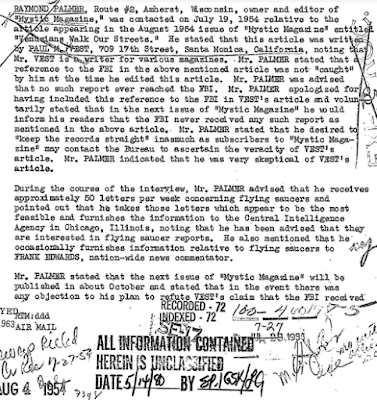
Not unlike the actions of Keyhoe, writers and opportunists numbered among those who worked the FBI into their narratives. One was a Paul Vest, published in Palmer's Mystic Magazine. This was the kind of thing that tended to get Director Hoover's attention, and in 1954 agents were dispatched to Palmer's location in Evanston, Illinois. They were equipped with instructions from Hoover to make it clear the FBI did "not appreciate having the name of the Bureau used in fantastic stories appearing in his publication to add credence to his stories and articles." 

The Vest piece was titled, catchily enough, "Venusians Walk Our Streets!". The author claimed in the story that FBI labs were in possession of a steel plate that just such a Venusian had marked with a half inch deep streak with no more effort than passing his fingernail over it. This also obviously suggested the Bureau was aware of said Venusians walking among the population. Hoover subsequently investigated to his satisfaction there were no FBI personnel at any such labs spreading stories as published and subsequently sent agents to make Palmer well aware of the fact. 

The creatively resourceful
Ray Palmer
In a memo dated July 22, 1954, a Special Agent in Charge at the Milwaukee Field Office advised Hoover contact was made with Ray Palmer. Palmer reportedly apologized for the misrepresentation of the Bureau and described it as an oversight on his part. This is where it gets a bit more interesting.

Palmer offered to publish a retraction, according to the FBI report, refuting Vest's claim about the FBI. Palmer further informed the agent he regularly supplied the CIA in Chicago with saucer reports mailed to him that he thought were most feasible, adding he was advised the Agency was interested in flying saucer reports. 

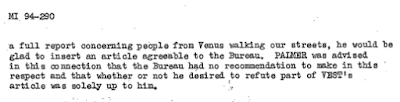
The FBI agent wrote Palmer explained, that in the next issue of Mystic Magazine, "he would be glad to insert an article agreeable to the Bureau." From the 1954 memo:


Was this Ray Palmer attempting to secure an advantageous relationship with the FBI? It could also be interpreted he was suggesting he already had such an arrangement with the CIA, and that perhaps the Bureau would find it mutually beneficial to be in the loop.

Whatever might be read between the lines, it was indicative of the niche Palmer carved out for himself, and a certain amount of power it wielded. It also signaled the beginnings of a tumultuous and unsteady alliance between certain writers and their intelligence agency contacts on the topic of UFOs. Those precarious relationships would persist to this very day.

-------------------------------------

See also:

UFO Activism and Congressional Hearings, 1960s Style

Tuesday, May 10, 2022

UFO Faux Journalism

    I'm not a journalist. I write about stuff I find interesting.

Journalism is a profession consisting of skilled investigators and reporters. Many are educated in its disciplines, although its protocols are often undermined by hobbyists. I think calling myself a journalist would devalue the work invested and dues paid by those who earned the title through years of college and employment. I just like to conduct research and then write about my findings, and I have been fortunate enough to be able to spend some time pursuing the pastime.

The UFO subculture blurred the lines between not only professional journalists and amateur reporters, but also between journalists and what are more accurately described as UFO promoters. It's been happening and morphing for decades. Such promoters become enmeshed with their subjects of interest and even seem offended at times if they are not discussed as primary parts of the stories.

The 2022 UFO Researcher of the Year at -
wait, being told that's pro wrestling promoter Vince McMahon

In recent years and months in (what we might generously call) ufology, numerous self-styled journalists cropped up to assist the usual UFO promoters in making an absolute mess of anything that may have ever held any resemblance to objective reporting. This happens through a combination of shortcomings. Make no mistake, the sometimes sincere yet unequipped self-styled journos are manipulated in some instances. They lack the skills and tools they need to navigate increasingly complex situations. This can result in folding to the noise of the crowd and those who push them hardest. They typically have minimal mentorship and what little they get is often low quality.  

In other circumstances they're more willingly coerced, hoovering up and disseminating talking points they're given by what they perceive to be movers and shakers. Some simply don't care about accuracy and have any number of ulterior motives, ranging from believing ends justify means regarding their beloved Disclosure to their quest for heightened community status that results from "attaboys" gifted from those movers and shakers. If you're thinking that sounds a lot like a cult, you're right. It should also be noted there are actual journalists who often don't fare a whole lot better when caught between UFO storytellers, deadlines, and their needs to get work published. A lot of rationalizing goes on. 

I do not consider myself a journalist. I do however, respect and observe standards recognized by the professional research community. I try my best to remain in the framework of those standards, citing sources as applicable and obtaining comment as I think adds value to my offerings. This has guided me through some 12 years of blogging and two self-published nonfiction books. 

For what my opinion may or may not be worth, I think the two dynamics described below are primary reasons current UFO "journalists" are following in the long tradition of failure forged before them. These dynamics are not new to the genre by any means, but various aspects of technology and current day circumstances indeed further aggravate the dysfunction. UFO reporters fail to produce quality work when: 

- They mistakenly try to be friends with the subjects of their interviews and research, and

- Online screennames and concealed identities create an environment in which they don't know who they are talking to from one interaction to the next 

We will explore these two dynamics further below.

Fraternizing

    Some UFO writers and podcasters get the idea that building a following must be contingent on being well liked. This goes hand in hand with wanting access to inside info and juicy gossip; it only seems to stand to reason you'll get more news tips and eyes on your work if people like you.

Unfortunately for them, this may well be the easiest type of person to manipulate. I often wonder if they're aware they transitioned from reporting to acting as someone's mouthpiece, and if they identify a particular point in time it happened.

Some of the manipulators are much more skilled than your average bear at transferring their talking points into someone else's platform. They may approach writers and podcasters in overly friendly manners, making it challenging to hold boundaries. They may then express disappointment and suggest they were hurt by the way a writer framed their statements or how a show host described their actions.

Is that gaslighting? You bet your ass it's gaslighting. They'll have you apologizing for accurately quoting them if you let them.

Another tool in their bag is dumping "off the record" remarks all over your inbox when you specifically requested comment for inclusion in a blogpost or book. In at least some instances, this is a direct attempt to influence your framing of a story without taking public responsibility for their statements: They are trying to persuade you to champion a cause but do not go on record for the simple reason they cannot prove the legitimacy of the tale they're selling. They want you to take the heat for it and be left babbling about how you can't tell anyone how you know it's true.

To the less experienced, I recommend bringing such exchanges back to focusing on comments to be published, and the sooner the better. You are outright being enrolled as an emotional support person or confidant without your permission, and in direct contradiction to the role in which you defined and presented yourself, a writer impersonally seeking comment for publication. 

It is simple manipulation. Recognize it, label it, and act accordingly.

Research and investigations should prioritize accuracy. We should seek to support or refute a given point. It's not personal. Keep it that way.

Sockpuppets

    Online discourse, research communities, and virtually every other aspect of internet interactions in the UFO subculture is in a state of dysfunctional paralysis. A leading reason is we simply do not know who we're talking to from one interaction to the next. This virtually cripples podcast hosts who rely heavily on social media for interacting with potential guests, as well as researchers who make themselves available for a variety of purposes. 

Let's say Podcaster A invites you to their show to discuss your take on the UFO research climate. Sounds pretty good, right? Well, how do you know they're not one of those anonymous trolls that posted an inappropriate and vulgar photoshop of someone's profile pic? And how sure are you they're not one of those people sending you unsolicited direct messages, asking you what you think about 'this' or 'that' about one person or issue or another? And why do people that just want to discuss this or that have to hide who they are?

A UFO researcher, podcast host, or
Luis Elizondo. Gets hard to tell which.
If you consider yourself a researcher and you're not willing to post your identity at an online venue, maybe you shouldn't be dabbling at that venue. Maybe it's more than you bargained for and you should give that more consideration. What does someone honestly think yet another anonymous voice can functionally contribute to this mess in a research capacity? If they feel their employment, community status, or similar circumstance prohibits them from sharing who they are, there's a pretty good chance they shouldn't be mixing it up with spooks and sociopaths who congregate to UFO websites in the first place. 

Moreover, screennames and hidden identities stand in direct contradiction to the very research process certain individuals and venues claim to pursue. In my personal experience, I considered publishing my real name to be part of making the decision to launch this blog in 2010. I did not see how I could undertake the things I intended to do without offering such a show of good faith. There are exceptions to what I have described here, but they are not the rule, and they certainly do not apply to people operating god only knows how many accounts to hide behind across multiple websites. We should all be sincere enough to differentiate between the spirit of rules and their intentional misuse and exploitation.

The bottom line is aspects of the UFO research community have largely paralyzed themselves again, as has always been the case. The means and technologies evolve, but self-styled reporters frequently find ways to waste time and attention instead of presenting meaningful material. That's no coincidence. It's likely in some instances by design and intentional manipulation, often to distract you from the fact promises of forthcoming revelations and claims of paradigm-shifting knowledge remain so utterly unfulfilled and empty. 

Saturday, September 11, 2021

Identify What You Want

    We've all been there. You log into your favorite social media site and rapidly forget what you even liked about it. Snark is rampant, jokes aren't funny, and your intelligence is insulted by nonsense meant to be taken seriously. It can be difficult to remember what you hoped to get out of social media, and it can be even more difficult to keep in mind that not everyone shares your goal. Most may not, actually.


Identifying what we're doing on a social media site may be a good idea. If you're reading this blog and have a Twitter account, for instance, you may have hoped to find people discussing UFO stuff online. Maybe you hoped you'd learn something about UFOs, or share some of your ideas with others. 

Many hope to find like-minded people to talk about topics they find challenging to share with friends and family. Many such attempts result in a wide variety of online responses, ranging from over the top credulousness to caustic rebuttals. This is an inevitable part of social media interactions, and the sooner we accept it, the better. This doesn't mean we should accept abusive remarks, but neither should we expect emotionally safe behavior from dysfunctional keyboard warriors. Ya gotta step in some crap if ya wanna get to the barn.

We might take responsibility for seeking online interactions, and what type of interactions we're looking for. Are we looking for UFO contacts? What for, exactly? What do we expect to gain? What are we willing to contribute in return, and are we able to voice this?

I'm reminded of complications that frequently arise between UFO witnesses and investigators. Both parties often seem to think their intentions should be understood without having to state them. A more functional perspective might be that witnesses could intentionally identify what kind of assistance they are seeking, and investigators could be prepared to clarify what services they claim to offer.

Are we looking for a competent investigation, or are we seeking emotional support? The skills and resulting activities for providing such services could vary greatly. It would be helpful if we could accurately identify what we hope to gain from contacting a UFO organization or investigator, and questions we might ask to facilitate the process. 

Similar might be said for swimming around social media. We would be wise to know what we hope to gain and how we intend to achieve it. Understand the inherent risks of emotionally leading with the chin in public forums. Choose your support systems wisely, as well as sources you identify as offering quality information.

Be kind to yourself and expect to make mistakes. They're signs you're trying. And identify what you hope to achieve. Otherwise, you'll never achieve it.

Monday, June 7, 2021

UFO Disclosure and Transparency: Good for Thee, Not for Me

    Longtime ufology staple Hal Puthoff, when asked about recovered craft and bodies, reportedly stated he couldn't discuss them. The evasive remark was apparently given in response to a question posed at a recent conference sponsored by the Scientific Coalition for UAP Studies, or SCU. 

Men and women with bold claims have been granted iconic status in the genre for decades. This is in spite of having never produced tangible, verifiable evidence to support their chronic insinuations of extraordinary circumstances.

Robert Bigelow
Anyone remotely familiar with UFO history is aware of the likes of Bob Lazar, George Knapp, Bob Bigelow and any number of his crew, and on and on, who have directly claimed access to paradigm-shifting evidence. For reasons that arguably only make sense to the gullible, UFO Disclosure advocates not only fail to seek verification of such alleged evidence, but support its obstruction. All the while, they manage to frame the participants of these UFO role playing games as heroic.

Why do those who claim to advocate UFO Disclosure and transparency not apply the same standards to members of the UFO genre as they do to Uncle Sam? As one individual observed, "Ufologists swoon at Puthoff’s supposed virtue for knowing more than he dare say, and condemn same behavior in government."

At this blog alone, we have explored circumstances in which Jacques Vallee, Garry Nolan, Diana Walsh Pasulka, Leslie Kean, and the list goes on, sought exemption from transparency while touting claims of significant, if not extraordinary, events. In most cases, the obstructions were implemented while alternately suggesting transparency should be applied to others, most certainly including federal agencies. 

In a recent discussion with UFO Classified host Erica Lukes, guest Mark O'Connell explained his interpretations of a presentation given by Luis Elizondo at a UAP conference a couple years ago (the referenced statements are about 68 minutes in). I suspect this was an SCU conference, as O'Connell mentioned it took place in Huntsville, where SCU holds some events.

"It was the most manipulative operation I have ever been witness to," O'Connell stated. 

Luis Elizondo
He described how Elizondo would enthusiastically tell the audience about exciting things to show them, and exciting discoveries being made, then do "a complete 180" when questions were posed, urging attendees to stay calm and patient. Now years later, people eagerly awaiting Elizondo to present verifiable information of exciting circumstances are still waiting.

As suggested, for whatever reasons, the UFO faithful show no interest in directing their demands for accountability and transparency at people who actually claim to know things and have evidence. In contrast and in real life, those working for government agencies who find themselves between an employment rock and an ethical hard place seek qualified legal counsel and whistleblower benefits as applicable. A recent example is Rebekah Jones, who obtained whistleblower status in her ongoing dispute with Florida Gov. Ron DeSantis over transparency pertaining to the accurate public reporting of COVID-19 cases. Note she did not seek assistance from George Knapp and Jeremy Corbell.

What's more, it has become increasingly apparent some in UFO circles believe ends justify means. With war-related analogies regularly tossed about, a portion of the UFO faithful seem encouraged, if not organized and directed, to oppose rationality and those who support it. That might be to a concerning extent, considering widespread credulousness and online extremism which led up to events of January 6.  

In the aftermath of the outing of a pro-UFO Twitter group chat in which tactics were discussed for use in what was described as a war for someone's followers, I noticed a Twitter user and UFO enthusiast declare the power of UFO Twitter. For those unaware, UFO Twitter, or those who tweet about UFOs, considers itself influential in guiding official policy on the handling of the UAP topic. They are often encouraged by higher profile activists to believe that is the case. The UFO enthusiast added in their tweet, "We too have been engaging in ops against the secret keepers."   

I chose to respond to the assertion, asking who is "we." I further inquired who the "secret keepers" are and what kinds of actions are being taken "against" them. I would indeed like to know more about who designs and directs these alleged "ops."   

After a brief exchange the individual suggested they would get back with me the next day. When they did not, I inquired again. They then "blocked" me, reducing my access to their tweets, and, in effect, the extent I might pursue the claims.

UFO Disclosure and transparency: Good for thee, not for me.  

Tuesday, February 23, 2021

Adam Gorightly Discusses 'Saucers, Spooks and Kooks'

    Adam Gorightly just released a brand new book, Saucers, Spooks and Kooks: UFO Disinformation in the Age of Aquarius. He is a longtime writer and researcher of UFO-related shenanigans, and I recommend giving a read to his latest offering from Daily Grail Publishing. 

The book dives into the often dubious tales that make up the UFO genre, taking particular aim at the circumstances surrounding the alleged underground alien base of Dulce, New Mexico. Adam tracks the stories to their origins, and shares insights about his personal interactions with characters who inhabit and cultivate those tales.

I asked Adam if he would field a few questions for a blog post. My questions are followed by his responses below. He also provided the accompanying images. 

    What made you decide to write Saucers, Spooks and Kooks, and what was most important to you about it?

    It was a project that evolved over time, starting with an article I was writing over ten years ago titled “My Breakfast with Tal”, which detailed my account of breaking bread with the one and only Tal Levesque. An enigmatic and somewhat shadowy character, he was a key player in promoting the Dulce Base story/mythos starting back in the late 1980s.

As things progressed, I started delving deeper into the many claims associated with Dulce Base, many of which Tal, and a handful of others, had seemingly seeded, and in some cases, it appeared, created out of whole cloth. Over time, the project evolved into a longer article with the working title “Deconstructing Dulce”. I set out to pick apart the entire Dulce Base story, in essence deconstructing all the elements, in an attempt to separate fact from fiction, and untangle the many seemingly spurious stories associated with Dulce. Many in ufology unfortunately have taken those stories as gospel over the ensuing years. So the article kept growing to the point where it ultimately became book length in order to cover all the aspects of the story, and the many players, in ufology and the intelligence community, who had helped form the Dulce Base narrative.

One of the key allegations in the Dulce Base story concerned a secret treaty between reptilian aliens and the U.S. Government in which ET technology had been exchanged in return for test subjects to be used in an alien-human hybrid breeding program. Rumors have long circulated that cattle mutilations were also somehow involved in these experiments, the ultimate goal of which was to allegedly create human-alien hybrids to preserve and revive a dying ET race.

As the story goes, a heroic security officer named Thomas Castello led a revolt against the Dulce Base alien bad guys and the end result was a shoot ‘em up that ultimately left sixty-six Dulce Base workers dead. Castello had at his disposal a “flash gun” that allowed him to take out a few of these dastardly aliens and hightail it out of Dulce, thereafter becoming a whistleblower on the run. This legendary battle, straight out of a sci fi B movie script, became known as “The Dulce War”.

    In Saucers, Spooks and Kooks, you trace the origins of several urban myth-like beliefs to Paul Bennewitz and Myrna Hansen, and their fateful interactions of the 1980s. How much of what came to be popularly accepted about alleged aliens would you say is directly related to Hansen and her influence on Bennewitz?

    Myrna Hansen was one of the first so-called alien abductees, way before the term became fashionable. Her encounter, or whatever you want to call it, occurred in early May of 1980, when she and her son Shawn, while driving in Eagle Nest, New Mexico, allegedly witnessed a cow get sucked up on a beam into a spaceship. Shortly after, they were also sucked up into the craft where all sorts of insanity ensued, first with the ETs dissecting the helpless heifer in front of their horrified eyes, and then Hansen was placed into a trance and underwent some sort of medical procedure.

Following her encounter, a terrified Hansen contacted the state police office in the town of Cimarron to inform them of her crazy encounter with knife wielding cow cutting aliens, and in turn the Cimarron office referred her to New Mexico state trooper Gabe Valdez. He worked out of Dulce, and had by this time acquired the reputation as the go-to guy for cut-up cows and unexplained lights in the sky. It was Valdez who put Hansen in touch with Paul Bennewitz, a private government contractor specializing in avionics who among other things was an APRO member. Through Bennewitz’s APRO connections he was able to enlist the services of Leo Sprinkle, a University of Wyoming professor who had been investigating UFO cases using hypnotic regression for over ten years. Sprinkle would conduct a number of hypnotic regressions with Hansen at Bennewitz’s home, and more specifically inside of Bennewitz’s Lincoln Town Car, which he had covered the windows with aluminum foil as a means to disrupt an alien beam he believed was attempting to interfere with Sprinkle’s hypnotic regression of Hansen.

Curiously enough, Sprinkle conducted hypnotic regressions back in 1973 with another lady named Judy Doraty, who recounted a similar tale as Hansen’s regarding ETs and cattle mutes getting sucked up into a space craft, so how much of this was crosspollination or contamination (i.e. investigators/regression therapists leading alleged witnesses to a certain conclusion) is still an open question. It should be noted that Bennewitz, in addition to his fascination with UFOs, also had an abiding interesting in the cattle mutilation phenomenon, and so the two—UFOs and cattle mutes, it could be presumed—became intertwined in his mind and this worldview leaked out on to those with whom he interacted.

Hansen’s regressions included a smorgasbord of standard alien abduction tropes, such as a victim being sucked up into a ship on a Star Trek styled tractor beam, then placed in a trance and undergoing medical procedures related to reproduction and the test tube creation of alien-human hybrids. Hansen, it was alleged, had been implanted with a monitoring device, a so-called “alien implant” as they became known in the lore, and she experienced “missing time.”

As the Sprinkle/Hansen regressions probed ever deeper into the recesses of her beleaguered brain, it was revealed, or she remembered or confabulated (take your pick), being transported to a secret underground facility. During a medical examination, a metallic object was allegedly implanted in the base of her skull, apparently as a means for the aliens to later track her and beam her with malevolent messages, which is the reason why Bennewitz went to all the trouble of constructing a tin foil beanie which he placed over the windows of his car during the hypnotic regression sessions.

At one point during her underground base misadventure, Hansen recalled escaping the clutches of her captors and encountering multiple vats of liquid containing the remains of human and animal body parts. Bennewitz somehow deduced that this underground facility where Hansen saw all this stuff was located near Dulce. All of these elements of the story ultimately became incorporated into UFO lore as we now know it. The term alien “greys,” as far as I have been able to glean, was another trope that came straight out of the Bennewitz Affair.

    As you explained in the book, the Bennewitz Affair came to involve Richard Doty and William Moore. I particularly appreciated your documentation of the origins of the unreliable Majestic 12 documents and their relation to Moore and his associate, Jaime Shandera. What do you think is most important for people to understand about that chain of events?

    One critical factor that’s important to consider when attempting to unravel the origins of the MJ-12 Papers was that in 1981, three years before the MJ-12 papers surfaced, Bill Moore was working on a book project with Bob Pratt, a National Enquirer reporter who covered the flying saucer beat for the magazine. This book project, originally titled MAJIK-12, was a fictionalized account based on supposedly true UFO related information relayed to them by none other than AFOSI special agent Richard Doty, who was identified by Moore in a draft version of this book as “Ronald L. Davis”. MAJIK-12, or alternately MJ-12, was short for Majestic 12, who as most of your readers probably know, was supposedly a super-secret government group involved in investigating UFO sightings and the retrieval of crashed flying saucers and aliens, dead and alive.

Although the Moore/Pratt book project ultimately fell by the wayside, the proposed title MAJIK-12  suggested that Bill Moore was aware of something called MAJIK-12 or Majestic-12 at least three years before a mysterious envelope landed on his research partner Jaime Shandera’s doorstep, sent anonymously with no return address, postmarked Albuquerque, New Mexico. This postmark seemed a huge hint to some that Richard Doty was behind this caper, as during that period Doty was stationed at Kirtland AFB in Albuquerque. The envelope contained a roll of 35mm film that when developed revealed photos of what became known as the MJ-12 papers.

Prior to the emergence of the MJ-12 papers, Moore and another research partner, Stan Friedman, speculated about the existence of just such a group as MJ-12, and had even compiled a list of its most probable candidates. Moore later shared these names with Doty in the hopes that he might be privy to information that would confirm their list of MJ-12 candidates. When the MJ-12 papers surfaced, they did indeed include on their roster some of these very same MJ-12 candidates that Moore and Friedman had previously speculated were members of the group, such as Roscoe Hillenkoetter, first director of the CIA (1947-1950), and James Forrestal, who was Secretary of Defense during that same period, thus seemingly providing confirmation to Moore and Friedman that they’d been on the right track. Others would suggest that Doty cooked up the whole caper, and through a feedback loop provided Moore, Shandera and Friedman with what exactly they were looking for regarding information that seemed to confirm the Roswell UFO crash, that just happened to be the subject of the book Bill Moore and Charles Berlitz published in 1979, The Roswell Incident. It has been conjectured that Moore had a hand in counterfeiting the documents, with or without the help of Doty. However, it’s never been conclusively proven who hoaxed the documents, although the FBI determined that they were not authentic, or in their words, “bogus.”

FBI conclusion of the MJ-12 docs: "bogus"

In the same manner that the MJ-12 docs mysteriously showed up on Shandera’s doorstep, a similar event occurred in 1994 when UFO researcher Don Berliner received an anonymously sent envelope that contained a roll of undeveloped 35mm film. Once developed, the photographs revealed a 29-page document called SOM 1-01, Majestic-12 Group Special Operations Manual, a purported military manual related to flying saucer crash retrievals.

SOM-01-1 also included a reference to “Kirtland Air Force Base, New Mexico” which some suspected was a wink and a nod that it may have been another Richard Doty snow-job. Nonetheless, SOM-01-1 has continued to be embraced by some of the more prominent voices in ufology, such as Linda Howe, who at the Citizens Hearing on Disclosure (a pretend Congressional hearing held at the National Press Club in 2013), claimed that SOM-01-1 had “stood the test of time” —which of course it had done nothing of the sort, and only added to the stack of other seemingly spurious MJ-12 related documents that have littered ufology over the years.

    You wrote about several instances in which members of the military supply UFO researchers with doubtful information, accompanied by promises of future revelations. Ultimately, the big reveal does not materialize and the rug is pulled out from under the researcher. Please tell us a little about one such event.

    In the early 1970s, film producer Robert Emenegger was on the business end of one such promised “big reveal” (that ultimately turned out to be a dud) when he and his co-producer/partner, Allan Sandler, were approached by U.S. Air Force officials with an offer to cooperate and share information for a proposed documentary on UFOs. According to their Air Force contacts, this would be an all hands on deck affair, with the support of each branch of the military who would provide  Emenegger and Sandler access to UFO files in addition to the promised crown jewel: 16mm footage of a UFO landing with ETs, allegedly filmed at Holloman Air Force Base in 1971.

After spending considerable time and resources developing the project, with repeated promises of the saucer landing footage for their documentary, Emenegger and Sandler ultimately had the rug pulled out from under their feet, and were left empty handed as the Air Force failed to deliver the promised goods, and this early version of so-called “UFO Disclosure” went kaput. Emenegger and Sandler’s UFO documentary was eventually released years later, under the title of UFOs: It Has Begun but its impact was obviously diminished greatly from a credibility standpoint after the Air Force pulled out of the project. That's assuming, of course, that the Air Force actually possessed the material they promised for the film.

A similar “UFO Disclosure” head fake happened with Linda Moulton Howe a decade later, when in 1983 she was tapped to produce an HBO special with the proposed title UFOs: The E.T. Factor. During this period, Howe had been investigating the claims of Paul Bennewitz for possible inclusion in her documentary, and along the way she came to the attention of Richard Doty, then assigned to Kirtland Air Force Base. Doty took Howe under his dubious wing, and  gave her a glimpse of some supposedly classified documents related to flying saucer crash retrievals and the astounding revelation that there was actually a little ET in captivity at a military base somewhere. Doty informed Howe if she played her cards right she might even have an opportunity to interview the little fella. In addition, Doty told Howe that government intelligence officers had in their possession film footage of a UFO landing at a military base, as well as other photos and classified materials she could use. After several months of stringing Howe along, Doty informed her that he’d been removed from the case, and passed her on to other intelligence contacts that likewise strung Howe along for a period of several months, but never produced the promised UFO footage. This delay eventually caused HBO to opt out of the project, leaving Howe dangling in the wind.

As for the main motivation behind these capers, one can speculate in a lot of different directions, one of which was that Doty was attempting to discredit and misguide Howe’s UFO research, and ultimately undermine her HBO documentary, as well as to find out what information she had on Bennewitz and the counterintelligence program aimed at him, of which Doty was an operative.

    You explained a lot about the Dulce mythos and the people who spread it. In your research and experience, what did you think was most interesting about all that?

    The evolution of the mythos, and how it came about in the first place, is what I find most intriguing. There are different elements to the story, including what has become known in UFO lore as “The Dulce War”, which I mentioned earlier, where supposedly this security guard at the base named Tom Castello helped form a resistance movement. Some of his fellow human co-workers then got themselves into a dust up with the aliens and came out on the losing end of the skirmish. When the dust had cleared, as the legend goes, sixty-six Dulce base workers perished, although Castello was able to escape on account of his trusty “flash gun.”

So where did this story come from? As far as I can tell, it originated in a December 2, 1981 letter that Paul Bennewitz sent to U.S. Senator for New Mexico Pete Domenici stating that “sometime late 79 or first of 80 an argument insued [sic] over weapons and the military abandoned [Dulce base]; the final circumstance of the men unknown…” In a September 11, 1984 interview, Bennewitz told UFO researcher Jim McCampbell that: “In 1979 something happened and the base was closed. There was an argument over weapons and our people were chased out, more than 100 people involved…” Although Bennewitz didn’t implicitly state that there was an actual battle between humans and aliens at Dulce, his comments about some type of conflict, or of the humans abandoning the base,  appeared to have been enough to plant the seed that later blossomed into “The Dulce War.”

1981 letter from Bennewitz to Sen. Domenici

Nearly a decade later, “The Dulce War” story was fleshed out with the more detailed account concerning Tom Castello and his fellow resistors that appeared in “The Dulce Papers”. Variations of this story have also cropped up concerning a similar battle/confrontation occurring at Area 51.

In the mid-1990s, the Dulce War story resurfaced or was repurposed by a mentally unstable fellow named Phil Schneider who for a time became a star on the patriot and UFO lecture circuit, basically repeating the Tom Castello story with himself inserted into the heroic role of Castello, including the whole shoot ‘em up with dastardly aliens routine.

    There seem to be a lot of common themes that run between each of these stories, such as Dulce, Area 51, SERPO, and events surrounding Paul Bennewitz. Please share some of your thoughts on that.

    I would also add Roswell and the MJ-12 Papers to that mix, and the same recurring cast of characters who promoted these stories that are featured in my book, among them John Lear, Tal Levesque, Richard Doty, Bill Moore and a handful of others that formed this nexus of “influencers.” Bill Moore would later disavow many of these claims, and ostensibly remove himself from this nexus of characters, who he said were pushing false stories that had ultimately driven Paul Bennewitz bonkers.

John Lear, who admittedly had ties to the intelligence community, was an avid MJ-12 Papers promoter, while at the same time, during the mid-1980s, he was leaking information to the media about a secret stealth aircraft testing program at Area 51. The specter of stealth technology was forever lurking on the edges of these tall tales related to Dulce Base, Kirtland and Area 51, part of what appeared to be an effort to shape the overall narrative and muddy the waters about what was actually going on at these military testing sites.

As for SERPO, Richard Doty had a large role disseminating that story, dating back to when he appeared as “Falcon” in the nationally televised special that aired in 1988 called UFO Cover-up Live!. According to Doty (a la “Falcon”), the U.S. government had participated in an exchange program, with the aliens basically giving our astronauts the keys to one of their saucers, and having them travel to their planet, while in exchange the aliens stayed on Earth for a number of years sharing their vast intergalactic wisdom with the Earthlings, which was fundamentally the same story as SERPO.

    What would you tell UFO researchers new to the fray who attempt to navigate these stormy seas?

    Well, I think the people who need to hear it the most would probably care the least about what I have to say, but if they did, I’d suggest looking back in the annals of ufology and examining its past. Do that before jumping aboard any particular UFO shark, because there seems to be nothing new under the sun when it comes to a lot of these recurring themes that continually crop up in UFO lore. 


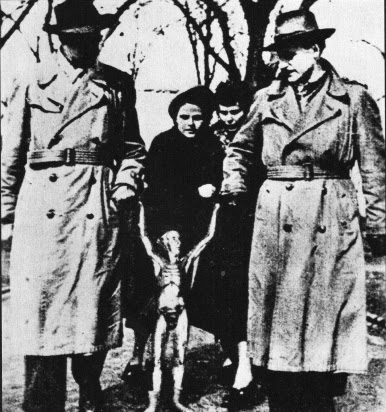
Ufology has the tendency to retread and repurpose many of the same stories, or elements of the same stories, time and again. A perfect example of this is the so-called Silverman photo, which first surfaced in the German newspaper Neue Illustrierte on April 1, 1950, with the title "Der Mars-Mensch" which showed a strange looking three-foot tall fellow apparently from Mars. A few days later, Neue Illustrierte admitted that the Martian story was an April Fool’s hoax, but that didn’t stop the photo from spreading through the UFO subculture in the years to come.

The infamous Silverman photo
Saucer historian Isaac Koi has compiled a timeline of the Silverman photo and the publications in which it appeared. The first book to feature this photo was Major Donald Keyhoe’s Flying Saucers from Outer Space (1953), which made no mention of the Neue Illustrierte hoax, but claimed that the photo depicted U.S. government agents escorting an ET known as “Aluminum Man”, who was covered with an aluminum spacesuit that protected him from cosmic rays. In Space-Craft from Beyond Three Dimensions (1959), W. Gordon Allen referenced that the creature in the Silverman photo had crawled out of a crashed saucer near Mexico City.

Most recently, Harold Povenmire in UFO's and Alien Abduction Phenomena: A Scientific Analysis (2016) published a colorized version of the Silverman photo promoting it as the real deal, although what “scientific analysis” he conducted is unclear. Thanks to Povenmire, this new iteration of the Silverman photo soon began worming its way through social media, as a new generation of true believers clicked and shared to their heart’s content.

Monday, June 15, 2020

UFO Research Integrity

Logic suggests explanations requiring the least number of hypothetical scenarios are often most feasible. Smart money goes with the most likely, least complex models when ranking possibilities.

In UFO circles we frequently lose sight of most likely explanations. Part of the reason may be because so much time is devoted to imagining the extraordinary. We tend to gravitate towards believing what we hear the most, no matter how often it may be properly framed as supposition. It's difficult to keep things in perspective when a 15-second disclaimer is followed by an hour of podcast speculation. Squeaky wheels get oil, even when delivered through sources such as fictional movies and television shows.

We often suspect the existence of hidden agendas - conspiracies, if you will - within the UFO genre because it can be so difficult to accept select researchers and organizations are as incompetent and credulous as they appear. Did the Roswell Slides promoters truly think that mummified Native American was a crash-landed visitor from the stars? Did Dr. Steven Greer really think that Atacama skeleton was an alien and did he and Dr. Garry Nolan honestly not understand the ethical concerns that would arise over their handling of itDid Robert Bigelow and a team of consultants think there was scientific merit in hiring "security guards" to reportedly play with alleged voice phenomena and conduct similar occult practices? (That last scenario was apparently funded by your tax dollars.) 

Could they have all sincerely had such poor judgement? Such reasonable questions abound.


The infamous Roswell Slides telltale placard

We might consider that, from a perspective of assessing research integrity, answers to the above questions don't really make that much difference. The integrity of research is weakened when investigators fail to respect and adhere to universally recognized protocols and codes of ethics. No matter what their agendas, their research is not reliable if they must incorporate numerous hypothetical scenarios into forming their arguments. We really don't need to know what personally motivated David Jacobs and if he is as obliviously incompetent as he seems in order to accurately identify his ethics failings and resulting poor quality of research. This means we don't learn anything of value, at least not about alleged paranormal experiences, from such material, and we are at high risk of absorbing and exposing others to incorrect information. Meanwhile, people are harmed and justifiably offended in the process of such examples as named thus far.

Paul Carr is a spacecraft systems engineer who facilitates several science-friendly podcasts. In response to request for comment on research integrity, Carr replied that he considers virtues of UFO research to include patience, humility, integrity and skepticism. Carr directs Aerial Phenomena Investigations (API), a UFO research group with a track record of commitments to evidence-based investigation and ethical treatment of UFO witnesses. He says the two go hand in hand.

"UFO research primarily deals with human memories," Carr stated, "and it has become clear to us at API that while the ethical treatment of witnesses and an open, honest, and careful approach to collecting and analyzing data are not the same thing, they are both members of a healthy body of research practice. Whatever threatens to corrupt one also threatens the other. Willful abuse of facts and fallacious reasoning readily metastasizes into abuses of innocent persons. This isn't something that just happens to organizations. It is a choice they make.

"It's not that we won't make mistakes - we will. It's what you do and how you change after a mistake is made that is the best marker of integrity."


Perhaps Robert Bigelow and his various teams assembled over the years have been unjustly saddled with conspiracy theories. It is possible they are simply as credulous as they seem to want us to believe. 

Substantial resources were poured into a Utah ranch. Claims of extraordinary creatures, portals to other dimensions, and various sensational happenings, the vast majority of which purportedly defied any kind of significant documentation, became the stuff of legends. Maybe the involved credentialed researchers sincerely do not understand the inherent problems in expecting others to embrace their unverified claims. Maybe they are truly that blinded by belief.

The Typhoid Mary-like innocence of claimed ignorance meets large problems when issues of fully informed consent arise. This was not only the case at the Skinwalker Ranch, as former security guards expressed concerns over their apparent unwitting involvement in state-funded research, but was a key component of the infamous Carpenter Affair as well.

Maybe John Carpenter, Robert Bigelow, John Alexander, John Schuessler and others were truly oblivious to the ethical minefield of covertly supplying Bigelow's National Institute for Discovery Science (NIDS) with information discussed between therapist and clients. Data and recordings of hypnosis sessions from some 140 case files were obtained for about 100 bucks apiece. Maybe some of the people involved in facilitating and concealing the transaction just didn't see publicly addressing the circumstances and voicing objections as feasible options. Obviously not, given their stances of mostly silence and aversion to questions. 

Perhaps some of them honestly believed the potential research gains outweighed the liabilities and betrayals. Maybe they honestly misunderstood and vastly overestimated the minimal scientific value of a collection of hypnosis-induced accounts of alien abduction. Such missteps are magnified when the parties claim to be conducting scientific study, as was the case.

Such scenarios, regardless of motive and intent, border dangerously on mad scientist territory. Codes of ethics are designed, in part, to deter researchers afflicted with delusions of self-importance from sacrificing human welfare during an incorrectly perceived pursuit of historic breakthroughs. This widely eludes much of the UFO genre and particularly its pro-hypnosis segment. Virtually anything appears deemed worth the cost of chasing an alien abduction carrot which has consistently remained out of reach.

"The importance of ethics in research integrity is that it creates the ground level from which all of your work is built," explained Dr. Christopher Cogswell, who holds a PhD in Chemical Engineering and co-hosts a popular podcast which explores fringe topics from reasoned perspectives. "If the ground isn't stable, then everything else you generate or say becomes built on a shaky foundation, which can easily be toppled by the first critical look at your methods and history. It is OK to be wrong or make a mistake, we are all human. But to continue despite evidence of mismanagement, error, or unethical practice makes your entire body of work suspect and tinged with that lens."  


We could carry our line of considerations to its chronological next steps, the Advanced Aerospace Threat Identification Program (AATIP) and the resulting To The Stars Academy (TTSA). Maybe intelligence professionals such as Luis Elizondo and Christopher Mellon are simply overly enthusiastic about the UFO topic and don't understand the problematic nature of trying to turn film clips into proof of the extraordinary. Perhaps Elizondo was simply too inexperienced at UFO investigation to adequately assess an extremely questionable case he and the seemingly ultra credulous Tom DeLonge highlighted on cable television. Maybe there's just an overwhelming amount of UFO history for Elizondo to learn, and maybe it simply never occurred to him to secure receipts that could answer questions about his background before he went to TTSA and started making claims he was apparently unprepared to adequately address if questioned. 

Maybe shelling out 35 grand for Art's Parts will prove brilliant. Perhaps the group's collection of alleged metal alloys, UAP fragments, or whatever the current going designation is will lead to paradigm-shifting discoveries. And, if not, maybe it all happened for no other reasons than none of the TTSA personnel knew any better. 

An obvious problem with AATIP is it consisted of Robert Bigelow and some of his perpetual cast members. This is not necessarily a negative thing in itself, but from a perspective of integrity of research, it is only prudent to question the effectiveness of the work of investigators who spent decades apparently more dedicated to belief than time-tested protocols. That's the case, anyway, if we are to believe their past indiscretions, as already described, resulted entirely from simple error. Again, it doesn't matter from an integrity of research standpoint whether they are incompetent or have ulterior motives when the outcome chronically produces nothing of significant scientific value.

As may have been the case with issues surrounding the security personnel at Skinwalker and the exploited hypnosis subjects of John Carpenter, perhaps it was poor understandings and lack of foresight that contributed to the Bigelow-facilitated covert funneling of DIA funds into MUFON. Maybe Bigelow, Schuessler, and none of the involved parties realized the problematic nature of an intelligence agency funding a 501(c)(3) UFO organization while concealing the fact from the rest of its governing board members and the public at large.  


Some of the boys in the Remote Viewing band. And NIDS.
And Skinwalker. And BAASS. And AATIP. And TTSA.

This isn't about people who may possibly be influenced by false memories or misidentify an exotic aircraft. We're not discussing individuals who experience some kind of event(s) they don't understand and go in search of answers. We're talking about credentialed scientists and professional intelligence personnel who in some cases subscribe to irresponsibly unsupported beliefs and flawed research methodologies, sometimes while under the commission of United States government grant funds.

It seems more than clear to this writer that, if we give all these people the benefit of the doubt and take them at their implied word, we should fully expect to scrutinize their opinions at length and have their research claims painstakingly verified before fully accepting them. Such investigators apparently, at best, suffer from recurring episodes of rather astoundingly poor judgement. 

The good news is we don't have to rely on personalities and popularity as tools for assessing research. Its merit or lack thereof should be self-evident.  

The fact will always remain that should some yet to be proven assertions turn out to be correct, they're indeed not established yet. Just because the future may show something to be accurate, that does not in any way mean you should currently exempt it from reasonable fact-checking. That's how we find out if it's true.

It is important we know the difference between facts and claims asserted by investigators, hold them accountable, and commit ourselves to respecting ethical standards and best practices as recognized by the professional research community. Integrity of UFO research, and ultimately what people believe is flying around up there, depend on it.