Showing posts with label conspiracy theory. Show all posts

Wednesday, October 20, 2021

NICAP Plus 65

     The National Investigations Committee on Aerial Phenomena was a Scorpio. The leading UFO organization of its day, and arguably the most popular ever assembled, was formally incorporated October 24, 1956. The NICAP legacy now celebrates and mourns its 65th birthday. 

Thomas Townsend Brown

As explored in a previous blogpost, T. Townsend Brown, Mary Vaughan King and Thomas D. O'Keefe acted as incorporators for the organization in August 1956. Vaughan King was president of Counsel Services, ostensibly a public relations firm yet previously under contract with the Economic Cooperation Administration. A 1949 letter authored from then-CIA director and future NICAP chairman of the board Roscoe Hillenkoetter to the ECA establishes the existence of a working relationship between the agencies. The ECA clearly provided the CIA classified "economic intelligence information" (The Economic Cooperation Administration was a precursor organization to the United States Agency for International Development, or USAID).

Another Counsel Services client was Col. Ulius "Pete" Amoss, a career CIA officer whose areas of expertise included psychological warfare. In 1952 the enigmatic Col. Amoss facilitated sending the USAF Office of Special Investigations on a UFO wild goose chase, the report of which landed in Project Blue Book:


Yet another Counsel Services client was the Townsend Brown Family Foundation. According to a 1971 Townsend Brown letter (see pp22-28) written in response to the inquisitive then-NICAP director Stuart Nixon, Brown's foundation retained a firm, almost certainly Counsel Services, in the early 1950's to assist with securing funding for his Project Winterhaven. The initiative involved anti-gravity theories to be applied to such fields as weapons research and communications, but never obtained funding sought from the Department of Defense. Brown's 1971 letter notably failed to include specific details in response to Nixon's questions about NICAP beginnings and incorporation, and inaccurately represented some of the circumstances.  

Immediately after the trio of Brown, Vaughan King and O'Keefe filed for NICAP incorporation in 1956, Vaughan King presented a contract to Brown and NICAP on behalf of Counsel Services (see pp6-7). The contract proposed inordinate service fees, and stipulated additional consultants and regional directors may be retained "to work under the supervision of the senior officers of this firm - namely, Mr. Thomas D. O'Keefe and Mary V. King".

The employment history of Mr. O'Keefe contains a number of points of interest, including 1952 service on the Selection Board for Foreign Service Officers at the Department of State (see p39). A search of government records indicates O'Keefe was indeed employed at the State Department, serving as a Deputy Director in 1947 in Washington, D.C.

Such consultants seemingly brought on by Counsel Services to work as early NICAP organizers included Nicholas de Rochefort, a psychological warfare expert with extensive experience in the intelligence and political arenas. He was almost certainly a CIA asset, and his records were once sought in a 1970's lawsuit filed unsuccessfully against the Agency on behalf of an investigative journalist. The journalist strongly suspected Rochefort's substantial activity in the powerful mid 20th century China lobby was undertaken for the CIA. The presiding judge dismissed the case, ruling intelligence services could be greatly impaired by irresponsible disclosure, which the CIA identified as enhancing its ability to navigate the FOIA (see p61). 

The FBI was much more forthcoming on Nicholas de Rochefort. FOIA responses from the Bureau provided multiple reports and alerted me to more records located at the National Archives, the latter of which are now in the process of being reviewed for release. FBI files already obtained indicate Rochefort was employed by the Department of Commerce and the State Department during the time, late 1956 and early 1957, we now know he worked on publicity campaigns for NICAP.

Fascinatingly, Bureau files include a Nov. 27, 1956, memo to Director Hoover from the Washington Field Office, containing information on Rochefort provided by a confidential informant (see p20). The document is heavily redacted, and stipulated that neither the information, obtained in early November, nor its source should be disseminated outside of Hoover's office:


The FBI conducted a requested Mandatory Declassification Review on the above memo. It declined to further declassify any part of it, stating the redacted information is exempt from the FOIA.

------------------------------------

The above circumstances and much more are explored in detail in my new book Wayward Sons: NICAP & the IC.

Related posts:

Read the Introduction to 'Wayward Sons'

The Birth of NICAP  

Tuesday, February 9, 2021

Discerning Truth

    Misinformation needs no introduction. You've seen it around, and a lot of it piggybacks on fringe subject matter. Sensationalism is a staple of the UFO genre. It can be argued that has to be accepted as the case before meaningful discussion becomes possible.

I asked a few writers and podcasters familiar with UFOs and similar subject matter if they would share some thoughts on how we explore such topics without getting overwhelmed in false information. How do we know what's true and what's not? How do we keep an open mind without making ourselves vulnerable to lies, opportunists, and cult-like thinking?

Sarah Scoles is a science journalist and writer of many articles published at outlets such as WIRED Science and Popular Science. She is the author of the books Making Contact: Jill Tarter and the Search for Extraterrestrial Intelligence and They Are Already Here: UFO Culture and Why We See Saucers. Sarah replied in response to my request for a contribution for this blog post:

    A story is just a story. No matter how compelling someone’s sighting or experience, it is just that: theirs. Human minds and memories are fallible things, especially when they're encountering something outside their everyday experience, and regardless of their owners’ expertise or power. No one interprets or recalls sensory input objectively. So as meaningful as a story may be to a person, that significance does not itself constitute evidence that their interpretation is correct. 

Second, consider the source. What organization or individual made this information public? How do they stand to benefit from its dissemination? What might their motivations be? Who pays ’em? How might all of that affect their coverage? 

Third, dig into the attribution. Are sources anonymous, and do the authors give a justification for why, or describe the vetting that ensures these mystery people are legit? Many mainstream publications have public policies on the use of such sources (many independent sites do not—but you can always ask). Even if the source is legit, ask what their motivation is for talking. 

Next, look at how much the piece relies on the word of its sources (turns out, people can say pretty much anything they want!), versus harder, more verifiable evidence. For example “Aliens landed on the White House roof, according to a guy who says he saw it happen” versus “four people who described the same thing independently” versus “security footage and genetic analysis” versus “a declassified document.” 

Speaking of documents, do the authors/producers link to documents they cite? If not, why not? Are these primary sources? Whenever you can, get your own hands on primary sources. 

After all that, ask honestly if you’re falling prey to confirmation bias: the tendency to seek out and interpret evidence in favor of existing beliefs. Confirmation bias is a normal human flaw—we all exhibit it! But by being aware of the tendency, you can step back and get a more objective view. 

Finally, be willing to change your mind in the face of new evidence. If you’re interested in the out-there stuff, separating the wheat from the chaff—not just dressing the chaff up fancy to look like wheat—lets you focus on investigations more likely to lead to something real and interesting...even if it’s not what you set out searching for.

*                           *                         *

Carol Rainey is an award-winning filmmaker and writer of diverse topics and formats. Her works include the article The Priests of High Strangeness: Co-Creation of the "Alien Abduction Phenomenon". Carol wrote:    

    If you’re new to the field of ufology, welcome. You’re in for a tour of great mystery, intellectual challenge, and ultimate puzzlement. Sometimes answers to the UFO phenomenon’s biggest questions seem to be right around the corner, if you just push on and run hard with whatever evidence you’ve turned up. But the mystery won’t easily unveil itself to you or anyone else. The study of UFOs, which shares turf with all things paranormal, often presents in deceptive, elusive, and ambiguous terms.

That’s why people at all levels of experience can truly get lost in the material they encounter – whether at conferences, in phone calls with experts or celebrities, in talk with others intrigued by the field, and in the plentiful websites, blogs and books on the subject. During the 10 years I worked closely with one abduction researcher, shooting a film about his work, there were times when even my most rational self lost the ability to distinguish factual events from those that were fanciful or fabricated. What reality was I living in? That’s an extremely uncomfortable place to be in.

There are steps you can take, early on, in the interest of keeping yourself balanced and level-headed:

  • Bring along your own internal bullshit detector – and use it frequently. The UFO subject often tosses out speculation and hoaxes right from center field. Will you be able to spot them without falling into them?

  • Try the buddy system. Plan to go on your journey with someone whose perspective you respect, whose judgement you have reason to trust.

  • Begin learning about UFOs and sightings first, only later tackling abduction cases.

  • Arm yourself with some deep reading in the literature of the field. There’s a surprising amount of it, including books by pilots, NASA engineers, psychiatrists, and military top brass. Recommended:  Uninvited Guests: A Documented History of UFO Sightings by Richard Hall (1988), The Invisible College by Jacques Vallee (1975), The UFO Experience: A Scientific Inquiry by J. Allen Hynek (1972), an astronomer and consultant to the Air Force. Early researcher John Keel offers fascinating takes on the phenomenon, as do books by Jerome Clark and The Trickster and the Paranormalby George Hansen. Eventually, you’ll want to explore work in anthropology, sociology, folklore, and religion. Start with The Fairy Faith in Celtic Countries by W.Y. Evans-Wentz.

Aaron John Gulyas is a historian and the author of several books on paranormal and conspiracy culture. He also produces the podcast The Saucer Life. Aaron wrote:  

    After creating The Saucer Life for the last three years—and writing about flying saucer culture and other fringe topics for far longer—I've got several ideas about the best way to get started in studying these topics.

The most significant thing that has helped with the perennial problem of information (misinformation? disinformation?) overload is to go back to the beginning. No matter what the story or claim is (and no matter how authoritatively an author writes about it), you will be best served by finding as much of the original documentation supporting that story as possible. Only when you strip away the years, or even decades, of accumulated expert opinion and analysis can you get to the bones of an encounter or incident.

What does this look like in practice? The best example I have is John Keel and the Mothman complex of weirdness. While reading The Mothman Prophecies is an excellent thing to do, it doesn't necessarily provide the most thorough understanding. Go back and check newspaper articles (there were a bunch). 

Then, pair that with the documents available at johnkeel.com, which has an amazing array of Keel's correspondence and notes from the time, years before he crafted The Mothman Prophecies. Will this tell you what the Mothman was? No. But it gives you a fuller perspective. Start there—get a grasp of the sources. Then, when you do engage with the small mountain of Mothman books and documentaries, you'll have a sharper focus and a solid grounding in the facts.

So go back to the beginning. Obvious advice from a historian, but it's the best way.

Jeb J. Card is a writer, researcher, and podcaster. His projects include In Research of... Podcast and his book, Spooky Archaeology: Myth and the Science of the Past. Jeb explained:

    Some key aspects of understanding alternative worldviews or conspirituality:

First, understand the roots of these ideas. It is rare that an alternative concept has no ancestral roots. Many can be found largely recognizable in the later Victorian period (when many fields of science were beginning to professionalize). These notions in turn often have even older roots. To really understand claims about lost ancient knowledge and secret beings that provided it, one should look much deeper, through Theosophy, through the Renaissance fascination with hieroglyphs, through alchemy, back to the Classical fascination with Egypt as a source of knowledge. Seeing the same ideas emerge again and again puts a different perspective on them in the present, where the trappings of scientific inquiry are at times bolted onto much older concepts.


Second, listen to claims rather than trying to place them in your existing classificatory frames. You may think you know what a phenomenon is (UFOs are ET or UAVs, Bigfoot is a mystery hominin or mistaken identity, ghosts are souls or EM signatures or infrasound effects). Focusing on “is it this” or “is it real/not real” can overshadow organic aspects of claims and ideas. You may not like your Bigfoot to be with a UFO orb, or vice versa, but if that’s what a claimant says, then that’s what they say. A broader unobstructed view can put these notions into perspective, be it because you think they are part of some larger paranormal entity, or because they have similar social dynamics (strange knockings, non-human entities, objects flying through the air: Séance or Bigfoot hunt?). 

Finally, don’t argue, describe. Descriptions and discussions of ideas, whether or not you find them credible, will do more to further your understanding and those of others, than yelling simple slogans on Twitter or getting into shouting matches.

Sharon A. Hill is the author of the book Scientifical Americans: The Culture of Amateur Paranormal Researchers (McFarland, 2017). Sharon contributed:

    Paranormal and mysterious subjects are a tricky business. Forming thoughtful opinions about mysterious subjects takes considerably more commitment than searching the web and watching YouTube videos where about 75% of the content is shallow, promotional, and possibly made up. 

The purpose of making strange claims and telling spooky stories is primarily to evoke an emotional response. It’s a secondary reaction to wonder if they are true and accurate. Listeners usually absorb what they see and hear and don’t apply too much critical thinking. Rationality ruins the magic and can create social pitfalls as a consequence of uncovering (deliberate or inadvertent) lies and deception. Curtailing logical rigor is essential to the process of promoting the strange idea. The researcher who is after the best answers must push against this flow of dramatic, exaggerated, repeated, or manufactured details and be committed to recognizing the lure of the fantastical to avoid being sucked in. This takes a considerable amount of experience and background knowledge - about perception, psychology, and persuasion - that most people will not gain until pondering and examining for years the human aspects that affect valid observations.

There are two crucial keys to developing thorough understanding of a controversial subject, both of which are inherent in the methods of scientific research:

1. What is the foundation that exists already? Find out about the earliest ideas in books or media and from where those concepts were pulled. Gain familiarity with the roots of the subject that existed pre-Internet, when there was a worthier effort put into scholarship and publishing. If you have no insight into the core writings and history of the subject, time and effort will be wasted, you will be confused and misinformed, and ultimately, will not succeed in gaining meaningful findings.

2. Know the arguments from all sides. That means diligently examining the ideas against the popular notions of the subject. For example, the best documented cases will have skeptical commentary. These perspectives keep you tethered to reality, even if you don’t accept a specific argument as valid. These two practices will help you build a filter for discerning useful information from garbage and experts from pretenders.

James Carrion is a writer, researcher, and former International Director of the Mutual UFO Network. He has authored multiple articles, papers, and books, including his latest, The Roswell Deception. James contributed: 

UFOs and Magical Thinking

    If you are interested in the subject of UFOs but feel overwhelmed with the conflicting information you hear from the mainstream media, entertainment TV channels, UFO organizations, and the Internet, you are in good company. How is it possible to constructively learn more about this subject without going down a conspiracy rabbit hole from which you may never emerge? The answer in two words is "Critical Thinking" - the analysis of facts to form a judgment. But whose "facts" should you analyze as many of the public sources I just mentioned all tend to portray their UFO assertions as facts?

Well let's start with this fact. No human has ever presented public unequivocal evidence of a UFO artifact of extraterrestrial origin. Sure, many have claimed to have handled, tested, and warehoused such artifacts, but unlike human space debris that you can observe firsthand yourself at the Smithsonian Aerospace Museum, you cannot yet see or touch incontrovertible UFO physical evidence. 

But wait, how about the alleged "real" UFO artifacts in the possession of the US government? Until these "artifacts" are on public display, you may just as well believe that the US government also has the Ark of the Covenant warehoused away somewhere. In other words, it is all magical and wishful thinking until you can observe the physical authenticated evidence for yourself. In that respect, the "reality" of UFOs is similar to the reality of Bigfoot, suffering from the same lack of incontrovertible physical evidence. Until a Bigfoot body can be shown to the world, it is just another conspiracy, kept alive by magical thinking.

Magical thinking is based on belief - an acceptance that a statement is true or that something exists. It does not equate to truth but just the possibility that something may be true - like the existence of fairies, leprechauns and the Loch Ness monster.  And therein lies the issue - most of the UFO information you are bombarded with from the aforementioned sources are based on beliefs and suppositions and not on hard evidence. If you allow yourself to forego unequivocal proof and settle for belief and magical thinking, then you have already gone down a conspiracy rabbit hole and no amount of logical persuasion may extract you from that orifice, even when presented with hard evidence to the contrary.

Falling into UFO "Belief" may be fulfilling to some as it meets some innate psychological need, the same way that for Q-Anons, belief in a persona named Q exposing the diabolical cabal behind the "Deep State", provides "meaning" and a sense of "order" in a complex and chaotic world. But allowing yourself to indulge in these fantasies may have a detrimental effect both on your mental wellbeing as well as the relationships with your families and friends. Magical thinking is a thirst that can never be quenched. I am not dissuading anyone from being curious about the subject of UFOs, but instead to approach the subject with a skeptical open mind that doesn't accept someone else's "facts" at face value, but questions their assumptions and suppositions and demands hard unimpeachable evidence.


Amy Martin is a co-founder of Midnight.FM. She is experienced in paranormal-themed podcasting and late night radio. Amy wrote:

    Critical thinking is an important mindset to cultivate as one enters into research of any kind. Despite what we as humans want to know, however, our desire to learn more about the unknown is driven by how far we are willing to open our imagination, rather than our restraining faculties of reason or critical thinking. As our imagination grows parallel to access to new information, so too grows the threat that if something exists, even as an idea, it can be exploited, to a very large scale. And as more and more we become an interconnected society, keep in mind that what we experience as researchers today once existed only in the imagination of someone else’s science fiction. With a background in IT and a passion for high strangeness that has transcended the Dewey decimal system, I say to anyone seeking to learn more about the weird: become a student of science fiction and learn to think like a hacker.

Simple confidence and behavioral exploits once recognized by stage magicians and skeptics of the late 19th and 20th centuries taught in handbooks and methodologies for learning deceptions toward a “critical thinking” toolbox are horribly outdated, as they seem to lack this one notion:

If it exists, it can be exploited.

I’ll say it one more time:

If an idea exists, no matter how innocent, it can and most likely will at some point in time be exploited.

Welcome to Social Engineering 101.

Some tips:

Always question the behaviors and motivations of anyone claiming to be an authority, cultivating an audience, or cult following, but do the legwork before making broad based assumptions.

Avoid presenters and information sources with narcissistic tendencies, especially if they seem to marginalize others or have no problem supporting those who exploit their audiences. 

Become a student of human behavior and learn how to think like someone distributing misinformation or disinformation. (See: motivations.)

Consider no “reliable source” an authority, no matter who they say they are or how romantic the story. 

Watch and read as much golden age science fiction as you can, especially B-movies. It can be both fun and educational. 

Draw the line with fascists or anyone that knowingly and willfully supports them. 

As you might interview people on sensitive topics, treat them with great care especially pertaining to their own stories, alleged encounters, and beliefs, however verifiable. Nobody starts life believing in anything until they’re the product of an environment, a culture, or a society. Make every effort to understand the origins and cultural issues which plague topics of high strangeness, particularly Eurocentric anthropologic or folkloric perspectives. 

Realize at the core of every movement is the opportunity for an exploit, even if it involves people who seem to be genuine. 

Someone who is very good at deception will blur the lines between fiction and reality, often presenting nuggets of truth to a larger unverifiable claim. 

Become familiar with principles of psychological operations, games (i.e. - ARGs) and learn how people and groups of people are targeted and exploited, whether motivations seem clear or muddy.

And finally, take an oath of ethics to intentionally do no harm and seek to minimize harm, always. 


Chelle Elmquist produces the paranormal and occult-themed The Eternal Void but With Jazz Podcast (Be sure and check out their show disclaimer). They share a personal perspective with us: 

    I’ve always been interested in the weird. Some of my earliest memories include weird happenings that would fit in any modern experiencer's account. When I was 10 I had what I’ll call my first sighting.

My mom came rushing into the house, absolutely ecstatic, claiming there was a UFO down the road and we had to go see it. Being curious, my brother and I loaded in the car with our mom and we took off to investigate this mystery. It wasn’t long before we found it. There in the sky, lit strangely, and traveling slowly and silently, was a large white oval. It was traveling right above us on the busy road. In that moment my entire world outlook shifted, and while I’d had other strange experiences that pre-dated this, I knew this was an important moment. 

Then, silently it started to turn, it’s shape changed. It made a slow wide arc above us on the crowded Central Florida thoroughfare and we saw it change shape. The words Coca-Cola were emblazoned upon its side. We had been chasing the Coca-Cola blimp. Up until this point I had seen plenty of blimps, the Goodyear blimp was a mainstay in Central Florida. But, I had never seen one directly from behind, at dusk, and that was key. 

This experience taught me a valuable lesson that I continue to carry with me. There is indeed wonder and mystery in the world. However, we must be cautious before assuming concrete conclusions about the reality of such events. Since then I’ve seen many other truly fantastical things that I may never be able to explain. In light of this experience though, I’ll be extremely careful before attempting to define them prematurely. In closing, stay curious, driven, and open, but above all: if you think you know what something is, be willing to be wrong. 

Thank you very much to all who generously contributed to this blog post. I appreciate each of your time and attention.

And thank you for reading. The time and attention of readers is appreciated as well. 

Let's do our parts to try to keep the path to truth as unobstructed and accessible as possible. It's up to each of us in our own ways. 

---------------------------------

Recommended further reading:

UFO Critical Thinking 101

UFO Community Members Weigh in on Dubious MUFON Speakers

Ethics of Exploring the Fringe, Part One: Sharon Weinberger and Nigel Watson on Responsible Reporting

Ethics of Exploring the Fringe, Part Two: Mark Pilkington on Deception Operations, Witness Claims and More

Wednesday, June 24, 2020

Whoa Cart, Let's Wait for the Horse

Research suggests people who subscribe to unproven conspiratorial theories often believe many such theories, even when they contradict one another. Live Science reported how one research project found those who suspected Princess Diana was murdered also tended to believe she faked her death. Similarly, those surveyed who believed Osama bin Laden was already dead when his compound was raided by U.S. Special Forces were also most willing to believe he is still alive. The common denominator seems to be a mistrust of authority, something in pretty strong supply.

It's easy to find the dynamic in UFO circles. It seems a lot of people believe the U.S. government was in possession of an extraterrestrial spacecraft examined by Bob Lazar at Area 51. It seems the same demographic likes to believe that same government is shelling out millions by way of AAWSAP and AATIP to learn about just such craft - of which they apparently don't provide access to the contractors awarded the grant funds. 

Robert Bigelow
Similarly, one of those apparent contracted scientists, Dr. Eric Davis, is believed by some to have been told about such secret information by an in-the-know insider, see the Wilson Leak, circa 2002 or so. We are apparently to also believe Davis, and in effect Team Bigelow and the eventual AATIP crew, failed to mention or substantially act on that knowledge while searching the globe far and wide for evidence of such craft and ET beings... that Uncle Sam is believed to already have in his possession. 

We could argue the logic - and lack thereof - indefinitely. We're always going to come back around to the importance of evidence available for public review. People either understand the significance or they don't.

An ongoing challenge with the TTSA saga is that some of it may indeed prove interesting from a number of perspectives, yet, at the same time, a lot of it is sensationalized by writers who supply a demand for Disclosure fury, if not create it. With a shout out to UAP written into a recent legislative bill, there are indeed points to ponder and social dynamics to keep an eye on. However, history shows us such dynamics are not new, yet to point this out may be viewed as wet blanketing the UFO blogosphere. Regardless, it might be wise to see how things play out and prioritize evidence available for public review before taking Disclosure victory laps.

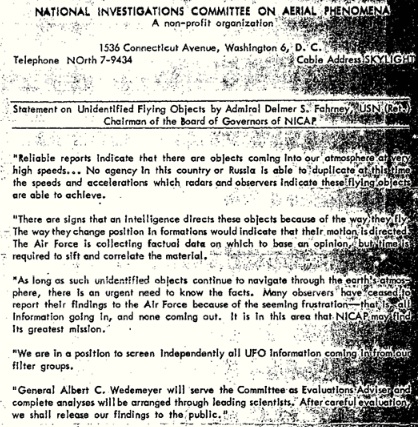
As we see in an FBI file compiled on the 20th century National Investigations Committee on Aerial Phenomena, statements very similar to those we read now were issued. Such statements, as is currently the case, were released by esteemed members of the intelligence community. 


We might also consider a 1958 letter, contained in the same FBI file, written by NICAP Director Donald Keyhoe to FBI Director J. Edgar Hoover. It indicates the respected members of the NICAP crew and the prior experience with government UFO research of one in particular, Major Fournet.


The similarities to current day events are striking. Time will tell if the outcomes are much different.   

Monday, June 15, 2020

UFO Research Integrity

Logic suggests explanations requiring the least number of hypothetical scenarios are often most feasible. Smart money goes with the most likely, least complex models when ranking possibilities.

In UFO circles we frequently lose sight of most likely explanations. Part of the reason may be because so much time is devoted to imagining the extraordinary. We tend to gravitate towards believing what we hear the most, no matter how often it may be properly framed as supposition. It's difficult to keep things in perspective when a 15-second disclaimer is followed by an hour of podcast speculation. Squeaky wheels get oil, even when delivered through sources such as fictional movies and television shows.

We often suspect the existence of hidden agendas - conspiracies, if you will - within the UFO genre because it can be so difficult to accept select researchers and organizations are as incompetent and credulous as they appear. Did the Roswell Slides promoters truly think that mummified Native American was a crash-landed visitor from the stars? Did Dr. Steven Greer really think that Atacama skeleton was an alien and did he and Dr. Garry Nolan honestly not understand the ethical concerns that would arise over their handling of itDid Robert Bigelow and a team of consultants think there was scientific merit in hiring "security guards" to reportedly play with alleged voice phenomena and conduct similar occult practices? (That last scenario was apparently funded by your tax dollars.) 

Could they have all sincerely had such poor judgement? Such reasonable questions abound.


The infamous Roswell Slides telltale placard

We might consider that, from a perspective of assessing research integrity, answers to the above questions don't really make that much difference. The integrity of research is weakened when investigators fail to respect and adhere to universally recognized protocols and codes of ethics. No matter what their agendas, their research is not reliable if they must incorporate numerous hypothetical scenarios into forming their arguments. We really don't need to know what personally motivated David Jacobs and if he is as obliviously incompetent as he seems in order to accurately identify his ethics failings and resulting poor quality of research. This means we don't learn anything of value, at least not about alleged paranormal experiences, from such material, and we are at high risk of absorbing and exposing others to incorrect information. Meanwhile, people are harmed and justifiably offended in the process of such examples as named thus far.

Paul Carr is a spacecraft systems engineer who facilitates several science-friendly podcasts. In response to request for comment on research integrity, Carr replied that he considers virtues of UFO research to include patience, humility, integrity and skepticism. Carr directs Aerial Phenomena Investigations (API), a UFO research group with a track record of commitments to evidence-based investigation and ethical treatment of UFO witnesses. He says the two go hand in hand.

"UFO research primarily deals with human memories," Carr stated, "and it has become clear to us at API that while the ethical treatment of witnesses and an open, honest, and careful approach to collecting and analyzing data are not the same thing, they are both members of a healthy body of research practice. Whatever threatens to corrupt one also threatens the other. Willful abuse of facts and fallacious reasoning readily metastasizes into abuses of innocent persons. This isn't something that just happens to organizations. It is a choice they make.

"It's not that we won't make mistakes - we will. It's what you do and how you change after a mistake is made that is the best marker of integrity."


Perhaps Robert Bigelow and his various teams assembled over the years have been unjustly saddled with conspiracy theories. It is possible they are simply as credulous as they seem to want us to believe. 

Substantial resources were poured into a Utah ranch. Claims of extraordinary creatures, portals to other dimensions, and various sensational happenings, the vast majority of which purportedly defied any kind of significant documentation, became the stuff of legends. Maybe the involved credentialed researchers sincerely do not understand the inherent problems in expecting others to embrace their unverified claims. Maybe they are truly that blinded by belief.

The Typhoid Mary-like innocence of claimed ignorance meets large problems when issues of fully informed consent arise. This was not only the case at the Skinwalker Ranch, as former security guards expressed concerns over their apparent unwitting involvement in state-funded research, but was a key component of the infamous Carpenter Affair as well.

Maybe John Carpenter, Robert Bigelow, John Alexander, John Schuessler and others were truly oblivious to the ethical minefield of covertly supplying Bigelow's National Institute for Discovery Science (NIDS) with information discussed between therapist and clients. Data and recordings of hypnosis sessions from some 140 case files were obtained for about 100 bucks apiece. Maybe some of the people involved in facilitating and concealing the transaction just didn't see publicly addressing the circumstances and voicing objections as feasible options. Obviously not, given their stances of mostly silence and aversion to questions. 

Perhaps some of them honestly believed the potential research gains outweighed the liabilities and betrayals. Maybe they honestly misunderstood and vastly overestimated the minimal scientific value of a collection of hypnosis-induced accounts of alien abduction. Such missteps are magnified when the parties claim to be conducting scientific study, as was the case.

Such scenarios, regardless of motive and intent, border dangerously on mad scientist territory. Codes of ethics are designed, in part, to deter researchers afflicted with delusions of self-importance from sacrificing human welfare during an incorrectly perceived pursuit of historic breakthroughs. This widely eludes much of the UFO genre and particularly its pro-hypnosis segment. Virtually anything appears deemed worth the cost of chasing an alien abduction carrot which has consistently remained out of reach.

"The importance of ethics in research integrity is that it creates the ground level from which all of your work is built," explained Dr. Christopher Cogswell, who holds a PhD in Chemical Engineering and co-hosts a popular podcast which explores fringe topics from reasoned perspectives. "If the ground isn't stable, then everything else you generate or say becomes built on a shaky foundation, which can easily be toppled by the first critical look at your methods and history. It is OK to be wrong or make a mistake, we are all human. But to continue despite evidence of mismanagement, error, or unethical practice makes your entire body of work suspect and tinged with that lens."  


We could carry our line of considerations to its chronological next steps, the Advanced Aerospace Threat Identification Program (AATIP) and the resulting To The Stars Academy (TTSA). Maybe intelligence professionals such as Luis Elizondo and Christopher Mellon are simply overly enthusiastic about the UFO topic and don't understand the problematic nature of trying to turn film clips into proof of the extraordinary. Perhaps Elizondo was simply too inexperienced at UFO investigation to adequately assess an extremely questionable case he and the seemingly ultra credulous Tom DeLonge highlighted on cable television. Maybe there's just an overwhelming amount of UFO history for Elizondo to learn, and maybe it simply never occurred to him to secure receipts that could answer questions about his background before he went to TTSA and started making claims he was apparently unprepared to adequately address if questioned. 

Maybe shelling out 35 grand for Art's Parts will prove brilliant. Perhaps the group's collection of alleged metal alloys, UAP fragments, or whatever the current going designation is will lead to paradigm-shifting discoveries. And, if not, maybe it all happened for no other reasons than none of the TTSA personnel knew any better. 

An obvious problem with AATIP is it consisted of Robert Bigelow and some of his perpetual cast members. This is not necessarily a negative thing in itself, but from a perspective of integrity of research, it is only prudent to question the effectiveness of the work of investigators who spent decades apparently more dedicated to belief than time-tested protocols. That's the case, anyway, if we are to believe their past indiscretions, as already described, resulted entirely from simple error. Again, it doesn't matter from an integrity of research standpoint whether they are incompetent or have ulterior motives when the outcome chronically produces nothing of significant scientific value.

As may have been the case with issues surrounding the security personnel at Skinwalker and the exploited hypnosis subjects of John Carpenter, perhaps it was poor understandings and lack of foresight that contributed to the Bigelow-facilitated covert funneling of DIA funds into MUFON. Maybe Bigelow, Schuessler, and none of the involved parties realized the problematic nature of an intelligence agency funding a 501(c)(3) UFO organization while concealing the fact from the rest of its governing board members and the public at large.  


Some of the boys in the Remote Viewing band. And NIDS.
And Skinwalker. And BAASS. And AATIP. And TTSA.

This isn't about people who may possibly be influenced by false memories or misidentify an exotic aircraft. We're not discussing individuals who experience some kind of event(s) they don't understand and go in search of answers. We're talking about credentialed scientists and professional intelligence personnel who in some cases subscribe to irresponsibly unsupported beliefs and flawed research methodologies, sometimes while under the commission of United States government grant funds.

It seems more than clear to this writer that, if we give all these people the benefit of the doubt and take them at their implied word, we should fully expect to scrutinize their opinions at length and have their research claims painstakingly verified before fully accepting them. Such investigators apparently, at best, suffer from recurring episodes of rather astoundingly poor judgement. 

The good news is we don't have to rely on personalities and popularity as tools for assessing research. Its merit or lack thereof should be self-evident.  

The fact will always remain that should some yet to be proven assertions turn out to be correct, they're indeed not established yet. Just because the future may show something to be accurate, that does not in any way mean you should currently exempt it from reasonable fact-checking. That's how we find out if it's true.

It is important we know the difference between facts and claims asserted by investigators, hold them accountable, and commit ourselves to respecting ethical standards and best practices as recognized by the professional research community. Integrity of UFO research, and ultimately what people believe is flying around up there, depend on it. 

Thursday, December 19, 2019

Vallee Declines to Substantiate Claim of CIA Simulating UFO Abductions

Dr. Jacques Vallee
Dr. Jacques Vallee declined to attempt to fully substantiate the assertion contained in his book, Forbidden Science - Volume Four, that he secured a document confirming the CIA simulated UFO abductions in Brazil and Argentina. "I felt a duty to call attention to the issue," Vallee explained in a Dec. 17 email, but chose not to share the document or address pertinent questions surrounding its circumstances.

"If you talk to serious researchers in Latin America, you will find they are not as naive in this field as US ufologists," he added.

However, it was not researchers in Latin America who made the assertion. The 2019 book authored by Vallee contains the statement, "I have secured a document confirming that the CIA simulated UFO abductions in Latin America (Brazil and Argentina) as psychological warfare experiments."  

The widely renowned UFO researcher was sent an email by The UFO Trail requesting comment, including any context he might provide, or clarify if the statement was, in hindsight, made in error. The email also made it clear a copy of the document was ultimately being sought, or as much identifying information as possible. Vallee chose not to address those questions and issues.

The email inquiry explained, "I hope you can empathize with the potential weight of the statement and why researchers would be quite interested in establishing facts surrounding its circumstances." 

Vallee replied in full:
Dear Jack,
Thanks for your message, I appreciate your interest in the book. As you know, the question of the use of ufology to camouflage various commando or social engineering operations is an old one. It is a subset of PsyOps techniques that have been used for a very long time (projecting images of the Virgin Mary over the battle lines in Verdun in 1917, or religious images over Cuba from a sub in the Bay of Pigs, etc.)
Much more competent historical writers than me have documented all that, and Latin America is only a later-day extension. I am not an expert in any of it, but my computer surveys tend to go TILT! when some relevant cases come up. So I don’t have a dog in the political fight, I’m just trying to avoid polluting my databases with garbage. That’s why I felt a duty to call attention to the issue. If you talk to serious researchers in Latin America, you will find they are not as naive in this field as US ufologists.
With best wishes of the Season,
Jacques 

A follow-up email was sent to Vallee, stating that while it has indeed been established that the intelligence community exploits the subject of UFOs for many potential reasons, it was hoped he could appreciate that actual confirmation of CIA abduction simulations would be extraordinary indeed. He was asked if it would be correct to say there is not a document confirming that to be the case. He did not immediately reply.  

A draft of this blog post was subsequently shared with Dr. Vallee prior to publishing. It was done in an effort to report the circumstances as accurately as possible and offer him a final opportunity to comment further. 

"I don’t have any further comments on the substance of the request or, obviously, about my source which I am obligated to protect," he replied in a Dec. 19 email.

"Most of the documents I have referred to, or used in the compilation of my diaries, have been donated to a University with a 10-year embargo on access — specifically to avoid the kind of spurious quarrels that erupt in ufology on a regular basis. So I expect that historical details like these will see the light of day in due course."

Sunday, October 13, 2019

Former Skinwalker Personnel Suspect They Were Unwitting Research Subjects

Robert Bigelow
Two men who state they formerly worked on Robert Bigelow's Skinwalker Ranch are expressing concerns they were unwitting research subjects during their employment. Chris Marx and Chris Bartel took to social media and podcasts to voice claims they experienced paranormal-like events at the ranch and that they underwent medical tests they now suspect involved research lacking their knowledge and fully informed consent. 

Marx suggested legal action may be forthcoming:


Bartel on Twitter:


Each of the two men were interviewed by Erica Lukes. More about their claims may also be found at the blog of Keith Basterfield, who is following this developing story. It is yet to be seen how much documentation will be presented to support the statements and allegations made by Marx and Bartel, but the circumstances have the potential to prove interesting.

Concerns about adherence to human research subject protocols arose when a statement attributed to a BAASS senior manager was posted May 4, 2018, by Channel 8 in Las Vegas, the host of controversial reporter George Knapp. The statement asserted BAASS adopted "a novel approach of utilizing the human body as a readout system for dissecting interactions with the UFO phenomenon." It was further asserted that several medical technologies and related tools were used "for in depth study of the effects of UFOs on humans." 

Such circumstances were previously suggested in the now well known NYT article published in December of 2017 that broke the AATIP story. The article stated, "Researchers also studied people who said they had experienced physical effects from encounters with the objects and examined them for any physiological changes," but no details or substantiation were provided.

Information pertaining to the review, approval, and oversight of research involving human subjects is thus far sorely lacking from the vague and anonymous reports. To date there has been no clarification of specifics surrounding the medical exams or whether the work was approved by an institutional review board, or IRB, which ensures adherence to legal and ethical standards. Several FOIA requests are pending which researchers hope will shed light on the methodologies and means of measuring progress of such claimed studies, among many other questions which remain unanswered, and, in many instances, unasked around the UFO circuit.

Non-lethal weapons expert,
former NIDS spokesperson,
CIA consultant, and ufology
influencer, John Alexander
Long before the 2017 article at the Times, select researchers expressed concerns the Skinwalker saga was misrepresented for what might be a number of different reasons and motives from one person to the next. Among the suspected reasons was the possible existence of some type of classified research and development project. 

The suppositions seem bolstered by a 1996 AP article (pictured below) in which non-lethal weapons expert Col. John Alexander, acting as a spokesperson for Robert Bigelow's now dissolved National Institute for Discovery Science, made vague and contradicting statements. Alexander told the AP a mission of NIDS was to make information widely available yet simultaneously declined to provide details of how or why research was being conducted at Skinwalker Ranch.   


"You know, the Skinwalker Ranch to me is interesting for a couple reasons," writer, researcher, and former MUFON International Director James Carrion explained in 2014.

"There's a mythology that was being built up. Why was it being built up? I think it had somewhat to do with the mythology surrounding Area 51. Somebody wants to continue that mythology."

Summing up his thoughts on Bigelow and the Skinwalker Ranch, Carrion added, "All I know is somebody is obfuscating what is really going on, and I don't think it has to do with protecting people's lives [concerning the lack of access and lack of transparency]. I think it's something else."

The funding sources for research conducted at Skinwalker are as unclear as the objectives and outcomes. The Defense Intelligence Agency, which funded the AAWSAP, responded to an FOIA request it has no records pertaining to contracts undertaken with or funding provided to NIDS. 

It may be noteworthy that the FOIA does not require agencies to disclose the existence of properly classified records. It is somewhat feasible such records exist and are classified. 

The National Security Agency, rumored to have been involved at Skinwalker, fully denied an FOIA request for documents pertaining to NIDS and BAASS. "Please be advised that due to security concerns, this is our standard response to all requests where we reasonably believe acquisition records are being sought on a contract or contract related activity," the NSA explained.

Many FOIA requests to the DIA remain pending on BAASS. One FOIA request which was completed, however, substantiates that BAASS was indeed awarded an AAWSAP contract in 2008. Details of what was ultimately delivered are yet to be fully disclosed. The project may eventually prove to have taken place in either part or whole at Skinwalker Ranch, but, as of this writing, that is yet to be established, as is a great deal about activities surrounding NIDS, BAASS, and intelligence agencies. 

Part of an FOIA response from DIA establishing BAASS
was awarded an AAWSAP contract
-----------------------------------

Recommended further reading:

The Carpenter Affair: For the Record 

UFO-Pentagon Story Reflects Fundamental Problems