Showing posts with label NICAP. Show all posts

Tuesday, June 6, 2023

Oh, Disclosure, I Hear You Calling

    The following post is an excerpt from Chapter 1 of the 2021 book, Wayward Sons: NICAP and the IC. It seems currently relevant - if not evergreen - to the UFO topic. You may find the book on Amazon.

Keep up with author Jack Brewer's activities at Expanding Frontiers Research, a nonprofit organization he co-founded with Erica Lukes, where they and a growing team of outstanding volunteers conduct FOIA-related research, maintain a blog, produce a YouTube video show, and plan exciting future projects.


OH, DISCLOSURE, I HEAR YOU CALLING

    The 1940s rang in the modern UFO era. Many researchers went on to sincerely believe they had legitimate shots at pulling the UFO sword from the stone.

The late Leonard Stringfield
“The greatest story involving Earth and Space may soon be told,” proclaimed an October 1, 1954, newsletter distributed by CRIFO. That organization was “Civilian Research, Interplanetary Flying Objects,” directed by Leonard Stringfield.

The assertion was based on an interview Stringfield conducted with Lt. Col. John O'Mara, described as a “Deputy Commander, Intelligence,” in the United States Air Force. The colonel apparently kindly “confirmed the existence of 'flying saucers,'” leading Stringfield to declare the “truth may be bared soon.”

Spoiler: It wasn't.

Stringfield further reported the Air Force planned to cooperate with the public about saucers, and that the public would be taken into confidence. This was believed to be “stimulated by recent events.” Ain't it always?

Stringfield continued, “Flying saucers 'do exist' the Colonel told me, and he added, in effect, past contradictions were unfortunate.”

Stringfield described Col. O'Mara as “wonderfully cooperative,” and the officer even gave a thumbs up to the CRIFO newsletter. Asked about the publication, the colonel indicated it was slanted in the right direction.

The CRIFO newsletter was shared with me in an email from writer and researcher James Carrion. He found the comparisons interesting to much more recent drums of Disclosure, as beaten by such outlets as the New York Times. I indeed share the perspective, as we can note many similarities to the ongoing story of the Advanced Aerospace Threat Identification Program (AATIP) and those promoting the narrative. Comparisons include: recent events were supposedly a tipping point; in-the-know intelligence community insiders were believed to be aiding the process; the government acknowledged the existence of UFOs; praise was bestowed upon the writer embracing the narrative; and, of course, the ultimate confirmation was to come any day. 

Members of the National Investigations Committee on Aerial Phenomena, or NICAP, once believed they, too, were on the verge of something big. In approximately 1958 literature from the young organization was distributed with a message from its director, Maj. Donald E. Keyhoe.

“Because of new developments, we expect a break in official [UFO] secrecy in 1959,” it was explained (see p4). The general story line came to be a 
recurring theme for NICAP and its investigators, many of whom worked diligently in their attempts to facilitate Disclosure. It was believed an ample amount of public pressure strategically applied to the right agencies and offices would cause a bean spill. The struggle, progress and setbacks of Disclosure were often publicly reported by the group. As a matter of fact, a tug of war with Uncle Sam pretty much came to define NICAP.

*                                    *                                    *

    “We're close to it,” Maj. Keyhoe declared in 1966 about discovering what flying saucers were. He made the statement towards the end of his appearance on the then-popular nationally televised show, To Tell the Truth.

In 1978, optimism among UFO investigators persisted. Phoenix-based Ground Saucer Watch (GSW) Director William H. Spaulding suggested during a funding appeal published in the organization's April bulletin that UFO answers were obtainable.

He wrote, “Now is the time all of us must ask ourselves if we really want to solve the UFO mystery. If you answer yes, then we must ask every member to donate five, ten, twenty dollars to help defer the expensive legal fees.”

Spaulding was alluding to legal action directed at targets such as the CIA to obtain what were believed to be revealing UFO documents. In that same bulletin, GSW Director of Research W. Todd Zechel expressed his confidence in cracking the case.

Zechel told readers, “In order to continue this fight and put enough pressure on government agencies to force them to start telling the truth regarding UFOs, we need substantial donations from each and every member. Moreover, we need help from the general public. After all, these efforts will benefit all of mankind, in that the evidence we obtain will once and for all allow us to determine the origin and nature of UFOs. I'll get you the truth: you get me the funds.”

In Spaulding and Zechel's defense, they and their colleagues actually did, in fact, successfully obtain a substantial amount of government documents pertaining to UFOs. The material just never conclusively established their ultimate suspicions and beliefs about Uncle Sam and saucers.

Too bad for Ground Saucer Watch they didn't think of raising funds by throwing a hat in the public securities ring. That's what happened in 2017 at To The Stars Academy of Arts and Science (TTSA).

Coinciding with a company launch and call for investors, TTSA front man Tom DeLonge took up the 'breakthroughs are imminent' torch, stating, “We believe there are discoveries within our reach that will revolutionize the human experience, but they can only be accomplished through the unrestricted support of breakthrough research and innovation.”

“Imagine having 25th century technology this century,” added longtime ufology staple and TTSA co-founder Dr. Hal Puthoff. He explained that a team of passionately curious minds was assembled to reveal and decode “information that can challenge the limits of traditional theory” pertaining to studying Unidentified Aerial Phenomena. Puthoff further asserted they were bringing transformative science and engineering out of the shadows.

Those 2017 remarks by DeLonge and Puthoff do not appear to be aging too awfully much better than those from their overly optimistic and perhaps at times self-important 20th century predecessors, but maybe I don't know revolutionized human experience and transformative science when I see it. I do, however, still have my money in my pocket. As of this writing, it appears much of that team of passionately curious minds sought greener pastures and the future of TTSA is very much in doubt.

Prior to the TTSA creative fundraising, the Mutual UFO Network (MUFON) cut right to the chase and seemed to accept funds provided to Robert Bigelow by the Defense Intelligence Agency (DIA). The controversial philanthropist and UFO World main character facilitated the arrangement as part of apparent Pentagon UFO programs. I say “apparent” because a great deal of the projects remain unconfirmed for the time being. Key MUFON personnel typically claim no knowledge of the source of the funds or involvement with what we now know to have been the agency originally managing the reported UFO projects, the DIA. It is also unclear if the DIA fully endorsed enrolling the services of MUFON, particularly if the feds were already in possession of so much information ripe for Disclosure, but we'll just keep moving.

Writers like Leslie Kean and George Knapp managed to position themselves in the midst of the Disclosure dust devil on several occasions, even if their coverage may be disingenuous, in error, or more than a little responsible for perpetuating the whirlwind itself. The two, along with numerous Disclosure beat reporters who followed suit, tend to promote rather credulous stories and flawed lines of reasoning in the form of what some came to consider access journalism. Such examples include Knapp's devotion to the Bob Lazar story, unquestioning portrayal of Skinwalker Ranch, and uncritical acceptance of TTSA statements and narratives while consistently showcasing the personalities involved.

Knapp's defense of the dubious Lazar case is particularly vulnerable to criticism, considering the duo's claim they were each aware of a location where Lazar stashed some purportedly alien-engineered Element 115, yet they steadfastly refused to produce it. Researchers aptly noted the irony of supposed Disclosure activists who, we are to believe, choose not to grace the world with the very smoking gun they demand from the powers that be.

Kean's objectivity and apparent confirmation bias were called into question when she perpetuated claims of a government cover-up of the JAL 1628 UFO case. The claims were directly contradicted by testimonies of two firsthand witnesses to the alleged cover-up. They attended a meeting in which the purported cover-up directive was allegedly issued, yet they said no such statements were made. Moreover, the two indicated info was actually distributed for analysis. Kean omitted the circumstances from her account of the case - even after researchers brought them to her attention - while reportedly simultaneously obstructing communication between the researchers and her contact who claimed the cover-up was in place.

Kean also made yet to be verified assertions about the AATIP, as well as fantastic claims about Chilean alleged UFOs that proved unsupported. The work of such writers as Kean and Knapp is held in high regard by many UFO enthusiasts, while others seriously question their chronic uncritical and incomplete reporting that often omits rather obvious discrepancies. Criticism may be most justified in the way the two present themselves as journalists, while titles such as UFO promoters seem much more accurate.

Yet another noteworthy UFO Disclosure activist, or at least he seems to like to think so, is Dr. Steven Greer. The former medical doctor undertook rather extreme theatrics and questionable lines of research, ostensibly designed to facilitate wider knowledge of UFOs and their occupants. Greer's activities reportedly include bringing an entourage of armed bodyguards to a scheduled speaking engagement at the 2013 Contact in the Desert event in Joshua Tree, California. He is also known for exaggerating the significance of his interactions with public officials and charging substantial fees for workshops purported to facilitate contact with extraterrestrials, among other eyebrow-raising activities.

Greer's general shtick is that the visiting ETs are friendly, but Uncle Sam wants to paint them as hostile and keep a lid on it because ET has a source of free energy. Letting the free energy cat out of the bag would loosen the government stranglehold on many industries, Greer suggests. His outspoken activism on UFO truth, he would lead us to believe, resulted in several thwarted attempts on his life by the powers that be, thus the dramatic scene at Joshua Tree.

Contents of a May 2013 promotional MUFON email

Greer may be most infamous for his extraordinary claims which proved incorrect surrounding the Atacama skeleton, and the ethical issues which arose with his and Dr. Garry Nolan's handling of the specimen. Nolan, an honored Stanford professor and researcher who obtained degrees in genetics, had a brief affiliation with To The Stars. He was also widely and confidently suspected to be a not so anonymously portrayed, starry eyed character in a Dr. Diana Walsh Pasulka nonfiction (sort of) book, American Cosmic.

The situation was questioned by your author, as was Nolan and Walsh Pasulka's lack of willingness to directly address their alleged involvement in reports of “security personnel” monitoring and editing her statements made on podcasts. Suffice it to say neither of the two had much to say about any of it, but I guess that's Disclosure for you. Transparency often seems to only be a good thing if it's applied to the actions of others. The sincerity of Walsh Pasulka's seemingly halfhearted effort to conceal the identities of primary characters in American Cosmic was questioned throughout segments of the UFO genre, as were the 
underlying motives.

Back to Greer. He shoveled the coal pretty hard on the Atacama skeleton story, which he sold as pertaining to extraterrestrials. This was depicted in his 2013 crowdsource-funded film, Sirius, which was billed as blowing the lid off the UFO mystery. Cash contributors voiced disappointment when they had to pay to view the movie and indicated they felt double billed. Some then found the contents of the movie lacking and falling well short of its advertised lid-blowing significance. The disappointment didn't get any less bitter when Greer announced yet another film which needed funding and would, once and for all, reveal the shocking truth. It of course didn't, then he did it again. Some might think tax forms show the purpose of his persistence in the face of chronic futility.

In 2014 I reviewed tax information submitted to the Internal Revenue Service by the Greer-operated nonprofit corporation, Center for the Study of Extraterrestrial Intelligence (CSETI), which seemed to serve as the hub for his ventures. I discovered Greer reported taking no salary from CSETI, but during the 2012 tax year, CSETI reported paying some $177,000 for consultation fees to the Greer-owned Crossing Point Inc.

The amount CSETI paid the prior year, 2011, to Crossing Point was $180,360. In 2010 over $214,000 was paid from CSETI to Crossing Point. During the three-year period reviewed, Greer's Crossing Point was paid nearly 70% of the $833,083 combined CSETI reported total income, according to 990 forms filed to the IRS.

The 2012 CSETI Form 990EZ indicated the organization surrendered its nonprofit status effective January 1, 2013. The move may have been related to bringing in so much more unrelated business income than public support that its nonprofit charity status was possibly jeopardized as defined by IRS. Surrendering the nonprofit status would then be an advisable move on Dr. Greer's part, and not bad work if you can get it.

Stephen Bassett crashed the Disclosure party and formed the Paradigm Research Group, a lobbying initiative, or something to that effect, to end the “truth embargo.” To the best of my knowledge, the Group officially and functionally consists of no one other than himself. His efforts include such projects as the 2008 Million Fax on Washington, in which he attempted to inspire followers to inundate the incoming Obama administration with faxes, emails, and phone calls demanding the release of UFO files.

Bassett probably made his loudest noise with the 2013 Citizen Hearing on Disclosure. Six former members of Congress were paid $20,000 apiece to sit in a mock hearing in which they spent a few days listening to dozens of people of varying levels of credibility, notoriety, and infamy provide testimony on UFOs. The above mentioned Steven Greer was among the presenters, and evening activities included a screening of his film, Sirius.

Richard Dolan was also among the presenters at the Citizen Hearing and is known for what his followers seem to believe is his fight to pry the UFO truth from the government. At the Hearing he rather shamelessly trotted out a filmed interview of an aged man, referred to as “Anonymous.” The man allegedly worked for the CIA and observed many astounding ET-related sights during his employment at Area 51. The statements, dubbed a deathbed testimony, were heavily implied to be motivated by the man's desire to tell the world what he knew and avoid taking the stories to his looming grave.

Trouble was, as I covered in 2013, Linda Moulton Howe had long since interviewed “Anonymous.” His completely unverified story was no less than 15 years old at the time it was implied to be urgent and showcased by Dolan and Bassett at the Citizen Hearing on Disclosure. In preparation for my above referenced 2013 article on the situation, I offered both Dolan and Bassett an opportunity to comment and explain what they would say to people who might question the tactic. Neither responded.

Mummy of a two year old boy promoted as an ET

Doubt was further cast on Dolan's judgment and motives when he participated in the Roswell Slides fiasco, a chain of events involving slides which depicted what was actually a mummified Native American child but were promoted as images of an ET. Dolan spoke at the dubious beWITNESS event, a public rollout of the slides sponsored by Jaime Maussan, at which time Dolan called the slides “compelling.” He also vouched for the research skills of the questionable crew promoting the story, who at absolute best utterly failed to pursue the most profoundly obvious of explanations. Many wondered how Dolan, who claims to be qualified to penetrate and analyze complex issues related to UFOs and national security, could sincerely be so inept.

Shortly after the beWITNESS purported big reveal of the slides, the truth came shining through and the story was completely dismantled due to the quality work of the Roswell Slides Research Group. Within hours of the event, a team of volunteer researchers was well on its way to competently analyzing the slides, high resolution images of which the promoters had previously withheld and supposedly been unable to accurately interpret for years. As stated, the slides were conclusively shown to depict a deceased Native American child. Dolan's stock continued to dip with other instances of seemingly unquestioning acceptance of fantastic stories that should test the patience of even the most credulous UFO fan.

He more recently vigorously fanned the flames of an ill conceived tale with extremely loose connections between dots, all ultimately designed to prove what, in UFO circles, is known as the Core Story (saucer crashes, alien bodies and all that). A word to the wise: if an argument relies heavily on speculation, it doesn't prove a point.

The incarnation in question of this version of the Core Story involves hearsay and alleged statements attributed to the purportedly in-the-know Adm. Thomas R. Wilson, and was referred to by Dolan as the “UFO leak of the century.” The story was of course amplified by George Knapp, since it included reference to Eric Davis and others of Skinwalker and TTSA notoriety. For those particularly interested, writer Billy Cox reported how Wilson repeatedly denied any validity to the rumors, among other problematic aspects of this shaggy dog story.

It is rather fascinating how the UFO Disclosure concept stays propped up so sturdily. Back on January 8, 1999, Art Bell hosted “UFO Disclosure '99” on Coast to Coast AM. Stephen Bassett was an integral part of the show, and other guests included Steven Greer, Richard Hoagland, and Joe Firmage.

It should be noted that so many of these UFO activists somehow manage to endlessly sell urgency. Many have been personally ringing an alarm of imminent Disclosure for decades.

The highest hurdle for Bassett to clear indeed became the fact the deadlines of his recurring insinuations and outright predictions came and went, unfulfilled. And he made a lot of insinuations and predictions.

Similar can be said of history's many UFO personalities who donned the Disclosure cape to promise all-telling government revelations to an eagerly awaiting UFO World. It may get tough to perpetually conjure Disclosure urgency, but it is obviously quite possible. New generations and followers continue to find it an irresistible draw while taking roles as both movement leaders and supporters. For some there may be a lack of awareness of the history of futility, while the dedication of others may be grounded in stubbornness, wishful thinking, questionable motives, or any number of such circumstances. The UFO-intoxicated masses just keep coming, and there is always a supplier to meet the demand, if not create it.

Let's dial the clock back from the current headspinning pace and return to the early days of the modern UFO steeplechase. Though absent internet and podcasts, the pioneers were not without urgency and drama. Far from it.

Our group of focus formed in Washington, D.C. in the 1950s. Mystery and curiosity surrounded the National Investigations Committee on Aerial Phenomena from its very inception. Many challenges would plague the organization, but public interest in its affairs was usually not among them. This was apparently due in part to the public's fascination with flying saucers, an occurrence which was driven by several factors, most certainly including media attention.

After considerable investigation I have become thoroughly convinced many NICAP members were sincere and effective researchers, even if unaware of their biases at times. Whatever games may have been afoot, there were indeed people in NICAP genuinely interested in a UFO mystery, for better or worse. They believed their work was important and they considered themselves to be pioneers of a sort. In some manners of speaking, perhaps they were. In other instances, motives are more in question, as is research accuracy at times.

NICAP experienced highs, lows, success and failure, reportedly amassing some 14,000 members at one point. For some context, the Mutual UFO Network currently claims on its website to have about 4,000 worldwide members.

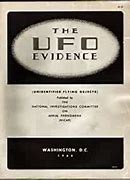
Among the most notable aspects of the NICAP legacy is The UFO Evidence, brought to life by editor Richard Hall. The 1964 report consists of some 200,000 words of UFO investigations. It embodies what NICAP felt was its 750 most compelling cases from the more than 5,000 contained in its files. The UFO Evidence was provided to Congress and more than 10,000 copies were disseminated to scientific research organizations, government agencies, universities, military installations, and libraries (see p46). While the relevance of the material could certainly be debated, the report offered a tangible starting point for discussions and a realized achievement for investigators of its day.

So what happened between NICAP's inception, a 1960s heyday of public interest, soaring membership, reports of CIA infiltration, the org's decline, and its eventual 1980s demise? To better understand the rise and fall of NICAP, and events of cultural and social significance along the way, let's start by exploring the beginnings. That takes us to the U.S. capitol. The year was 1956.

Saturday, September 17, 2022

CIA Responds to FOIA Request on Jack Acuff

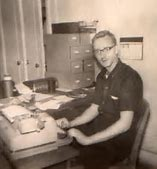
John "Jack" Acuff
     A Freedom of Information Act request submitted to the CIA on John L. "Jack" Acuff, Jr., the man instated as president of NICAP in 1970, received a September 9 response in which the spy network would neither confirm nor deny the existence of records that would reveal an unacknowledged or classified association with Acuff. Known as a "Glomar response," the Agency explained that the admission of the existence or nonexistence of such records is a fact that is exempt under the FOIA.

The Agency did, however, provide copies of two previously released documents that reference Acuff. The first is an intriguing, two-page, unattributed profile of NICAP as cited and explored in Wayward Sons. The second is a 24-page Robert J. Durant essay, Will the Real Scott Jones Please Stand Up?. The 1990s Durant work, widely known among researchers familiar with the latter 20th century saucers and spooks scene, apparently found its way into possession of the CIA for what may be a variety of possible reasons and came to be archived on its website.

Jack Acuff took charge of the National Investigations Committee on Aerial Phenomena in the wake of the removal of Donald Keyhoe as director. Staffer Stuart Nixon was given Keyhoe's former position in what became known as the Acuff-Nixon era of the UFO organization. Speculation and accusations of hidden intelligence community agendas involving NICAP echoed throughout the UFO subculture and continue to be popularly accepted today among those familiar with the circumstances.

The two-page document carries the heading, "National Investigations Committee on Aerial Phenomena (NICAP)," and appears to possibly be a draft of a memo or report. The name of an author is not included and the specific purpose of the document is not clear, although it is apparent that NICAP structure and operating methods were the focus of the work. It places Nixon as director and Acuff on the Editorial Review Board, suggesting the date of the piece was the early 1970s. The two pages were apparently originally approved for release by the CIA in 2010.

The document goes on to break down the education and scientific backgrounds of select NICAP volunteers. "All investigators carry credentials identifying them as investigators for NICAP," the author informs the unknown intended audience.

From the document:


Will the Real Scott Jones Please Stand Up? takes readers through the shenanigans and misadventures of intelligence professional Cecil B. "Scott" Jones and a surrounding cast of dubious characters. Many of them have been explored on this blog, including Jones himself, who I interviewed by email in 2012.  

Acuff makes an appearance in the essay when author Durant quotes the work of Fawcett and Greenwood (Clear Intent). They explained how prior to serving as president of NICAP, Acuff "was the head of the Society of Photographic Scientists and Engineers (SPSE), a frequent target of Russian spying attempts and a group that had many members involved in Defense Department intelligence units, including the CIA."

Acuff was indeed but one NICAP officer of many with significant and direct ties to intelligence agencies. Stuart Nixon left NICAP in 1974, which was the same year Sen. Barry Goldwater joined the Board of Directors. Goldwater went on to chair both the Senate Armed Services Committee and Senate Intelligence Committee.

In 1978, Acuff now-infamously sold the NICAP mailing list to a Toronto-based Nazi group. Twice. The purchaser, Ernst Zundel, aka Christoff Freidrich, was reportedly none too pleased because the list included 8,000 names of people who were physically dead (see pp1-3).  

The office of Goldwater was likewise not thrilled with the turn of events, at least due to the potential publicity problems, but relations between Acuff and the Senator apparently did not entirely go south. Although Acuff was replaced at president by Harry Cooper in 1978, he did not depart NICAP for good until 1982. This happened after he secured a four-digit cash settlement from the org for what at least one member reportedly described as holding its files ransom (see p14).

In a letter dated January 29, 1982 and shown below, Acuff notified Goldwater he was leaving the Board (see p21). Acuff thanked the Senator for the help he and his staff gave him. 


Saturday, July 23, 2022

Working the FOIA

    Earlier this year I submitted a FOIA request to the FBI for all records cross-referencing or pertaining to Ira Samuel Einhorn. The late Einhorn, dubbed the "Unicorn Killer," was convicted of the murder of his former girlfriend Holly Maddux. It is a tragic and somewhat complex saga that winds through the environmental activist community and an international trail of evading authorities.

The infamous Einhorn
Maddux disappeared in 1977 during a trip to gather her belongings from an apartment she and Einhorn previously shared in Philadelphia. A year and a half later her remains were found in a trunk in his closet. Einhorn fled to Europe and was assisted by supporters who he convinced of his innocence. He was not arrested until 1997 in France, and even then the extradition process proved complicated. 

Einhorn was eventually convicted in 2002, but not before taking the witness stand in his own defense and claiming the CIA killed Maddux. He asserted he was set up because he knew too much about the Agency's military paranormal research. The case resulted in researchers such as Mark Pilkington and Greg Bishop showing interest over the years. 

Einhorn died of reportedly natural causes in a Pennsylvania prison in 2020. For those wondering, he was called the Unicorn Killer because "Einhorn" apparently translates to "unicorn" in German.

So a few months ago some friends were discussing the case and I offered to submit a FOIA request to the FBI. The Bureau responded in May with 356 pages of records

However, the response indicated the Bureau was simply providing records which were previously offered in response to other requesters:


This means a thorough search was not actually conducted, but the request was filled by providing the material already offered in response to the same or similar requests. As once pointed out by John Greenewald, an effective means of having an additional search conducted is to promptly respond with a request for all records not included in the release.

I realize this sounds crazy. A FOIA request gets submitted for all records on XYZ, the agency responds, then the requester asks for all the records not included in all the XYZ records. Like, no, really, all the records. But this technique results in additional documents a rather surprising amount of the time. While it is indeed a little crazy, it makes a bit more sense when understood from the perspective the initial response was pretty much nothing more than giving the requester what was already provided to previous requesters.

In this specific instance, FBI notified me July 19 of an additional 4,473 pages of potentially responsive records not included in the initial response to my request:


A large number of additional documents does not always prove to be as interesting as it initially seems. For instance, sometimes 356 pages of XYZ may be stored in a much larger folder containing thousands of pages pertaining to similar cases as XYZ, perhaps from the same era or general topic. Nonetheless, one might indeed prefer to be made aware of such records and browse the material for them self. 

The quoted cost of a reproduction of the roughly 4,500 pages is $130 which may be delivered in pdf in nine monthly increments of about 500 pages each. I will probably order the material and post it as I periodically receive it.

In related FOIA news, I received 47 pages of previously released FBI records on George Hunter White in April. White was a Federal Bureau of Narcotics agent who parlayed his career underperformance into becoming a member of the MKULTRA crew. He ran houses of ill repute for the CIA where hookers dosed unsuspecting Johns in the name of national security and science. 

According to John Marks, the overindulging White once had a fender bender in the neighborhood of a CIA-sponsored brothel, resulting in the Agency paying cash for damages to the other driver in an effort to protect the cover of Operation Climax. He reportedly once used a gun to shoot his initials in the ceiling of a New Orleans hotel room. He's also the guy that released hallucinogenic chemicals on a New York subway for the Agency you may have heard about. Real charmer, this guy. 

In response to my request for all records not included in the initial response, FBI replied July 20 that additional responsive records were transferred to the National Archives:


I will post from my Twitter account as I learn more about the number of pages involved and as I obtain the files. NARA will advise of the circumstances in response to a request for the material.

As I discussed in WAYWARD SONS: NICAP and the IC, the FBI may offer insights into CIA personnel and activities that are not always accessible through the Agency. Director Hoover had his nose in virtually everything, and FBI files may reflect espionage investigations, background checks for security clearance, and any number of circumstances which provide more material than released by CIA.

Along those lines, readers of WAYWARD SONS will recall the significance of the Office of Policy Coordination, a 1948-1952 front for the CIA and State Department. From the book:


    In 1949 the OPC had a total of 302 personnel. By 1952 it had 2,812 with an additional 3,142 overseas contract personnel. The 1949 OPC budget was $4.7 million. Just three years later, in 1952, it was $82 million. By the time of its merge with the Office of Special Operations, OPC activities included worldwide covert missions conducted out of some 47 overseas stations. 

The previously cited 1973 CIA intelligence study and its assertion the Clandestine Services stepped up the pace thereafter could certainly be interpreted as significant, if not outright mind boggling. The study references a CIA-composed history of the OPC made up of five volumes, consisting of 722 pages plus three appendices and eleven attachments (To the best of my knowledge, the five-volume OPC history has not yet been released, although a partially redacted version of its introduction is contained in the referenced 1973 CIA Studies in Intelligence).


The OPC originally operated on the watch of Director of Central Intelligence Roscoe Hillenkoetter. Col. Joseph Bryan III was recruited and ran a psy warfare subdivision consisting of such notable characters as E. Howard Hunt. Both Hillenkoetter and Bryan were destined to play influential roles on the board of directors of the National Investigations Committee on Aerial Phenomena.

Curiously, Hillenkoetter's CIA successor, DCI Walter Bedell Smith, expressed interest in the use of the UFO topic as a psy warfare tool. He wanted to know "what use could be made of the UFO phenomenon in connection with US psychological warfare efforts," according to the CIA itself. In 1950, DCI Smith took complete control of the Office of Policy Coordination from the State Department. Surrounding circumstances and the cast of characters are explored at length in WAYWARD SONS.

On July 21 the FBI responded to a 2021 FOIA request on the Office of Policy Coordination. All responsive material was withheld in full:


The cited exemptions involve privacy and security issues. I am in the process of appealing the FBI determination to withhold the material, most, if not all, of which is now over 70 years old.

I recommend those interested in studying the FOIA process (and particularly obtaining related resources) follow Beth Bourdon, a fulltime attorney and parttime FOIA activist. She maintains a Patreon which has proven valuable in furthering my understandings of FOIA appeals as well as related steps of effectively navigating the entire process.

Sunday, May 22, 2022

Hall, Keyhoe and the FBI

    Richard Hall served as Donald Keyhoe's assistant in the National Investigations Committee on Aerial Phenomena. He is credited as the driving force behind The UFO Evidence, a 1964 report embodying some 750 of what NICAP deemed its most compelling cases. The organization compiled over 5,000 UFO reports by that point in time. 

Hall largely ran day-to-day NICAP operations with a typically understaffed office. Keyhoe is remembered as an off-site manager, perhaps most effective at pursuing public relations and appearances. This provided Hall opportunities to organize projects, conduct research, and coordinate the growing number of NICAP subcommittees, the structure of which he is credited with designing. 

It was Hall holding down the fort at NICAP headquarters on Connecticut Avenue in Washington when the CIA came calling in 1965, as explored in a recent blogpost and WAYWARD SONS: NICAP and the IC. He loaned materials to officers dispatched from the CIA Contact Division for what a now-declassified Agency document indicates was delivery to its Office of Scientific Intelligence. The OSI was composing an evaluation of UFOs at the request of DCI John McCone. The declassified documents do not support the NICAP narrative of an orchestrated CIA and Air Force cover-up.

FBI files on Richard Hall show he was a quick study of Maj. Keyhoe. Hall quickly picked up the technique of requesting Director Hoover clarify FBI official policy on investigating UFOs, circumstances Hoover repeatedly addressed and minimized. The official FBI position probably reflected that Hoover sincerely had no interests in UFOs, at least not until the topic would bleed into areas for which the Bureau considered itself responsible.

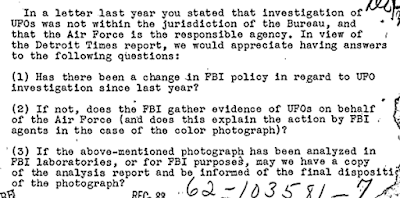
Hall got wind of FBI agents reportedly taking an interest in a photo from a case in Flint, MI. Part of his resulting and inquisitive 1960 letter to Hoover:  


The above linked records obtained from the FBI pertaining to Hall do not include a response from Hoover to the above inquiry. I speculate that may be because Hoover did not respond and ignored the query, other than having the letter from Hall placed in his file of correspondence.

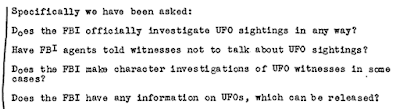
This is a throwback to previous exchanges between Keyhoe and Hoover. A 1958 letter written by the major to the FBI chief included the following questions (see page 5):


Keyhoe further requested "an interview with an FBI official acquainted with the facts, and with the FBI policy which may be involved." I guess one could admire his determination if nothing else.

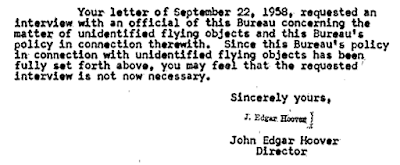
In Hoover's 1958 response (see pages 2-3), he explained to Keyhoe the FBI did not investigate UFO sightings and did not issue instructions not to talk about them to those who report sightings. It was not a function of the Bureau, Hoover continued, to make character investigations of UFO witnesses. The FBI had no information concerning UFOs which could be released, which did not imply it had information which could not be released. 

In closing, Hoover acknowledged Keyhoe's request to interview an FBI official. "Since this Bureau's policy in connection with unidentified flying objects has been fully set forth above," the FBI director concluded, "you may feel that the requested interview is not now necessary.": 


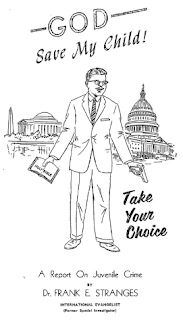
Hall's correspondence with the FBI included apparent efforts to offer assistance to the Bureau. In one instance in 1962, Hall supplied Hoover with a NICAP report compiled on Frank Stranges (view FBI files compiled on the good doctor of divinity). It had come to NICAP's attention, Hall explained to Hoover, the Bureau had investigated Stranges, so NICAP wished to provide the FBI an overview of its experience with Stranges and offer further information as requested. 

Pamphlet by "Former Special
Investigator" Stranges
 
Hall and Keyhoe often seemed to take exception to individuals exploiting the UFO topic such as Stranges, who launched the story of Venusian Valiant Thor. Hoover did not seem to share such concern. I don't think Hoover cared in the least about honesty and integrity in the UFO subculture. The FBI director took interest if and when such behavior became criminal or, in the case of Stranges, came to stretching the truth about relationships with the FBI. 

Hoover discovered that those attending the lectures of Stranges and reading his literature were often left with the incorrect impression he was a former FBI agent. This seemed to be what Hoover was concerned about, and instructed agents in 1962 that Stranges "should be admonished" to cease implying an affiliation in any way.

As explored in a recent blogpost, FBI agents were similarly dispatched in 1954 to pay pulp writer and editor Ray Palmer a visit to clarify the Bureau's displeasure with being granted a starring role in his sensational saucer stories. The misrepresentation and exploitation of the FBI was Hoover's concern, as compared to the ethical shortcomings of writers and UFO investigators as NICAP seemed to have tried to urge the director to monitor and patrol. 

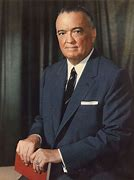
J Edgar Hoover
It could also be interpreted Keyhoe and Hall tried less successfully than they hoped to build bridges with the FBI by framing themselves as honest saucer brokers. Hoover was diplomatic but wasn't biting and, frankly, NICAP probably greatly overestimated Hoover's commitments to honesty and integrity.

Further example of NICAP efforts to build bridges with the Bureau may be observed in a 1957 letter of congratulations Keyhoe wrote to Hoover about the FBI work on the "Trip to Venus" swindle. Career conman Harold J. Berney was arrested after using a UFO-inspired story about his travels to Venus to separate a woman from $38,000. Factoring inflation, that's approaching 400 grand. 

A resulting article stated Keyhoe congratulated Hoover for exposing the fraud and offered full NICAP cooperation in securing evidence of other false UFO claims (see pages 184-185). It's a bit difficult for me to envision Keyhoe was not being obtuse when he emphasized potential FBI interest in the false UFO claims of the Berney case as compared to financial extortion perpetrated by a career criminal. I suspect Keyhoe was attempting to capitalize on potential advantageous public relations while simultaneously encouraging Hoover to get in the business of UFO fact-checking, or at least Keyhoe's version of it. The article went on to explain Hoover diplomatically yet carefully responded to Keyhoe, "I have received your letter of May 29, 1957, concerning our activities in the 'Trip to Venus' case and I want to thank you for your thoughtful congratulations."    

The above linked FBI records were obtained over the course of writing and conducting research for WAYWARD SONS. In January 2021 the FBI advised a document yet to be processed for the FOIA and potentially responsive to my request on Richard Hall was in the possession of the National Archives and Records Administration, or NARA. FBI identified the document as 100-HQ-359927 Serial 41. I subsequently filed a FOIA request to NARA.

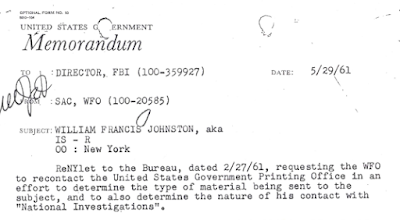
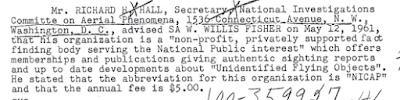
In recent months NARA provided what proved to be the 3-page document, which contains two pages of a 1961 FBI memo from the Washington Field Office to Director Hoover on a William Francis Johnston. It appears the FBI was trying to determine the activities and interests of Johnston, particularly including his interaction with NICAP:


Hall was apparently interviewed by Special Agent Fisher, who determined Johnston, of Long Island, submitted a NICAP "Membership Subscription Application" in 1959:


SA Fisher further discovered Johnston sought assistance from Keyhoe and NICAP to secure a speaker for a civic group. Keyhoe and Hall each indicated they were unable to specifically recall Johnston or if they supplied a speaker, while office notes provided by Hall to FBI suggested they offered to help, which was essentially part of the NICAP mission.

Curious to see what else the file contained, earlier this year I requested NARA provide FBI file 100-HQ-359927 in its entirety. NARA advised in an April 13 email that William Francis Johnston was the subject of the requested records, compiled as part of a domestic security investigation created between March 1942 and January 1972, consisting of about 400 pages.  

The estimated time to process the file under the FOIA is 39 months. Current cost for a reproduction, or pdf in my specific circumstance, is 80 cents per page, or about $320. It should be noted it is not necessary to pay to have files processed and, once processed, they may be viewed for free at the NARA facility in College Park, MD. I am therefore of the opinion the first step is to have the material made available for release, then worry about how to obtain and view it, thus I proceeded with the request.

Perhaps Mr. Johnston was involved in some type of employment requiring security clearance. Perhaps he was an asset of the FBI, or maybe he was of interest for any number of other reasons, or all of the above. It could nonetheless be considered interesting his path intersected with 1959 NICAP. I look forward to eventually reading more about William Francis Johnston and the FBI.  

-----------------------------

Recommended further reading:

Cold War Cash, Politics and Saucer Stories

Ongoing NICAP Research: FOIA Request Lands FBI File on Counsel Services Co-Founder

Monday, May 16, 2022

Pulp UFO Writers and the FBI

     Ray Palmer was an editor and distributor of pulp magazines during the mid 20th century. He got in my sights while I was researching and writing WAYWARD SONS: NICAP and the IC. Palmer distributed pulp fantasy and sci-fi on a wide scale and is considered to have significantly contributed to the public perception of flying saucers and conspiracies during his era. Suffice it to say Palmer was not overly concerned with accuracy in his magazines as compared to getting eyes on the pages.

Maj. Donald Keyhoe, who became the face of the National Investigations Committee on Aerial Phenomena, was a widely published author before his run as the most high profile UFO activist of his time. His writing included contributions to the fantasy genre, as Palmer was popularizing. Keyhoe's work once made the cover of Weird Tales, pictured right. 

FBI records on Keyhoe indicate the Bureau was not a fan of his articles. A 1958 FBI memo on Keyhoe quotes Bureau Assistant Director Nichols as describing Keyhoe's writing as flamboyant and irresponsible. 

An example is cited of a 1941 piece co-authored by Keyhoe and published in Cosmopolitan. It apparently reported Adolph Hitler had a plan to seize the Merchant Marines and went on to assert the FBI possessed documents to that effect. The memo stated the assertion "was completely false." From the 1958 FBI memo:


There was no doubt media was a valuable tool in shaping public sentiment, and the FBI had keen interests in all phases of the process. That included Palmer and his distribution of pulp magazines, in addition to keeping an eye on what was coming out of the typewriter of Donald Keyhoe.

A 1953 report contained in an FBI file obtained on Ray Palmer lists five publications he operated at that point in time. Among them was Fate, with a reported circulation of 65,000. Several former publications were mentioned in the report as well, such as Amazing Stories, which gave rise to some of Palmer's most widely known sensations. 

The FBI file indicates an investigation was launched on Palmer in 1953 after the Bureau received a tip he was publishing Communist propaganda. Palmer would have seemingly been in a minority if he wasn't accused of Communist sympathizing, and the investigation found nothing of concern, at least not about Russians. There were other aspects of the resulting reports authored by Special Agents that caught my attention, however.

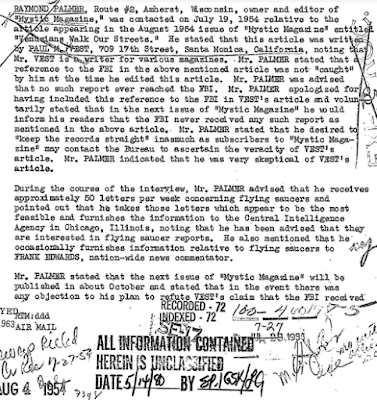
Not unlike the actions of Keyhoe, writers and opportunists numbered among those who worked the FBI into their narratives. One was a Paul Vest, published in Palmer's Mystic Magazine. This was the kind of thing that tended to get Director Hoover's attention, and in 1954 agents were dispatched to Palmer's location in Evanston, Illinois. They were equipped with instructions from Hoover to make it clear the FBI did "not appreciate having the name of the Bureau used in fantastic stories appearing in his publication to add credence to his stories and articles." 

The Vest piece was titled, catchily enough, "Venusians Walk Our Streets!". The author claimed in the story that FBI labs were in possession of a steel plate that just such a Venusian had marked with a half inch deep streak with no more effort than passing his fingernail over it. This also obviously suggested the Bureau was aware of said Venusians walking among the population. Hoover subsequently investigated to his satisfaction there were no FBI personnel at any such labs spreading stories as published and subsequently sent agents to make Palmer well aware of the fact. 

The creatively resourceful
Ray Palmer
In a memo dated July 22, 1954, a Special Agent in Charge at the Milwaukee Field Office advised Hoover contact was made with Ray Palmer. Palmer reportedly apologized for the misrepresentation of the Bureau and described it as an oversight on his part. This is where it gets a bit more interesting.

Palmer offered to publish a retraction, according to the FBI report, refuting Vest's claim about the FBI. Palmer further informed the agent he regularly supplied the CIA in Chicago with saucer reports mailed to him that he thought were most feasible, adding he was advised the Agency was interested in flying saucer reports. 

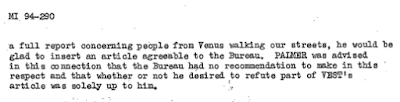
The FBI agent wrote Palmer explained, that in the next issue of Mystic Magazine, "he would be glad to insert an article agreeable to the Bureau." From the 1954 memo:


Was this Ray Palmer attempting to secure an advantageous relationship with the FBI? It could also be interpreted he was suggesting he already had such an arrangement with the CIA, and that perhaps the Bureau would find it mutually beneficial to be in the loop.

Whatever might be read between the lines, it was indicative of the niche Palmer carved out for himself, and a certain amount of power it wielded. It also signaled the beginnings of a tumultuous and unsteady alliance between certain writers and their intelligence agency contacts on the topic of UFOs. Those precarious relationships would persist to this very day.

-------------------------------------

See also:

UFO Activism and Congressional Hearings, 1960s Style

Friday, May 13, 2022

UFO Activism and Congressional Hearings, 1960s Style

    Below is an excerpt from Chapter 10 of WAYWARD SONS: NICAP and the IC. The excerpt explores the efforts of Maj. Donald Keyhoe and his National Investigations Committee on Aerial Phenomena to generate Congressional hearings on UFOs during the 1960s. There are many similarities to events happening in today's overlap of politics and UFO advocacy. While Keyhoe's efforts may have initially appeared successful, his lobbying may arguably serve as more of a cautionary tale than cause for celebration. 


    NICAP files contain reference to what the organization considered “educational work” conducted in 1962. During the first quarter of the year, “special material” was sent to 62 students and teachers for what was described as use in preparing term papers, science projects, research reports, and so on (NICAP_Educational_work.pdf, p1). Such material included “a bibliography, source material, back magazines, etc.” More shipments for the fall were reportedly being processed. 

Similar efforts to “educate” Congress were also undertaken, as indicated in a 1962 form letter apparently authored by Keyhoe (NICAP_Educational_work.pdf, p9)

We can observe Keyhoe's tactic of declaring UFOs represented a national security threat. This would hold obvious significance to elected officials and intelligence agencies. Perhaps, however, applying the term “UFO” to such potential threats was not as relevant as UFO proponents might prefer the public believe. Beyond groups like NICAP using the issue as a public relations ploy, it's not clear how the armed forces should do its job any differently if it called air incursions UFOs instead of radar returns. Similar circumstances may be observed today. 

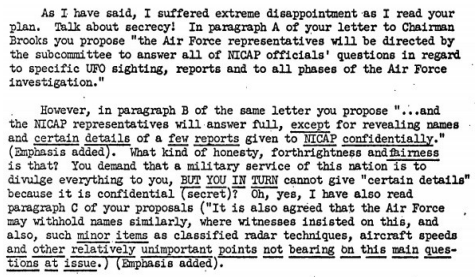
Keyhoe previously ran into resistance on such matters. Rep. Joseph Karth, in a 1961 letter to Keyhoe, addressed Keyhoe's proposal for a Congressional hearing. Karth wrote (NICAP_Keyhoe_Karth.pdf, p3): 


Rep. Karth expressed disappointment in Keyhoe's apparent intention to focus on Air Force secrecy as compared to presenting substantial evidence of UFOs. It has since become an all too standard part of the ufologist tool kit to plead their cases based on the obstruction of evidence rather than its presentation. 

Furthermore, Karth suggested he questioned Keyhoe's arrogance and hypocrisy concerning national security and secrecy. The Congressman appeared perturbed Keyhoe seemed oblivious to the sensitivity of classified material, referring to it as “minor items,” while expecting to be granted the luxury of withholding information as he saw fit. This of course became a staple of the UFO genre, and it continues today. Such concealed details frequently obstruct fundamental aspects of the universally recognized fact-finding process. The double standards try the patience of the more discerning members of the community at large. Rep. Karth was apparently in the “put up or shut up” camp, and saw the irony in Keyhoe reserving the right to remain silent while demanding answers from men charged with protecting national security. 

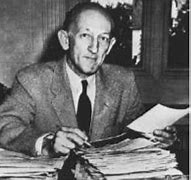
Richard Hall
Nonetheless, as noted in the above 1962 letter penned by Keyhoe, The UFO Evidence was on its way. It was destined to be considered among NICAP and editor Richard Hall's most significant contributions to the study of UFOs. From a July 1, 1964 NICAP press release (NICAP_papers_mixed_years.pdf, pp32-33): 

    “A documentary report charging Air Force censorship of unidentified flying objects was submitted today to Congressman John McCormack, Speaker of the House, and Senator Mike Mansfield, Majority Leader. The report is based on a 7-year investigation by military and technical experts of the National Investigations Committee on Aerial Phenomena (NICAP). 

“The 184-page document, titled 'The UFO Evidence,' contains hundreds of verified UFO sightings by airline and military pilots, aerospace scientists and engineers, and other experienced observers. 

“NICAP, a private fact-finding organization, includes on its Board of Governors and Advisers: Army, Navy and Air Force officers, scientists, veteran pilots, and other specialists... 

“The charge of official secrecy was backed by a majority of the Board and Advisers, including Colonel J. Bryan III, USAFR (Ret); Admiral H. B. Knowles, USN (Ret); Dr. Leslie K. Kaeburn, biophysicist, University of Southern California; and Dr. C. P. Olivier, President of the American Meteor Society... 

“The NICAP Report covers approximately 750 cases selected from over 5000 on file. The documented cases include numerous reports by Air Force pilots, and incidents of UFOs which made close approaches to aircraft... According to NICAP, the large majority of these cases are totally unsolved. Although Air Force analysts claim to have explained some of the cases, NICAP says counter-to-fact answers have often been given to Members of Congress and the press... 

“After the current outbreak of UFO sightings, the Air Force admitted it had 910 unsolved cases out of 8128 - approximately 11%. Heretofore the Air Force had insisted it had solved all but 1 or 2%. The most recent unexplained sighting, according to the Air Force, is the April 24 observation by a police officer in Socorro, N.M., who saw an egg-shaped UFO take off from a gulley. Imprints and scorch marks were found at the site. 

“The NICAP report states '...it is a reasonable hypothesis that the unexplained UFOs are real physical objects... artificial... under the control (piloted or remote) of living beings'... Many of the NICAP Board Members and Advisers have gone further, contending that the UFOs are extraterrestrial devices observing the earth. Among these are Col. J. Bryan III; Admiral H. B. Knowles; Prof. C. A. Maney; Dr. Leslie K. Kaeburn; and Capt. William B. Nash. 

“Verified cases in the report show speeds and maneuvers beyond the capabilities of any earth-made machines, often confirmed by radar... In addition to the massive U.S. evidence, NICAP reports dozens of foreign cases from trained observers which confirm the observations of high performance objects and lead to the same conclusion. 

“In order to reduce the dangers of accidental war caused by misidentification of UFOs on radar screens, and to educate the public to the realities, NICAP advocates a sweeping review of government policies on the subject by Congress. Speaker McCormack and Senator Mansfield have been asked to request UFO hearings. Many Members of Congress in recent years have gone on record in favor of open hearings... 

“In releasing the document, NICAP warned that crackpot groups might try to take advantage of it by claiming it supports their views. The Committee disowned any claims that UFOs proved any particular religious or philosophical views currently being expounded by UFO cults. NICAP stated it had not found verification of a single claim of communication with space men.” 

    NICAP would indeed eventually see its hopes come to fruition for a Congressional hearing on UFOs, but before that happened, CIA officers paid a visit to NICAP headquarters. A now publicly available CIA memo dated January 25, 1965, reflects Agency interest in obtaining materials, including UFO reports, from NICAP for delivery to its Office of Scientific Intelligence (OSI). The memo further states OSI desired the information to assist in preparing a paper on UFOs. 

The CIA Contact Division met with Richard Hall on January 19, 1965, at which time he loaned the dispatched officers material and UFO reports for review. It was noted in the January 25 CIA document there was a strong feeling on the part of NICAP officials that the Air Force tended to downgrade the importance of UFO sightings. Hall apparently told the CIA officers there had been instances where the Air Force attempted to intimidate witnesses and get them to sign false statements. 

In closing, the report stated a security clearance was being requested on Hall. There are various accounts and anecdotes around the UFO community about Hall's interactions with intelligence agencies, often framed as Hall having a rather nonchalant attitude about them. A generally accepted consensus is Hall was never issued a security clearance and did not develop a significant relationship with the CIA, and I have not discovered any particular reasons to suppose otherwise. 

A now declassified OSI memo is dated January 26, 1965. You will note it was apparently composed the day after the above memo was written. The OSI memo was sent to the Director of Central Intelligence from OSI Assistant Director Donald F. Chamberlain. It was written in response to a request from DCI John McCone for an assessment on UFOs. The materials borrowed from NICAP contributed to findings reported by Chamberlain in the memo, according to the CIA

Chamberlain summarized some then-recent UFO reports, adding no evidence was revealed UFOs were of foreign origin or were a security threat to the United States. He clarified OSI monitored UFO reports, including those investigated by the Air Force, and concurred with Air Force conclusions. 

Ironically, while Keyhoe and his supporters were convinced an orchestrated UFO cover-up was being perpetrated by the CIA and Air Force, the two agencies were apparently actually in agreement there was not even a threat, at least not from unknown airborne objects. Threats of propaganda and espionage were another story, as suggested previously by the Robertson Panel. An argument could be made such concerns, and the resulting minimization of the topic for what may have been considered in at least some instances the public's own good, contributed significantly to the perception of official UFO secrecy. 

Similar might be said about the intelligence community's aversion to publicly addressing UFOs due to reasons that included its own manipulation of the topic in an offensive capacity. Uncle Sam obviously did not want to address his own covert use of the UFO subject. 

There was additional irony in the way UFO enthusiasts tended to interpret CIA interest in NICAP. For instance, NICAP and Keyhoe chose to withhold certain information because they did not want to divulge sources of reports and documents. They subsequently feared the CIA was snooping around to infiltrate their lines of communication. That may have been true to some extent, but not for the reasons NICAP chose to believe, which hinged upon the perception the CIA was scrambling to keep the existence of an extraterrestrial presence from becoming publicly revealed. 

In a manner of speaking, NICAP activities and subsequent CIA responses served as a self-fulfilling prophecy for NICAP. Intelligence community actions often seemed to be interpreted to confirm what UFO investigators chose to subjectively believe, and that largely continues to be the case in the UFO genre today. 

                    *                                        *                                        *

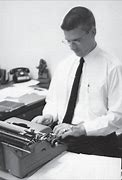
Gordon Lore
    Gordon Lore explained it was during this point in time he began working at NICAP. In his book Flying Saucers from Beyond the Earth, Lore stated he had taken a job as a writer-editor in Washington, D.C. In addition to writing, the future NICAP assistant director was also a musician who played the guitar at night at a local coffee house. 

Richard Hall was in attendance during one of Lore's performances in the summer of 1965, Lore wrote. He accompanied Hall and a group of friends back to Hall's apartment where they hung out and Lore entertained some more. Lore told Hall about his interest in UFOs, and was hired to join NICAP by the end of the night. He soon submitted his resignation at what he described as a subsidiary of U.S. News and World Report and was on his way to work with Keyhoe, Hall and NICAP.

“It was to become a dream job,” Lore wrote, “mixed with more than a little anxiety about keeping the organization afloat during the next five years.” 

In 1966 a series of dramatic UFO sightings began in Michigan. The widely reported events included dozens of witnesses, as well as police officers giving chase to whatever they were seeing in the sky. Renowned UFO investigator J. Allen Hynek infamously suggested swamp gas as a feasible explanation. 

Then-House Minority Leader and future-President Gerald Ford took interest. As an elected official of Michigan, he was among those supporting calls for a Congressional hearing on UFOs. The House Armed Services Committee soon conducted just such a hearing, although it was relatively brief. While there wasn't much in the way of substantial information getting revealed, a chain of events was by that point in motion that would forever shape the timeline of UFO World. 

The Air Force announced a forthcoming independent review of Project Blue Book and related UFO evidence. It was titled the University of Colorado Scientific Study of UFOs, conducted by what was known as the Condon Committee due to the lead researcher, physicist Dr. Edward U. Condon. 

Richard Hall described events of 1966 and how they influenced NICAP in his previously referenced 1994 paper, The Quest For The Truth About UFOs: A Personal Perspective On The Role Of NICAP. With a little help from the UFOs, Hall explained, NICAP was thrust further than ever into the media spotlight. As a result of all the buzz, NICAP was deluged with mail, routinely receiving hundreds of letters a day. Public interest in UFOs, and subsequently NICAP, produced a degree of financial stability previously unknown to the organization. 

Don Berliner reported that by early 1967 NICAP grew to some 14,000 members. The Committee then employed nine full-time staff, which, Berliner noted, was more than could be said for the Blue Book payroll. 

Hall wrote that NICAP worked diligently to provide Dr. Condon and his staff with the best evidence possible to assist in compiling its report. NICAP understandably saw the UFO study undertaken at the University of Colorado as significant, or, as Hall put it, that their dreams were coming true. The help was enrolled of Dr. James E. McDonald, an outspoken UFO proponent and atmospheric physicist at the University of Arizona. Many UFO proponents probably fully anticipated a desirable outcome, at least initially, because they sincerely believed the evidence did indicate an abundance of interplanetary craft. Intelligence agencies and other scientists, not so much. 

In his 1973 book, Aliens From Space, Maj. Keyhoe stated NICAP eventually compiled some 9,300 UFO cases, 2,000 of which he suggested were top notch. I guess he was suggesting there were aliens all over the place. Perhaps it did not occur to Keyhoe that overwhelming Condon and the public in endless stories might not be as effective a tactic as he hoped. 

Hall wrote NICAP “worked on a massive project of copying files for the Colorado scientists.” This went on for over the course of a year and included “hundreds of strong cases,” as well as NICAP subcommittees sending Condon new reports perceived as potentially important. 

Keyhoe further wrote that almost right away Condon and the project administrator, Robert J. Low, began indicating to the press they did not anticipate arriving at conclusions supporting anything overly significant about UFOs. The two were quoted as speaking favorably about Air Force investigative efforts, as well as suggesting the government should get out of the UFO business. Such positions were of course in conflict with stances held by NICAP. 

In spite of the statements, Keyhoe and NICAP tried to stay the course. That might have particularly been due to repeated assurances received from Condon and Low the study would be conducted objectively, according to the writings of Keyhoe and Lore. Dr. Condon and Robert Low reportedly minimized the significance of their published remarks when asked about them by Keyhoe. 

The final straw came for Keyhoe when he learned of what came to be known as the “Trick Memo.” It was a leaked Condon Committee memo written by Robert Low in which he described an operating strategy for the UFO study. The committee would consist of scientists, Low explained, who could not possibly prove a negative result, even though they might indeed publish an impressive body of evidence suggesting there was nothing extraordinary about UFO observations. Low then added, “The trick would be... to describe the project so that, to the public, it would appear a totally objective study, but, to the scientific community, would present the image of nonbelievers trying their best to be objective but having an almost zero expectation of finding a saucer...” (Lore, Gordon. 2018. Flying Saucers from Beyond the Earth. BearManor Media. (p124))

Keyhoe and his organization, when they got wind of the memo, responded with an April 30, 1968 press release, “NICAP Calls Colorado UFO Project Failure” (NICAP_incorporation_papers.pdf, p31). The release stated NICAP sent a report to the president of the United States, containing evidence of “grave deficiencies” in the University of Colorado UFO project. It was further stated NICAP broke relations with the project after 17 months of cooperation. Reasons listed for the break included Condon had never conducted a field investigation of a UFO sighting or interviewed responsible witnesses, although named as chief principal investigator. 

“Dr. Condon summarily discharged two Project scientists,” the news release continued, “for revealing written proposals by Project Coordinator Robert J. Low that the Colorado Project be represented to the public as 'totally objective', when in fact it would be constituted almost entirely of non-believers, with 'an almost zero expectation of finding a saucer'.” 

It was further alleged Condon and Low “both refused, in writing, to answer NICAP questions as to whether the Project was being conducted in a biased and negative manner.” Condon, it was asserted, “refused to guarantee he would examine any of the hundreds of NICAP-investigated UFO reports, submitted at the Project's request.” 

Keyhoe and NICAP took measures to prepare for public response to what was clearly going to be, from their perspectives, an unfavorable report from Condon. Their efforts included a second Congressional hearing, organized by NICAP supporter Rep. J. Edward Roush, an Indiana Congressman who chaired the House Committee on Science and Aeronautics. He held the Symposium on Unidentified Flying Objects on July 29, 1968. 

While a few qualified scientists and NICAP representatives attended and provided testimony, the event was limited in scope. It did, however, mark the historic occasion of a second Congressional hearing on UFOs. 

                    *                                        *                                        *

    The Condon Report was published in January 1969. The general conclusion stated nothing had come from the study of UFOs that added to scientific knowledge. It was additionally reported, “Careful consideration of the record as it is available to us leads us to conclude that further extensive study of UFOs probably cannot be justified in the expectation that science will be advanced thereby.” 

The issue was addressed in the document as to what, if anything, the federal government should do about UFO reports received from the general public. “We are inclined to think that nothing should be done with them in the expectation that they are going to contribute to the advance of science,” the Condon Committee wrote. 

If the implications were not clear enough as to what the group collectively recommended about operating government UFO research projects outside normal military channels, it explicitly clarified its stance. “It is our impression that the defense function could be performed within the framework established for intelligence and surveillance operations without the continuance of a special unit such as Project Blue Book, but this is a question for defense specialists rather than research scientists.” 

The Condon Committee made its position clear: The study of UFOs was producing nothing of scientific value and Blue Book should be discontinued. 

                    *                                        *                                        *

    The report, eagerly anticipated by the public, was now actually published. Gordon Lore wrote a memo to the NICAP office in the aftermath. The January 27, 1969, memo declared the organization and the UFO subject were facing perhaps their most critical period. Refuting the Condon Report was crucial and would require cooperation and hard work on the part of NICAP, Lore suggested (NICAP_Condon_reaction.pdf, p1). Time would show the goal was not to be achieved. 

Challenges included quarrels among the staff and a declining membership. If the negative Condon Report wasn't bad enough, it had now been over two full years since the Michigan sightings. People were tired of waiting for answers, or at least the answers they wanted to hear. What's more, a growing number of NICAP supporters' patience was wearing thin about attacking the Air Force. 

As explored earlier, it is difficult to tackle the UFO subject without drawing lines in the political sand. This was not only true in Keyhoe's day, but was the case for years to come. As I write this, current news cycles are more likely to include statements about UFOs from Pentagon spokespersons, Senators, and bureaucrats than from scientists. We should take that into deep consideration when forming our assessments. We might also question what practical contribution Congress might even make to the topic of UFOs. In hindsight, much of it seemed to be performative and in pursuit of a mixed bag of agendas. 

Maj. Donald Keyhoe
In the case of Keyhoe, he seemed to have come to believe lobbying elected officials and leveling demands at intelligence agencies was UFO research. At the least, it appears he considered it the most likely way to produce substantial results. If his actions were indicative of his beliefs, and he truly thought he was pursuing the most productive path, he was simply wrong. He gave it a hell of a try, though, for what that may or may not be worth. 

Many at the time seemed to believe the Condon Report was part of an orchestrated cover-up to deny the reality of UFOs and ultimately the extraterrestrial presence the reported craft were often believed to indicate. More than a few still think so, at least among those in UFO circles who are aware of the Condon Committee. Frankly, I doubt many people could tell you why they believe the study was a sham, the idea just took on the quality of one of those “everybody knows” kind of things. 

I strongly suspect very few people could articulate such circumstances as the Trick Memo and offer specific reasons why they believe the Air Force and Condon Committee conspired to deceive the public and cancel Project Blue Book. In most circumstances, the primary reason for such beliefs seems to be because UFOs were not confirmed to be sensational, thus there must have been a government cover-up. 

Perhaps there actually were more deceptive motives at play. It's possible, for any number of reasons. It's also possible the Air Force came to conclude chasing UFOs was a waste of time much more often than not, and Condon and Low were subsequently identified as good candidates to arrive at such a conclusion. 

It's a reasonable likelihood Air Force officials sincerely found UFOs and the related controversies to be an unproductive drain of resources, and believed objective scientists would concur – as had often been the case up to that point. The powers that be may therefore have identified a somewhat “fixed” study as the best way out of the problem. It may not have been they were trying to rig the study as much as they were trying to ensure it did not fall under the care of overly enthusiastic saucer fanatics. 

It could even have been the intent, at least in part, for the Condon Committee to upstage NICAP, and create an alternative group of respected scientists and researchers. The alternative group would, of course, reach different conclusions than those promoted by NICAP. In the process, it would ease the Air Force burden of answering questions about UFOs and constantly finding itself in the crosshairs of Donald Keyhoe. 

                    *                                        *                                        *

    Richard Hall did not seem to subscribe to conspiracies about the Condon Committee. That was the case even though he was admittedly bitter over circumstances surrounding his August 1969 final departure from NICAP. He described negotiations as long and contentious with Board members Col. Joseph Bryan III and Joseph B. Hartranft, Jr. Hall wrote the conflict was over back salary issues and stated the negotiations ultimately went nowhere. 

Hall extensively supplied information to the Condon Committee, as well, which stood to substantially increase his disappointment about the resulting report and overall circumstances. Nonetheless, he did not promote the Condon cover-up angle. 

“Was the Colorado UFO Project a conspiracy to debunk the subject?” Hall wrote in 1994. “Another 'front' operation to sweep the UFO problem under the rug? Many UFOlogists today write it off in that way, assuming that it must have been a put-up job from the start. However, there is a much simpler and all too-human explanation for what happened.” 

Condon and Low were simply not interested in UFOs, Hall suggested. Hall wrote that during one briefing he attended, Condon fell asleep. 

In another instance, Hall explained he personally hand-carried to Condon what he felt was an impressive and thick investigation report on a 1966 UFO case. When the Condon Report was later released, Hall was astonished to find no mention of it at all. 

“It had never occurred to me,” Hall explained, “that he would simply ignore it.” 

In his previously referenced 2018 book, Gordon Lore reflected, “Following the public release of the Condon Report, the prospects for NICAP continuing as a viable UFO organization quickly took a downward spiral. Adding fuel to the fire, unfortunately, was Keyhoe himself. Being an organizational and money manager was not his cup of tea. Some had even compared him to 'a second Townsend Brown.' 

“In a secret meeting on December 3, 1969, the NICAP Board with Colonel Joseph Bryan III presiding, fired both Keyhoe and myself. It soon became apparent that I had to be terminated as a convenient 'scapegoat.'” (Lore, Gordon. 2018. Flying Saucers from Beyond the Earth. BearManor Media. (p237)) 

And like that, the Keyhoe years were over. 

Staffer Stuart Nixon became director, and John “Jack” Acuff was soon appointed president. Ted Bloecher recalled the circumstances in a letter written to Richard Hall in approximately 1973. He was initially referencing his own business disagreement with Nixon, as compared to those concerning Keyhoe and Lore, when he wrote, “I have underestimated the lengths Stuart is capable of going to. But then, he's the one who fixed it so Major Keyhoe and Gordon Lore got axed. The shame of it is, I went along with it.” (NICAP_Bloecher_Report_1947.pdf, p5)