Friday, March 25, 2022

DIA Releases More AAWSAP Files

     The Defense Intelligence Agency filled three more FOIA requests Friday, bringing to five the number of final responses issued this week on requests pertaining to AAWSAP-related material. The Advanced Aerospace Weapon Systems Application Program has been confused with a variety of project names, and even the purpose and scope of the program are matters of debate. Ongoing FOIA requests have been used to clarify matters, and among the items emerging as most significant may be the absence of select records and terms. 

The latest three FOIA releases include a response consisting of eight files containing 52 pages, along with the DIA letter of response. The material is uploaded to a folder for viewing.

It was issued in response to a May 2018 request for documents pertaining to the AAWSAP Solicitation HHM402-08-R-0211, including proposals funded, project updates, reports submitted, contractual records, a list of funding recipients, amounts of funds awarded, budgets, and related documents. The majority of requested records are absent, in spite of references to detailed reports in "briefing" documents, the purposes of which might be interpreted more as sales pitches than objective assessments. 

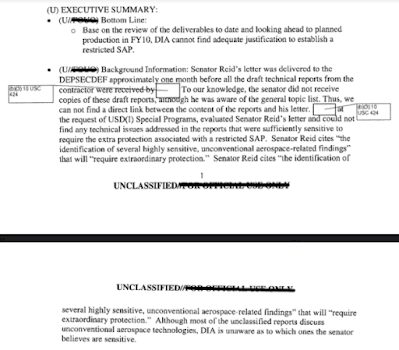
Perhaps most noteworthy are memos referencing Sen. Harry Reid, in which a lack of shared vision is expressed. In one particular November 2009 memo it is entirely unclear if the DIA understands what AAWSAP personnel are doing or why the Senator might request Special Access Program status, which was not granted:


DIA likewise issued a response on Friday of several files to an April 2018 request for similar AAWSAP material, as well as some files in response to a December 2017 request for AATIP records. Some of the material is repetitive, while a lack of budgets, project reports, expenses, and similar principal records, although specifically requested, is a recurring theme. Various types of project reports are mentioned in the material provided, but no such specific reports are included in the documents, perhaps raising questions about their whereabouts and value. 

It should be noted the DIA continues to advise that it is reviewing all of its AATIP holdings. The material is estimated to be released in approximately December 2022, but it is not clear how that might differ from what has been requested and provided. 

The two DIA responses as described in a blogpost earlier this week are uploaded to a folder, containing two response letters and five files. All contracts undertaken with and funding provided to Bigelow Aerospace Advanced Space Studies were requested, resulting in one of the final responses and the five files. 

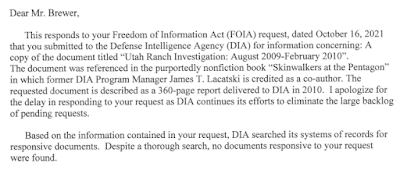
The other was in regards to an October 2021 request for a 360-page report, "Utah Ranch Investigation: August 2009-February 2010". The document was referenced by former DIA man James Lacatski and co-authors in the purportedly nonfiction book Skinwalkers at the Pentagon, and said to have been delivered to DIA in 2010.

"Based on the information contained in your request, DIA searched its systems of records for responsive documents," the DIA explained. "Despite a thorough search, no documents responsive to your request were found."    

The AAWSAP Trail

    Below are previous blogposts depicting additional FOIA responses and items of note obtained in recent years and related to circumstances surrounding the AAWSAP. As information continues to become available, perhaps the overall picture comes more into focus.

DIA: No Docs on NIDS was a 2018 post explaining the Defense Intelligence Agency reported no documents responsive to contracts undertaken with and funding provided to Robert Bigelow's National Institute for Discovery Science. The nonprofit organization was known for controversial UFO investigations, including purported research conducted at what became known as the Skinwalker Ranch. NIDS operated from approximately 1995 to 2004, at which time it was dissolved.

In a 2019 post we explored a 2011 FOIA response provided to an independent researcher and pertaining to the AAWSAP. A subsequent DIA response to a FOIA request for the records released in 2011 resulted in confirmation that Bigelow Aerospace Advanced Space Studies was awarded an AAWSAP contract. 

In June of 2021 the DIA responded it found no correspondence, such as emails or memos, exchanged between Luis Elizondo and the DIA pertaining to the Advanced Aerospace Threat Identification Program. Pentagon spokesperson Susan Gough emphasized the DIA managed the AATIP and that Luis Elizondo was not assigned to the DIA. Elizondo did not respond to an opportunity to provide comment for potential inclusion in the blogpost. 

Soon afterward, in July 2021, Government Information Specialist Raymond Hartwick indicated the Office of the Secretary of Defense had no records pertaining to the AATIP in response to a request for same. He recommended records be sought from DIA. When advised Elizondo and his associates asserted Elizondo ran the AATIP after it was transferred from DIA to the Office of the Under Secretary of Defense for Intelligence, Hartwick checked with his "components" before reiterating requests should be directed to DIA. "The AATIP was managed by DIA from 2008 until it ended in 2012," he wrote.     

Monday, March 21, 2022

DIA Further Verifies AAWSAP Award to BAASS, Fails to Locate Skinwalker Report

     The Defense Intelligence Agency (DIA) issued final responses to a pair of FOIA requests by email today, one of which further substantiates Bigelow Aerospace Advanced Space Studies was awarded a contract in the Advanced Aerospace Weapon Systems Application Program (view the documents). The contract award was previously established in 2019 at The UFO Trail through the FOIA after acting on a lead uncovered by researcher Keith Basterfield.

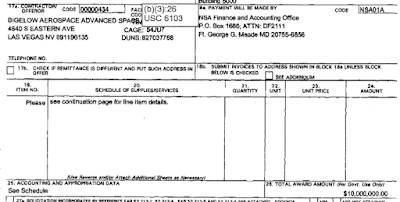
The most recent documents provided by the DIA consist of five files totaling 36 pages, issued in response to a 2018 request for all contracts undertaken with and funding provided to BAASS. The documents include a file containing a 2008 contract and a 2009 amended contract. The contract number is HHM402-06-C-0072, issued in response to AAWSAP Solicitation Number: HHM40208R0211, numbers of potential significance to select researchers who have closely followed the winding saga. 

The 2008 contract indicates some 10 million dollars was allocated to be paid to BAASS from the National Security Agency:


Also included in the most recent FOIA response is a 2009 apparent DIA memo, "SUBJECT: (U) Review of Advanced Aerospace Contract Deliverables".  The memo states, "The goal of the contract is to identify key technologies and physics concepts that would support revolutionary aerospace vehicle research and development. Contracted studies were designed to provide a prioritized list of technologies/concepts that then would drive detailed, focused searches into foreign aerospace research and development.":


The 2009 "Info Memo" goes on to state reviews of technical reports were performed by three research staff members at Sandia National Laboratories. It is suggested reviews were favorable and the evolving work might be useful to Defense Department agencies, circumstances we might question given the apparent discontinuation of the project and shuttering of BAASS.

In a second final response received today, the DIA stated no report was located as described by James T. Lacatski and co-authors. The report, referenced in Skinwalkers at the Pentagon and said to be titled "Utah Ranch Investigation: August 2009-February 2010", was unable to be found after a search was conducted: 


Several FOIA requests remain open for records pertaining to AAWSAP and AATIP. The DIA continues to advise that it is conducting a review of all its AATIP holdings and preparing those documents for release. Upon release, the DIA explained, the documents will be available for viewing in its online FOIA Reading Room. The release is estimated to occur no sooner than December 2022.

Saturday, February 26, 2022

Copernicus Did Not Cite Esotericism

    There is an argument that "the phenomenon" is ambiguous and fleeting. The elusive apparitions act with intent and even a sense of humor, or so say many of those who believe they have met the UFOs, Bigfoot, and similar oddities up close and personal.

My friend tells me if there are such goings ons, the instigator simply refuses to be corralled. They say it's like a soap bubble drifting on the breeze, colorful and attracting our interest, yet disintegrating under the very grasp which tries to contain it. 

The sights and events often interpreted to be related to UFOs and similar reported phenomena, some suggest, must surely all be from the same mold. This would account for its elusive nature and an overwhelming lack of confirmed physical evidence, even as cost effective technologies have advanced which would make the collection of hitherto absent evidence all the more feasible.   

Such theories of an intelligence behind an overarching and elusive "phenomenon" teeter on the edge of subjectively assigning definitive characteristics to apparitions not yet shown to so much as exist, at least not "exist" in more commonly accepted definitions of the word. Some would argue therein lies the rub, and perhaps they are correct. Maybe further knowledge of UFOs and things that go bump in the night indeed lies in the realms of the esoteric and traditions passed down among indigenous populations. 

If that is the case, however, they must also take responsibility for understanding they cannot expect those who prioritize evidence-based research to embrace their assertions on faith alone. They must effectively demonstrate a specific difference between their chosen endeavors and searching the snow on the television screen for patterns of intelligence. If there is a difference, it should be demonstrable.

If knowledge of the "phenomenon," "other," "visitors," or whatever labels one chooses to project upon it, is more likely found in monasteries than science labs, the scientist trying to simultaneously sell both ideas to the public - and funders - must come to terms with the dilemma. At the least, it is unreasonable to take the role of a persecuted Copernicus, suggesting those who argue alternative views will not accept your evidence, when your argument advantageously relies upon the notion your white whale leaves no evidence when convenient. It can't be both.

Sunday, February 20, 2022

Value Those Who Know Fact From Opinion

    We all disagree on many things, even with our closest friends and loved ones. Preferences in restaurants, football teams, and styles of music are likely to invoke wide ranges of comments from those around us.

The more meaning we assign an issue - the more we value it - the less tolerant we tend to become of those who have different values. A friendly rivalry about a ballgame is one thing, falling on different sides of Roe v. Wade is another. 

Some of us lean towards treading softly into such issues. We've all heard the saying about not talking religion and politics at social gatherings, but what about social media? And what about groups where emotionally charged subject matter is the very focus of discussion?

Fact or Opinion

    A challenge that typically arises is accurately differentiating between fact and opinion. We would be wise to recognize those who consistently show an ability to know the difference between what the facts are and what the facts indicate. The former should be universally recognized, while the latter may be matters of opinion and subject to debate.

It is a fact I write this blog. Its value is subject to debate.

Likewise, it is a fact people report UFOs. What that fact indicates becomes a matter of debate, often interpreted through a variety of filters. 


Fork in the Road

    Recognizing someone's ability to appropriately differentiate between fact and opinion offers us opportunities to widen our horizons. It is at this fork in the road, separating those more skilled at it from those less skilled, we may be surprised to find valuable common ground where we might otherwise disagree. The key factor in this context is not the opinion one takes on any given issue, but their ability to recognize it as a personal preference and empathize with those in disagreement.

In practice, this means we might find worthy discussion among a group of socially diverse people; the antithesis of an echo chamber. The most important factor is not socioeconomic class, level of education, religious affiliation, or similar category, but their willingness to identify where facts end and beliefs begin. 

This allows opportunities to exchange support and participate in shared learning. Our differences can be celebrated, encouraged, and valued, rather than hidden and unmentioned out of fear of inciting anger and wrath. 

We should choose the people in our inner circles wisely. Empower those to express disagreement who have earned the right to your valuable time and attention. Demonstrate to them it is emotionally safe to challenge your position, and cultivate reciprocation. Doing so supports original thinking and individuality. There just have to be guidelines for it to be functional, and those guidelines involve accurately differentiating between fact and opinion. 

----------------------------------------

Recommended reading:

UFO Research Integrity

Friday, January 21, 2022

FOIA Process: Not All Good or Bad

    The Freedom of Information Act is a valuable resource. It can be employed for a wide variety of useful purposes. 

Readers of my offerings have become acquainted with ways I rely on the FOIA to shed light on circumstances of interest. I have a great deal of appreciation for FOIA personnel employed at government agencies, the online reading rooms maintained by those agencies, and the painstaking aspects of the entire process. The work is important, and I respect the stamina it takes. 

That stated, anyone remotely familiar with the FOIA process has heard it referred to as "broken." Practicality can be called into question, with requests infamously taking years to get final responses, which by no means ensures material will be forthcoming. Below are some adventures I've had with the FOIA process.

Doc's in the Mail
   
Gen. Walter Bedell Smith,
Director of CIA 1950-1953
    On Nov. 28 I requested records on the late lawyer and government official Gordon Gray from what I've come to feel is the typically FOIA-reliable FBI. Mr. Gray directed the Psychological Strategy Board under DCI Smith's Central Intelligence Agency in 1951 and 1952.

The Bureau promptly responded by email Dec. 3, providing several links to material responsive to my request. Per standard protocol, the material had been posted for me to download in pdf in the FBI FOIA portal. 

Unfortunately, one of the links was dead because the corresponding file had not been posted. Compounding the complications was the fact the number of pages specified to be contained in the filled request indicated the missing pdf was the most substantial part of the haul, easily a three-digit number of pages.

This began a series of email correspondence with the FBI. I was initially informed the links would be reposted. They weren't. 

I was later informed the material had been emailed to me. It wasn't.

After continuing to stay on it and submit inquiries, I was then advised Jan. 6 (by then a full month into the saga) there were complications with sending the material electronically, so it would be delivered through standard mail. I informed the Bureau today, Jan. 21, I had still received no package. In their defense, I was promptly emailed an apology for the delay, and informed it was mailed yesterday.

Also in their defense, during the course of my attempts to get the full amount of material responsive to the request, FBI made me aware of a potentially responsive file at the National Archives. A request was subsequently submitted to NARA, which, like the Bureau, I have a lot more good things to say about its handling of FOIA requests than bad.    

NARA responded Dec. 15 it initially assessed Gordon Gray to indeed be the subject of the file sought, compiled by the FBI during investigation conducted between May 1961 and November 1975. The file consists of about 250 pages. It must be processed for release, which is projected to take until March 2025, a timeframe which is standard in my experience.  

Say Again

    On July 20, 2020, I submitted a request to the CIA for a Mandatory Declassification Review, or MDR. My hope was that a document I came across in a CIA archive would be reviewed for further release. In practical terms, I was requesting they'd remove redactions from the document, which consisted of correspondence from 1959 and appeared to have been last reviewed in 2003. 

Jan. 14, 2022, I received an emailed final response from the CIA. The body of the response stated, “We completed a thorough search for records responsive to your request and located the enclosed document, which we can release in segregable form, with deletions as marked...”

However, there was no enclosed document as described. I immediately advised CIA by telephone.

William J. Burns,
Director of CIA since March 2021
I soon received a second Jan. 14 email from CIA, carrying a second final response. Perhaps you can imagine my disappointment and confusion when I read, “Please note that the document you requested is unclassified, and as such, is not subject to review under the [MDR] Order. Therefore, we must decline your request.”

They're not getting rid of me that easy!

On Jan. 18 I submitted a request to CIA for an Administrative Appeal. I requested the circumstances be further considered, explaining I was hoping redacted sections on the document in question could be reviewed and released.

Jan. 19 I received a response (that was quick!) from CIA to my request for Administrative Appeal. The response reiterated the document is unclassified and therefore not subject to review, adding that the Agency must decline to process the appeal. It was further stated I could find more about CIA regulations and appeal rights under subparts 1900.42(a) of title 32 of the Code of Federal Regulations. (For those of you not as familiar as I with intricacies of big important intelligence agency speak, that means they promptly told me GTFO.)


I was a bit curious what the cited subpart actually says. I soon discovered it states, “A right of administrative appeal exists whenever access to any requested record or any portion thereof is denied,” the very such circumstances I was seeking to pursue.

Okay, now, in all seriousness, I could be way off with this. It's not like I really know what I'm doing. There could easily be circumstances I don't properly understand about the MDR process as it relates to CIA and the specific records in question. I got my degree at Google and all that, but there are a pretty limited number of ways to skate around the initial two email responses, which stated a document was enclosed, which was not actually enclosed, followed by informing me the request was denied. 

As of this writing, I continue to seek clarification and resolution, so Wednesday night I submitted a request for review of the circumstances to the Interagency Security Classification Appeals Panel. I'll let y'all know when nothing comes of it!  

Use Your FOIA    

    I sincerely strongly encourage researchers and interested parties to utilize the FOIA. The above examples are by far exceptions to the rule.

A major reason I have come to particularly depend on the FBI is I have now filed dozens of requests to the Bureau on NICAP-related figures alone. I find the procedures to be reasonable on requesting records pertaining to deceased individuals, and the guidelines are not difficult to follow. The FBI might prove to be a productive resource on any number of historic topics; if the topic mattered, it is entirely likely Director Hoover had an agent on it, if not an entire series of field offices. 

The FOIA takes time. It takes patience. It has some bumps and sometimes it's just plain impractical, but a lot of things are that are worth doing. Hang in there, or just get started. In the meantime, I gotta go check my mail!    

Monday, January 17, 2022

Cold War Cash, Politics and Saucer Stories

Leo H. McCormick, as he appeared in
a 1948 edition of The Baltimore Sun
 

   A two-page pdf was recently obtained from the National Archives and Records Administration (NARA) as the result of a FOIA request for records pertaining to Leo H. McCormick. The file contains copies of correspondence exchanged in 1956 between McCormick and the Eisenhower administration in which McCormick urged support for the Atlantic Convention Resolution. 

The Counsel Services co-founder was previously investigated by the FBI for employment with a CIA intelligence gathering asset, the Economic Cooperation Administration. The circumstances were explored in a recent blogpost which described the contents of a 30-page file on McCormick obtained from the FBI. It should be noted the Bureau indicated additional records potentially responsive to requests on McCormick were destroyed and/or not in their expected locations. 

The latest information from NARA was obtained after submitting a FOIA request citing the FBI file. Serving as the basis of the request was a 1949 FBI report located in the file which states personnel records for McCormick were maintained at the National Archives. The two-page pdf was subsequently located and provided by NARA. Potential additional responses from NARA are pending. 

In this post we will review and further explore related circumstances. 

NARA File

    Two letters contained in the pdf recently received from NARA are pictured below. The image on the left depicts McCormick's June 1956 message to President Eisenhower, suggesting McCormick took great interest in what are termed Eisenhower's efforts to support NATO contributions to peace. McCormick then expressed his belief such peace could best be accomplished by the president urging Congress to pass the Atlantic Convention Resolution.

The image on the right appears to be a draft of a response to McCormick from the Public Services Division. The document suggests McCormick's letter was forwarded to the State Department from the White House. It further states that although the administration took a great deal of interest in all steps designed to increase the unity of the Atlantic community, it felt Congress alone had the responsibility to decide on the passage of the resolution.   


Atlantic Union

    Researchers Meyer and Luenen of the Global Policy Institute noted in a 2008 report that the Atlantic Union Committee (AUC) was formed in 1949 and encouraged North Atlantic democracies to promote their shared values. The AUC was chaired by former high-ranking U.S. officials, including Will Clayton, who, together with George Kennan, was the main author of the Marshall Plan. The Marshall Plan was a financial initiative to aid Western Europe. It came to also be known as the European Recovery Program. Its co-author Kennan relentlessly promoted the idea of an Atlantic Union in the United States.

The feasibility and practicality of the Union were debated throughout the 1950s. As reflected in Leo McCormick's 1956 letter to President Eisenhower, proponents took up the strategy of suggesting a convention be held to discuss the issues. A resolution for an Atlantic Exploratory Convention was sponsored in Congress, and, as one might expect of a political platform, drew both support and opposition. 

The Veterans of Foreign Wars opposed the effort. According to the Congressional record, the VFW printed an article in its February 1955 magazine which encouraged its base to appeal to their elected officials to reject the resolution. Likewise, the American Legion, in its May 1955 magazine, called the Atlantic Union a scheme for world government and a plan to sacrifice American sovereignty. Supporters of the initiative called the accusations unfounded to the point of not justifying serious response.         

Meyer and Luenen further reported that in 1959 the Atlantic Union Committee was a primary force in bringing together 700 citizens of NATO member-states in London. The Atlantic Institute was established as a result. Three years later, in January 1962, the AUC was instrumental again in organizing an Atlantic Convention in Paris, which concluded with the signing of the Declaration of Paris. The Declaration established a commission on Atlantic Unity; created a council; formed a court to address international legal disputes; and promoted measures to ensure more effective defense, which included further development of a unified command, among other items.   

McCormick and Counsel Services

OPA promotional material

   Leo McCormick's 1947 Counsel Services went on to be instrumental in the 1956 incorporation and initial operation of the National Investigations Committee on Aerial Phenomena. As recently explored, McCormick previously worked with another Counsel Services founder, Mary Vaughan King, at the Office of Price Administration (OPA). He was employed at the OPA from 1941-1946, serving as the Director for the State of Maryland. King worked under his supervision.  

In 1947, the two, along with L.G. Shreve, founded Counsel Services, outwardly a public relations firm. In 1948 McCormick vacated his position as secretary and treasurer of the corporation for reasons which included launching an unsuccessful campaign for the Democratic congressional nomination in Maryland's 4th District. 

"After careful consideration I have decided to become a candidate and I have freed myself from all business obligations so as to devote my entire time to my candidacy and to the service of the public," McCormick was quoted in an article announcing his candidacy in the March 10, 1948, edition of The Baltimore Sun.

A 1949 FBI report which contributed to the investigation of McCormick states he sold his interest in Counsel Services to King and Shreve on February 17, 1948 (see pages 23-24). King had been acquainted with McCormick since 1942, while Shreve had known him for 15 years, according to the report. Both spoke very highly of McCormick and thoroughly recommended him for a position of trust and responsibility.   

Hillenkoetter and the ECA

    A copy of a March 1949 letter was obtained from the Central Intelligence Agency which establishes the Economic Cooperation Administration (ECA), a federal agency, as an ongoing CIA asset (The ECA was a forerunner to the United States Agency for International Development, or USAID). The letter is authored by future NICAP chairman of the board and then-DCI Adm. Roscoe Hillenkoetter. It is addressed to "Mr. Paul G. Hoffman, Administrator," of the Economic Cooperation Administration. 

Adm. Roscoe Hillenkoetter,
CIA Director 1947-1950,
NICAP Chairman of the Board 1957-1962
Hillenkoetter stated in the letter the CIA had a continuing need for economic intelligence information. A great and valuable part of this need, the admiral added, could be satisfied by pertinent information that became available through the activities of the ECA. 

Such information was already being furnished to the Agency from the ECA, Hillenkoetter qualified, but was confined to classification of SECRET or lower. The CIA director then requested the ECA put the Agency in the loop for communications and reports of all classifications, including TOP SECRET. Hillenkoetter closed the letter by thanking the administrator for cooperation given in the past.

Counsel Services Goes Abroad

    A May 1949 newspaper clipping, two months removed from Hillenkoetter's letter to the ECA, reported three members of Counsel Services were en route by air to China, working under ECA auspices. Mary Vaughan King was described as executive vice president of the firm and cited as the source. She indicated L.G. Shreve, president of Counsel Services, and others who became affiliated with Counsel Services specifically for the assignment, would be working in China. 

The article additionally stated, "Shreve initiated the project last December when he was in China with headquarters in Canton. A veteran public relations man, he served with the Army in the China theater during the war as information and education officer."

Fascinatingly, it was in August of that year, 1949, that Leo McCormick reportedly terminated his employment with a life insurance company to take a position with the Economic Cooperation Administration (see page 25). This resulted in an FBI investigation to clear McCormick for involvement in the European Recovery Program, a post-World War II economic project administered by the ECA. Readers will recall the European Recovery Program was also known as the Marshall Plan, authors of which strongly promoted the Atlantic Union as described above. By any name, the project was credited with distributing some 13.3 billion U.S. dollars in aid to Western Europe from 1948-1952 (Readers of WAYWARD SONS will recognize this period as the same operating years, coincidentally or otherwise, of the influential CIA and State Department front, the Office of Policy Coordination). Adjusting for inflation, that's about 154 billion dollars dispersed, give or take a few annual budgets of third world countries.  

ECA poster used to promote
the Marshall Plan in Europe
The (by this time) well-connected McCormick was recommended for inclusion in the European Recovery Program by impressive references, including two sitting state governors who were each interviewed by the Bureau about their dealings with the applicant. The Baltimore Sun would later report McCormick was involved in the administration of the Marshall Plan in 1950 and 1951. 

July 1950 newspaper article reported Counsel Services was among nine firms making up a newly formed agricultural development association. "Specialists of Counsel Services," the story continued, "are now under contract to the Economic Cooperation Administration in connection with work in Europe after having worked in the ECA's audio-visual education operations in China."

A later published obituary for Leo McCormick indicates in 1952 he was assistant to the chairman of the Democratic National Committee. McCormick served as secretary of the Democratic State Central Committee for Maryland and traveled with Illinois Gov. Adlai Stevenson as an aide during Stevenson's first campaign for president. 

In 1953 McCormick began a long association with the consulting and insurance firm of Poor, Bowen, Bartlett and Kennedy. He would later establish his own general insurance agency, Leo H. McCormick and Co.

NICAP Founder Previously Retained Counsel Services 

    Prior to the 1956 formation of NICAP, Counsel Services was retained by future NICAP organizer T. Townsend Brown. The inaugural front man of the UFO org heavily implied that to be the case in a 1971 letter he wrote to then-NICAP executive director Stuart Nixon (see pages 22-24). Brown suggested the public relations firm was first contracted to assist in securing funding from the Department of Defense for Brown's pet project, Winterhaven, which involved antigravity research and the purported weapons and communications applications. Brown began trying to secure funding for the project in 1951. The funds never materialized, but Counsel Services would go on to be a key component in launching NICAP.

T. Townsend Brown
In the summer of 1956, Townsend Brown, Morris K. Jessup, Clara John, Donald Keyhoe, and other NICAP founding figures were meeting around the Washington, D.C. area. While that was taking place, Leo McCormick was lobbying for support for the Atlantic Convention Resolution.

In August 1956 a NICAP certificate of incorporation was submitted to applicable authorities. Incorporators were Townsend Brown and Counsel Services officers Mary Vaughan King and Thomas D. O'Keefe, a former State Department Deputy Director. A contract was quickly drawn up between NICAP and Counsel Services, stipulating King and O'Keefe were empowered to hire and direct consultants at their discretion. NICAP was responsible for all related costs, along with inordinate fees to be paid to Counsel Services to handle organizational management, membership drives, and similar responsibilities. The incorporation of NICAP was formally completed October 24, 1956. 

The launch of NICAP, combined with the personalities involved both directly and indirectly, could be considered intriguing on the timeline of the Atlantic Union Committee and its efforts to solidify public support for stepping up NATO relations. NICAP rapidly assembled an impressive group of community leaders and military intelligence officers, many of which provided the media with an abundance of headline-making statements about air incursions executed by technology-defying craft. If the propaganda efforts of opponents of the AUC, such as the VFW and American Legion, were identified to consist of talking points asserted in bad faith, perhaps the Union and its allies took up similar strategies to manipulate the public. 

For whatever ultimate reasons, one of the consultants apparently enrolled by Counsel Services for help with NICAP was a psychological warfare expert with specific experience in creating a remarkably successful lobbying group. His history also seems more than a bit in step with the activities of Counsel Services and its clients.

Nicholas de Rochefort  

Nicholas de Rochefort delivering a 1954
pro-democracy speech broadcast by Voice of America

    Nicholas de Rochefort was a talented Russian-born Frenchman. Educated in France, he was already speaking and writing for Voice of America by the time he sought United States citizenship in 1954. 

Rochefort was notably credited with founding the Committee of One Million in 1953. The group opposed the domestic and international acceptance of Communist China. It also became the most recognized aspect of the significant and wealthy China lobby. 

Rochefort's Committee of One Million bore a striking resemblance to the Committee of Five Million, a 1949 political action committee chaired by New York attorney Desmond FitzGerald. By the time Rochefort made political waves with his group four years later, "Dez" FitzGerald was a rising CIA star.  

FBI records obtained on Rochefort through the FOIA indicate he was an employee of the U.S. government at the time he organized the Committee of One Million in 1953, although he had not yet applied for citizenship. Researcher Stanley Bachrack strongly suspected Rochefort was working on behalf of the CIA, resulting in suing the Agency for records on the activist in 1975. Despite Rochefort having been deceased for over ten years by that time, a judge dismissed the suit in 1976 on the grounds an intelligence service could be greatly impaired by irresponsible disclosure (see page 61). A much more recent FOIA request submitted by your author to the CIA on Rochefort was met with a Glomar response, stating such records, which may or may not exist, would be classified and exempt from the FOIA. 

FBI investigations on Rochefort, which took place during the summer of 1956 as NICAP was in its planning stages and McCormick helped push for the Atlantic Union, reveal he was quite well-connected. The Committee of One Million involved collaboration with influential politicians, and FBI agents followed Rochefort's trail all the way to the Joint Chiefs of Staff to obtain statements. He was repeatedly portrayed as loyal to democracy and upstanding in character. The psychological warfare expert was also described as a good propagandist, having worked on multiple such projects in a professional capacity. 

Part of the FBI investigation on Rochefort included an intriguing November 1956 significantly redacted message to Director Hoover from the Washington Field Office. It explained the information contained therein was obtained from a confidential informant under the stipulation it was to be held in strict confidence and not disseminated outside the director's office. The message to Hoover, which indicates the confidential information on Rochefort was obtained by the FBI on November 2, 1956, just days after the October 24 formal incorporation of NICAP:


A request for a Mandatory Declassification Review of the above document was submitted. The FBI cited exemptions from the FOIA and declined to further declassify any portion of the redacted material.

Rochefort worked during the final quarter of 1956 on organizing and promoting NICAP. He is listed in NICAP literature as the Executive Vice Chairman. Related circumstances are covered rather lengthily in WAYWARD SONS.

A FOIA request was submitted to NARA after being advised by the FBI of the existence of a file in its possession. NARA replied in March 2020 that Nicholas de Rochefort is in fact the subject of the file. It is estimated to consist of some 200 pages, compiled as part of an internal security investigation conducted between 1955 and 1964. The file requires processing for release under the FOIA, which was estimated to take about 30 months, but one could reasonably suppose it may take a bit longer than initially projected, all circumstances considered.      

The enigmatic Nicholas de Rochefort went on to reside in Georgetown until he passed away due to cancer in 1964. He was a professor at Georgetown University, which happened to be the alma mater of Leo McCormick.                

Closing Thoughts 

     One could debate the significance of circumstantial evidence as presented above. Perhaps a primary point is we should not avert from thorough examination of such evidence in lieu of embracing UFO hearsay and wishful thinking often promoted during the same era. An argument could be made that's like looking for proof of Santa Claus through skywatching and examining the chimney for forensic evidence, while refusing to acknowledge information found on the credit card receipts of select adults. 

Regardless of what legitimately unusual UFO-related phenomena may or may not have traversed the skies, it is simply intellectually negligent to ignore the significant social circumstances surrounding key figures of NICAP and the mid 20th century UFO subculture. The evidence of a variety of agendas is abundant, easily locatable through numerous historic archives and the Freedom of Information Act. Money, power, politics, and the inherent related intelligence agency games are prevalent in those agendas.

This is not to suggest, however, involved parties were necessarily nefarious. Many of them quite likely believed they were acting in the best interest of the American people, or at least convinced one another that was the case. 

FBI records obtained, newspaper clippings, and similar resources repeatedly show men such as Nicholas de Rochefort, Leo McCormick, and Roscoe Hillenkoetter to have been respected by their communities and found to be highly reputable by the FBI and other intelligence agencies. Some readers might find this to be less impressive than other readers, given what is now known of projects such as COINTELPRO and MKULTRA. The fact will remain, however, many NICAP players and surrounding cast were decorated war heroes and on the right side of history, at least for their day. It is doubtful, in many instances, they considered themselves to be dishonest or disruptive, even if knowingly deceptive. They seem to have often had what they felt were justifiable reasons for their actions.

This is a point that contradicts many beliefs held, both past and present, in UFO circles. It is much more typically believed that if assets of the intelligence community imbedded themselves in UFO groups, it was necessarily a bad thing. Reasons often include the belief disinformation is being cultivated and spread, usually of the variety that will obstruct facts from the public about an extraterrestrial or advanced intelligence adamantly believed to be here among us. 

As more recent events should have shown us, such lines of reasoning are overly simplistic. Characters involved in the To The Stars Academy and related AATIP story have proven to be colorful, intriguing, and quite skilled at conducting public relations, yet also shown themselves to often be long on claims and short on accountability. The motives and agendas appear to be a mixed bag. Additionally of interest is the continuing shift of the concept that spooks necessarily lie about UFOs. It is no longer so etched in stone, but entirely negotiable, depending, it seems, on whether or not those spooks tell one what they want to hear.

The spooks surrounding the NICAP story were not altogether different than those in your Twitter feed today. Arguably most importantly, neglecting to examine their activities and connections to one another potentially - and quite likely - robs us of significant pieces of the overall puzzle. Its omission tends to promote pro-UFO belief systems which may very well be flawed and incorrect, and those very belief systems were poured into foundations long ago on which ideologies were built for generations to come.

Wednesday, January 5, 2022

The Wider UFO Picture

     Sometimes it can be difficult to stay aware of the forest as we closely examine the trees. Details matter, of course they do, but what is the "takeaway" from some of our deep dives into UFO World?

The late Frank Wisner, who ran the
Office of Policy Coordination before
becoming Deputy Director of Plans
In Wayward Sons, I take extensive looks at some of the organizations involved in mid 20th century UFO shenanigans. They included NICAP, the FBI, the CIA, and some specific aspects of the Agency are explored, such as the Office of Policy Coordination and the Directorate of Plans. The actions of specific individuals are also examined, as compared to just suggesting the ever present "they" were up to something, because details matter. Indeed they do.

That stated, a more overarching plotline might be considered as well. The intelligence community, along with a media consisting of "journalists" who are uninterested in accuracy for a variety of reasons, acted in ways that cultivated unsubstantiated UFO-related beliefs. That is the case regardless of what legitimately interesting and unexplained phenomena might lie at the heart of an extremely small percentage of UFO cases.

UFO researchers, and the orgs they founded and represented, subsequently parroted and embellished the unsubstantiated tales of interplanetary visitors. While there are many different reasons for the credulous actions of UFO investigators, the fact will remain the cumulative effect was a poorly informed public. 

In spite of all the sensationalism, hundreds of conferences, thousands of books, and countless hours of podcasts and online presentations, there is very little established as fact about UFOs. As one contact once put it, "Everything we know about UFOs would fit on a postcard." Unfortunately, many poorly informed people think they know a whole, whole lot.

Researchers such as Greg Bishop, Mark Pilkington, and Adam Gorightly, to their credit, extensively explored the story of Paul Bennewitz. The saga orbited around the actions of such figures as Richard Doty, William Moore, Leonard Stringfield, and Myrna Hansen.

Greg Bishop's Project Beta:
The Story of Paul Bennewitz,
National Security, and the
Creation of a Modern UFO Myth
As the referenced researchers demonstrated, there is virtually nothing in the saga that can be accepted as true. The entire account of aliens kidnapping people, abusing cattle, and inhabiting an underground base in Dulce grew out of regressive hypnosis sessions and fabricated stories released upon an eagerly receptive UFO community. In their individual works, Bishop, Pilkington, and Gorightly tracked this down because details matter. 

What they also teach us, in addition to the details, is the saga contributed to the public becoming grossly misinformed about supposed UFO phenomena. Extremely important point: Many of the talking points first introduced during the Bennewitz Affair continue to be widely accepted today as truthful, as well as embellished upon, as if they were steps in a legitimate unfolding research process. Many people who subscribe to the beliefs simply could not tell you where the Dulce base legend, for instance, actually came from; they just unquestioningly accept "everybody" knows it.

James Carrion took deep dives into the UFO events of 1946-1947. His resulting research included extensive examination of official government documents, establishing such circumstances as the press being misinformed of R&D on a supposedly airborne weapon comparable to the atomic bomb. The referenced operation, Project Seal, was actually related to underwater explosives and had been discontinued before military officers promoted it as the latest and greatest flying weapon.

Similarly, Carrion documented how an intelligence analyst reported his assessment the "Ghost Rockets" story was a deception. The analyst, a Robert A. Winston, explained why he suspected the Swedes were aware of the origin of any such rockets. Winston further explained his reasons for concluding Swedish officers weren't worried about the rockets. Incidentally, Winston became a CIA officer and his story overlapped into my research of the 1960's scene surrounding NICAP as well.

Details matter, and we should indeed follow such lines of research as far as possible. A panoramic view of such circumstances, however, further reveals meddling in things UFO. 

I contend that the wider story from one instance and well-researched saga to the next is that the circumstances exist at all. We have clear and documented evidence the UFO topic has been manipulated since the outset of the modern phenomenon, 1940's to present. That's the case completely independent of the motives and intentions of the players, and it subsequently impacts the public, their beliefs, and their abilities to think critically. While it matters who the involved parties were and what they did, a relevant point that should not be overlooked is the very basis for much of the popular beliefs is grounded in demonstrably unreliable information. 

It's been that way from the outset. We would be wise to act accordingly.