Saturday, July 27, 2019

Arrest of Florida Hypnotherapist Signals Need for Caution

In a grim reminder to exercise caution choosing emotional support systems and mental health services, a Florida man was arrested and charged with being a psychotherapist engaging in sex with a client or former client. Robert Andrew Nichols, who advertises himself as a hypnotherapist who offers psychospiritual therapy, was charged by Gainesville police. 

The specific nature of the hypnotherapy sessions is not yet clear, but a woman who initially met Nichols while she was a student in adult education classes he taught at Santa Fe College reported he asked her intimate questions about her sex life. Nichols unexpectedly kissed her on the lips and invited her to his house to continue the appointment. The couple reportedly ended their professional relationship and continued to engage in what was termed sexual therapy and ritual magic.

The Gainesville Sun reported:
Florida statutes state that "Any psychotherapist who commits sexual misconduct with a client, or former client when the professional relationship was terminated primarily for the purpose of engaging in sexual contact, commits a felony of the third degree..."
The state defines a therapist as a person licensed under various statutes "or any other person who provides or purports to provide treatment, diagnosis, assessment, evaluation, or counseling of mental or emotional illness, symptom, or condition."

The story is reminiscent of extremely questionable and unethical applications of hypnosis conducted by so-called investigators of alien abduction. In the 1990's a series of actions by John Carpenter, a Missouri Licensed Mental Health Counselor and hypnosis advocate, became known as the Carpenter Affair.

John Carpenter
By his own admission, Carpenter provided copies of some 140 case files of alleged alien abductees to controversial philanthropist Robert Bigelow. In at least some instances recordings of hypnosis sessions were included. The hypnosis subjects, or alleged alien abductees, were not informed their files and data were shared. Carpenter, who served as the MUFON Director of Abduction Research at the time, was provided $14,000 in compensation from Bigelow for what Carpenter described as the discrete arrangement.

Carpenter married two of his former clients, one of whom was among the 140 whose files were released without consent to Bigelow. An administrative hearing followed a complaint filed to the Missouri Board of Professional Registration. Carpenter's actions in "dual" and "multiple" roles with his clients were examined, along with the inherent dysfunction. 

The result was a five-year probation period enforced upon Carpenter's license in 2001. Stipulations included submitting to a psychosocial evaluation for an impaired professional and adhering to the subsequent treatment plan.

David Jacobs
Other abusive and unethical actions were committed by amateur hypnotist and self-styled alien abduction researcher David Jacobs. He conducted dozens of hypnosis sessions by telephone with Emma Woods. She ended the relationship in 2007 and published audio clips from their sessions showing his remarkably unscrupulous behavior. Among the most infamous occurrences were his request for her undergarments and an offer to send her a chastity belt, each done during phone hypnosis sessions. Also remarkable were the widespread rationalizing and lack of condemnation within a UFO genre bent on maintaining a narrative at seemingly all costs. 

Such documented instances of misconduct veer alarmingly close to the case of Michael W. Fine. In 2016 the former Ohio attorney was sentenced to twelve years in prison stemming from hypnotizing several female clients with neither their knowledge nor consent, then sexually accosting the women. 

Fine's is an unusually well documented and established case of such allegations. Police received similar complaints from multiple female clients, conducted surveillance, and obtained specific details of his abusive actions. His techniques reportedly included directing the women during hypnosis to not recall what had taken place.

While exchanging emails with Emma Woods and obtaining what would become material included in The Greys Have Been Framed, Woods informed me Jacobs administered something she termed "amnesia blocks." These were instructions to not recall information discussed during their sessions, Woods explained, and she supplied me an audio file of an example. 

From pages 54-55:
I downloaded and played the file, in which Jacobs instructed, "I want you to become very, very relaxed. Now this is a session that I want you to be able to just put into a corner of your mind - in sort of a, a vault-like structure nobody can get into - behind a brick wall that is totally inaccessible to anyone. The vault is shut tight. Your memories are in there. You can access them a little bit when you want in the future, but the point right now is nobody will know that you remembered this. Nobody can get to that part of your mind that is sealed. This is your private part of your mind. No one can access it. If someone tries, even if they try hard, even if they're powerful, it will not matter because the harder they try, the more they will not be able to access it, the dimmer it gets, the smaller it gets, the tighter it gets. They will not know that you have remembered this. They will not know. You will not allow it. This is your mind. They will not be able to access it. It is too far out of reach for them – locked in that vault, behind that brick wall. No matter what they do, they will not be able to get to it. You are strong. You will be able to keep it from them.
"Now I'll bring you out of this again. Five, coming out of this..."

It is difficult to overemphasize the importance of prioritizing caution while seeking support, particularly within the UFO subculture. Hypnosis as a memory enhancer is conclusively unreliable and is extremely ill advised as an investigative tool. 

If seeking other kinds of emotional support or investigative services, you are empowered and entitled to request clear explanations of methods, objectives, and projected outcomes. If service providers are hesitant to commit to you or if you feel apprehensive about the relationship, be extremely cautious. There are many instances of individuals who sought assistance who were only provided more damage to heal. 

Friday, June 14, 2019

The UFO Reporters

Lots of sensational claims were dealt out. There were the lines about metal alloys and the unsupported assertions UFO witnesses were physiologically changed by their experiences. Leaked documents lacked provenance and in some cases couldn't be verified as authentic. 

Discrepancies increased, including details of such documents raising deeper doubt. Personnel couldn't be verified, and neither could a lot of their stories. They avoided direct questions and took only softball interviews. 

Mainstream journalists took notice. Many of them parroted lines as apparently instructed, while others seemed to grab the story because it involved actual intelligence officials, for whatever reasons. Some journos also seemed curious as to why their colleagues were so easily manipulated and willingly acting as uncritical mouthpieces, in some instances publishing assertions so ill advised they refused to even state sources.

This evolving story is going to keep going for a while yet, and it will be interesting to see how it plays out, and to what extent, in the public at large. A much deeper issue confronts the UFO community: Its popular high profile reporters failed miserably to verify many of the claims they assured us were true, and tried to shore up the stories when select journos began dismantling them. Most importantly of all, it has long been this way and there is more than adequate evidence such UFO reporters have chronically had little interest in accuracy as compared to sensational stories. Everybody knows it, other than the most gullible, and many don't even care for a variety of reasons. 

We're going to keep coming back to a main point, though: The UFO reporters assured us they could vouch for circumstances that continue to be unverified, and their only excuse is incompetence. Otherwise, we are forced to contemplate how intentionally they were attempting to confuse their followings and mislead the public when they argued in defense of the contents of documents that established no such things as they repeatedly asserted.

The UFO community is ultimately going to have to come to terms with how it accounts for being repeatedly fed unsupported stories by credulous, if not opportunist, reporters and filmmakers, spanning years. Then, when some journalists spend a few short weeks on the UFO reporters' latest story, they dismantle it to an embarrassing extent. Do we want more of the same? Are we willing to revisit the integrity of the sacred cow stories these same UFO reporters assure us are iconic? 

Questions of intelligence and integrity loom. Questions of how the community chooses to define itself loom larger. 

If nothing changes, nothing changes. 

Wednesday, June 5, 2019

TTSA and Uncritical Reporters Wilting Under Scrutiny

Significant stories surrounding TTSA and the AATIP have been firing off faster than tent bought fireworks on the Fourth of July - and you thought all the wild times in UFO Land went out with the 1980's and 90's! Let's dive right in.

Tyler Rogoway continued his top rate research into specifics of TTSA flagship cases, and his work warrants careful reading for those interested in military and technical details. If your eyes start to cross and you find it difficult to sustain interest, maybe that could give you a little insight into how a lot of the general public feels about the UFO topic in general. 

Rogoway's work is well worth the time and attention for the deep divers, as he explains how the events in question, although years apart, include Navy vessels and aircraft equipped with a certain type of advanced radar. The crew also just so happened to be in waters that provided ideal, lab-like test conditions. Be sure to follow Rogoway's links to his past work that set the stage for this latest article. Such coincidences as pointed out are extremely unlikely and warrant much more scrutiny. We might reasonably ask why the AATIP, reportedly consisting of elite experts, could be unaware or mum about the info presented, which brings us to Luis Elizondo, the media, and some huge discrepancies.

Among the many uncritical media pieces on the Pentagon, UFOs, and TTSA was one by Steven Greenstreet at the New York Post. Most of these celebrated articles arguably read more like singer profiles in Seventeen than what we should expect of professional journalists. In Greenstreet's case, he obtained a statement from Pentagon spokesperson Christopher Sherwood, and the Post apparently interpreted it to be reflected in the resulting title, The Pentagon finally admits it investigates UFOs

Greenstreet offered a few quotes from Sherwood, and one particularly eyebrow raising paraphrase. It turned the heads of several bloggers and researchers when Greenstreet wrote, "[S]pokesman Christopher Sherwood acknowledged that the department still investigates claimed sightings of alien spacecraft."

As a result, Keith Basterfield unsuccessfully attempted to obtain the full Pentagon statement from Greenstreet in order to fact check it against the reporter's paraphrasing. Others did as well, but Greenstreet was unhelpful.

Researcher Roger Glassel indicated he reached out to Sherwood and successfully obtained the statement in full. The actual statement not only failed to include any direct acknowledgement of investigating "sightings of alien spacecraft," as paraphrased by Greenstreet but, in fact, included an assertion Luis Elizondo had no responsibilities in the AATIP. Greenstreet apparently thought this unworthy of mention. We can only speculate why he chose to withhold the full statement, as shown below, but we can reasonably assess it wasn't because he desired people to be aware of its contents.

Full statement to Greenstreet obtained by Roger Glassel

To be clear, TTSA spokesperson Kari DeLonge previously specifically stated Elizondo ran the program out of OUSDI (hat tip to John Greenewald at The Black Vault. Check out his site for comprehensive coverage of this tangled fishing line of a saga). Kari's statement is obviously contradicted by the above statement of Pentagon spokesperson Christopher Sherwood.

Kari DeLonge's statement to John Greenewald

In contrast to Greenstreet, journalist Keith Kloor indeed found the passage newsworthy. In his June 1 piece at The Intercept, Kloor detailed his efforts to establish Elizondo either directed or worked on the AATIP, an unconfirmed assertion now echoed by media outlets ranging from The New York Times to Politico, the NYP and many points in between. Kari DeLonge and Elizondo did not respond to Kloor's requests for comment. 

Not only did Kloor's research turn up nada on Big Lue running the AATIP, Christopher Sherwood offered further clarification how he established Elizondo had no responsibilities in the AATIP. Kloor reported:

I then asked Sherwood how he knew that Elizondo hadn’t worked for AATIP during his time with the Office of the Under Secretary of Defense for Intelligence, where he was based from 2008 until his retirement in 2017. Sherwood said he’d spoken with OUSDI leadership, including individuals who are “still there” from the time when Elizondo started working in the office.
Maybe Elizondo was running AATIP under the purview of another office or agency within the Department of Defense? Sherwood acknowledged that Elizondo "worked for other organizations in DoD." But that, too, would have contradicted Kari DeLonge’s statement to Greenewald.

This isn't Glomar, neither confirm nor deny type stuff. This is a Pentagon spokesperson directly and repeatedly asserting Elizondo had no responsibilities in the AATIP. It's going to take a lot to change the course of this ship.

In response to the significant Elizondo discrepancies - which, I'll remind readers, Greenstreet chose to not disclose in the name of Disclosure - George Knapp trotted out another unsourced document, because that's what Knapp does. Knapp shared a partial screen shot of a letter reportedly authored by Sen. Harry Reid on the AATIP in 2009 which included Elizondo on a list of personnel. 


Several problems arise with Knapp's rebuttal, and have been competently pointed out by John Greenewald and others. For one, Knapp's stuff never has provenance. Secondly, it can't even be claimed the letter establishes Elizondo as director, as it doesn't address him as such. Yet another point of concern is if the letter is indeed from 2009, that's prior to when Kari DeLonge stated Elizondo began running the AATIP. While there are circumstances that might account for the problems, it still cannot be overlooked in good faith that the letter far from establishes much of anything, even if entirely authentic. As a matter of fact, it makes it all the more concerning if this is the type of evidence such reporters as Knapp, Rojas, Kean, and Politico's Bryan Bender have been hanging their hats on to assure us they've established Lue ran the AATIP. 

In this writer's opinion, the entire saga highlights a situation long needing more attention in the UFO community: a lack of professional research protocols and standards of evidence. Seeking verification of TTSA claims has predictably unsettled a following deeply vested in having their beliefs validated. I empathize with their perpetual disappointment, but the resulting rationalizations are grounded in poor understandings of why it matters, for examples, to show provenance of documents, expect more than faith to accept a claim, and take responsibility for offering verification in the first place when one asserts a former position in the intelligence community.

In the end, Big Lue may yet be shown to have run the AATIP, but it won't change the fact it has not yet been confirmed, and it won't change the fact the UFO reporters didn't so much as try. 

Tuesday, May 7, 2019

It's Not the Topic, It's the Presentation

The controversy surrounding the Form DD1910 story gives us an opportunity to observe fundamental and chronic challenges within the UFO community. I contend these challenges are part and parcel of what hampers the genre's struggle for wider acceptance and credibility.

Established communities such as those consisting of academics, scientists, critical thinkers at large, and professional researchers and journalists do not reject the work of UFO writers solely because the work is about UFOs and related fringe topics. They reject it if it does not respect and conform to the guidelines which qualify such work as professional and credible. 

To emphasize, please: The UFO community collectively claims to seek acceptance from other genres, while failing to recognize research protocols established by those genres, or even recognizing the importance of best research practices. Many UFO buffs then unreasonably complain their voices are minimized and not respected.

2017 International UFO Congress Researcher of the Year,
Tom DeLonge
We could detail the particulars of the DD1910 story - which is important and some researchers have done a fine job doing so - but in a broader sense, it's more a symptom of the problem. The UFO community historically fails to recognize such basic fundamentals as how facts are established. We collectively assign credibility where it has not yet been earned or maintained, and avert from the consequences of doing so. This is self-evident to qualified experts and those who adhere to professional protocols.

It is our responsibility to present news stories and research in coherent, succinct, and fact-based manners. This includes sourcing material, providing evidence in timely manners which support assertions, and primarily relying on such procedures to form assessments as compared to relying on trust. Failing to do so carries consequences. That has long been - and will long continue to be - the case.

Friday, May 3, 2019

DoD Contradicts Knapp Story on TTSA Vids

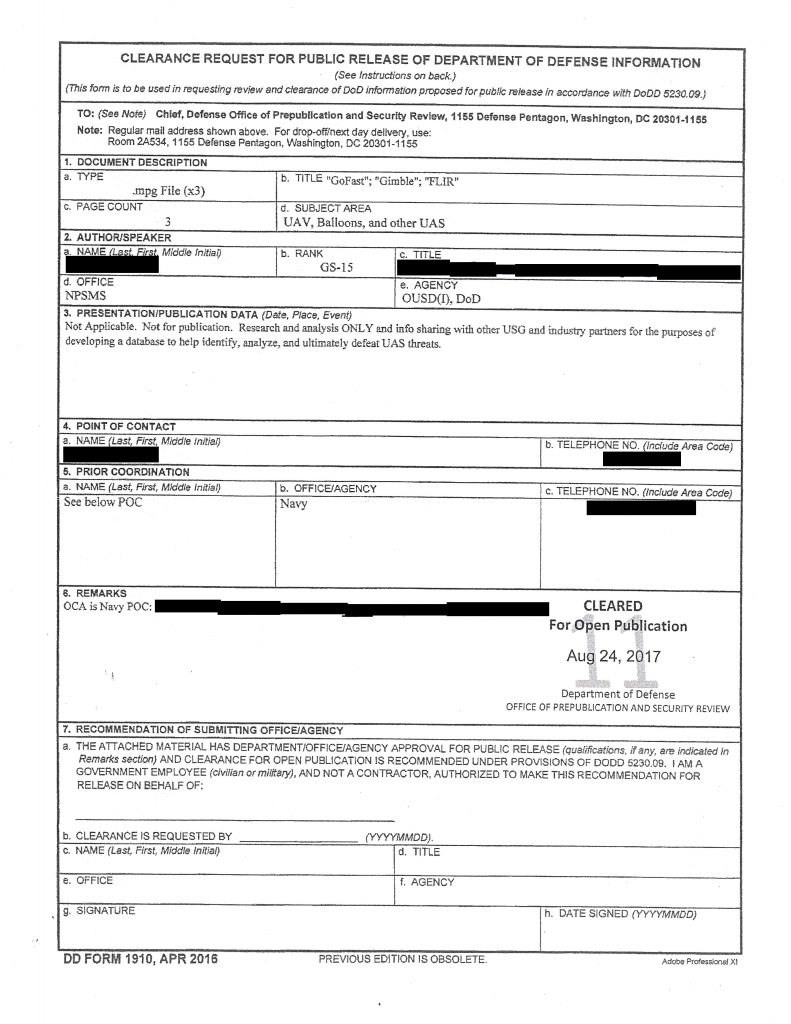
In an April 29 post at Las Vegas Now, George Knapp asserted it was confirmed the Pentagon released the three videos published by TTSA, citing a Form DD1910 of unclear origin. John Greenewald, Jr. subsequently obtained an email statement from a Department of Defense spokesperson who explained otherwise, stating the form actually indicated the videos were "not for public release." The spokesperson further clarified at Greenewald's request the internal approval on the form "does not mean public release approval."

George Knapp did not immediately respond to an opportunity to comment for this blog post. 

Form DD1910 in question
The sourcing of the vids has been a point of contention, particularly in light of how simple it should be for TTSA to publish a chain of custody. Doubts have surfaced given the lengthy amount of time DeLonge's group has failed to do so. Questions have arisen over numerous aspects of the clips, including when and how the audio portion of the "Gimbal" footage was laid over the video.

Adding fuel to the fire are TTSA unproven assertions. Early in the Gimbal video posted by TTSA, it is clearly claimed, "Gimbal is the first of three U.S. military videos of an unidentified aerial phenomenon (UAP) that has been through the USG declassification review process and approved for public release." 

Shortly thereafter, TTSA further asserts, yet a year and a half later continues to fail to prove, "This content has chain of custody documentation to ensure preservation of its original condition."

Two million views and 17 months later, TTSA has yet to present
the claimed chain of custody
     
Knapp recently wrote the DD1910 was "obtained," but did not clarify how, adding the form "shows the videos were released by the book." While some revere Knapp for past work on UFO stories such as Skinwalker Ranch and the Bob Lazar case, others feel he champions sensational material at the expense of relevant questions and the contradictory information such questions often reveal. Additional criticism includes failing to provide sources for documents presented. 

Experienced FOIA submitter John Greenewald, Jr. posted questions about the DD1910 published by Knapp. He questioned Knapp's portrayal of the doc as proof the DoD released the videos to either TTSA or the general public. Issues include why the name of the contact was redacted on the form, presumably by Knapp or his associates. Also questioned were the subjects of the videos, not listed as UAP or UFOs, but UAV (Unmanned Aerial Vehicle, commonly known as a drone), balloons, and UAS (Unmanned Aircraft System).

A May 2 statement obtained by Greenewald from Pentagon Spokesperson Sue Gough clarified the form in question was a valid DD1910. However, Gough continued, "Per block 3 of this form DD1910, the submitter requested release of videos solely for research and analysis purposes by U.S. government agencies and industry partners, and not for general public release."

The May 2 DoD statement posted by Greenewald:


Following push back to the above statement, Greenewald sought and obtained further clarification. Spokesperson Gough further specified the approval noted on the form "does not mean public release approval":


TTSA fans seem intent to continue to support the outfit regardless of conflicting story lines and the seeming obstruction of information by the very people claiming to be disclosing it. At some point, however, they may have little choice but to more soberly address why TTSA does not, itself, simply clarify its sources of material and any claimed importance. As it currently stands, TTSA perpetually leaves it to bloggers to piece together what TTSA seems either unable or unwilling to reveal.

Monday, April 29, 2019

A Long Way from Kitty Hawk

This is not an easy post to write, but some things need to be said and nobody is saying them (as usual).
Tyler Rogoway, Twitter

Tyler Rogoway is a writer, photographer, & journalist on aviation and military topics. If you haven't heard yet, which you should have if you're interested in UFOs, on April 26 he posted an article, What the hell is going on with UFOs and the Department of Defense?. The post explores the U.S. Navy updating UFO reporting procedures for its personnel, as well as the influence that Team TTSA is having on shaping UFO talk. I urge reading the article in full, and there are some points in particular I'd like to explore.

Ours or Theirs?

Rogoway addressed the possibility human beings, not extraterrestrials or a non-human intelligence, are the forces behind some craft perceived as UFOs. This was accomplished while sufficiently acknowledging technology demonstrated during the now much discussed Nimitz encounters involved flight capabilities that shatter our perception of propulsion and even physics. That's a difficult thing for many people to accept, he wrote.  

That's competently argued. Even without the decades-long laugh factor associated with controversial flying objects, lots of people, certainly including those with skeptical leanings and expert backgrounds, tend to bail on discussions when reduced to sighing, "I don't know."

Others are fond of drawing questionable conclusions about select UFO cases involving craft which display flight capabilities beyond current known technology. "It couldn't be ours," they surmise.

To that we might ask, "How do they know?" Are they experts with special access to classified aircraft and not bound by security oaths? 

The possibility many UFO cases can potentially be explained as quite human technology is a likelihood that absolutely must be given its due, particularly prior to jumping to unfounded speculation and conclusions. This doesn't necessarily mean human technology explains every case, but we can reasonably assume it's a strong contender for a whole lot of them.

This is how it started, Dec. 17, 1903
In the history of mankind, humans are the only beings conclusively known to construct and launch machines into flight in this neck of the woods. If you see a vehicle of some sort flying around, there's a really, really good chance people put it up there. Let's just say there's a lot of supporting documentation.

That doesn't have to mean there are no interesting mysteries. It does mean that scientists, academics, and intelligence personnel who wade into ufology to work for an entertainment company or wander around the desert looking for saucer debris should be held accountable for acting like they don't understand horses come before carts.  

Setting the Stage

Rogoway took his post a big step further than most and indeed explained something that needs to be said. In 2004, when the "Tic Tac" case unfolded, the Nimitz Carrier Strike Group was the only flotilla equipped with and testing a state of the art surveillance and tracking system called Cooperative Engagement Capability (CEC). 

Rogoway wrote, "What many may not know about this event is that it occurred in a place and time where the most powerful set of aerial surveillance sensors ever created were amassed together and were watching and recording it all."


USS Nimitz
CEC combined multiple data sources to enable target visibility to an extent never before achieved. It was cutting edge, continues to evolve, and "this integrated air defense system architecture was just being fielded on a Strike Group level for the first time aboard the Nimitz and its flotilla."

How significant was it?

"We are talking about a quantum leap in capability and fidelity here folks," Rogoway continued.

What's more, the location the encounters occurred, off the Baja Coast, is potentially significant. According to Rogoway, there's no better place to test such a system. The location is not an operational environment and aircraft are not armed because nobody's expecting to engage in a fight. 

"In other words," Rogoway explained, "it was an ideal testing environment that featured the very best aerial, surface, and undersea surveillance sensors and sensor crews on the planet."
  
He further clarified, "The key takeaway here is that if ever there was an opportune time to capture the very best real-world sensor data on a high-performance target in near lab-like controlled settings offered by the restricted airspace off the Baja Coast, this was it. And by intention or chance, this is exactly what happened."

It would seem reasonable to be a bit annoyed that ufology's self-proclaimed intelligence insiders, as well as supposedly qualified experts who delved extensively into the Tic Tac case, seem unaware of the CEC and the significance of the location of the Nimitz during the events. I very much appreciate Tyler Rogoway reporting on these potentially important circumstances. His post is objective, informative, and recommended. 

A Question of What's Being Concealed

It has been argued that Uncle Sam's armed forces are negligent in not recognizing select reports of UFOs as legitimate threats to national security. Perhaps that is true. A lot of UFO researchers sure think so.

A counterpoint could be made there could be other, more rational reasons for official stances of disinterest in UFOs. Those reasons could in some cases also be much less dramatic than the widely believed UFO cover-up.

Lack of UFO urgency arguably comes from the top and trickles down. If the brass aren't worried about nuke facilities getting buzzed, then neither are intel analysts. There is indeed precedence and many examples of this dynamic. 

Widely circulated photo of reported
Ghost Rocket originally released
by Swedish Army
James Carrion took a deep dive into the reported Ghost Rocket phenomenon of the 1940's. He presented authenticated memos and documents which showed intel analysts, officers, and even an FBI Special Agent became pretty thoroughly convinced upper echelon members of Swedish and U.S. intelligence were well aware of the origins of the supposed mystery rockets. This was due in substantial part to a lack of official concern, including allowing officers to remain on leave and failing to significantly increase security measures during a reported rocket wave. They just weren't interested, in spite of intel reports and public proclamations. 

Please allow me to emphasize that intelligence reports also cited contradictions in statements by officials and their lack of presenting tangible evidence in assessing it was likely the powers that be were themselves responsible for the Ghost Rockets: They pushed stories lacking verification, and they did not display evidence or concern in proportion to the stories.

U.S. Navy Admiral Henry Kent Hewitt, who Carrion suspects would have been among the informed upper echelon, actually discouraged investigation. He declined a chance to visit a potential rocket crash site to obtain debris for testing. The admiral suggested there would be more opportunities later. Opportunities, of course, which never came. 

It should be noted the purpose of the Ghost Rocket ruse would by no means have been to dupe the public into believing aliens were among us. That seems to have been accomplished by a credulous and often less than intellectually honest UFO community.

Objectives of the operation would have included confusing adversaries about what's in the sky and who's flying it, which would have potentially created a variety of advantageous situations for further exploitation. Perhaps one man's UFO cover-up is another man's classified job description of gas lighting the global intel community. 

A Long Way from Kitty Hawk

Orb-like objects have reportedly been flying in the vicinity of Iranian nuclear facilities. Those up on their UFO lore should quickly recognize a few common themes here, like the seeming nuclear site issue. Also noteworthy are the reported flight capabilities and actions of the flying objects, which include flying outside the atmosphere, achieving Mach 10 speeds, hovering over a target at a speed of zero, and powerful electronic countermeasures (ECM) which jam enemy radar and disrupt navigation systems through the use of high levels of magnetic energy. 

That's a lot to chew on and could sure get one's alien senses tingling. The Iranians, however, who apparently haven't been part of an altar call at a MUFON Symposium, suspected a much different explanation. They assessed their uninvited visitors to be CIA drones.

Iranian Air Force F-14 Tomcats
In 2004, which, by the way, was the same year of the Nimitz events, an Iranian F-14 Tomcat unsuccessfully tried to lock its radar on a luminous object over the Arak nuclear facility. The radar beam was effectively disrupted, apparently by the object, which was described by the pilot as spherical in shape. It reportedly had something described as a green afterburner which caused turbulence in its wake, then increased speed and "disappeared like a meteor." Interestingly, the Iranians seemed to think the flying objects emitted light in order to enable nighttime photography, whatever we may specifically make of that. 

In 2012 the two crewmen of an F-14 were killed when scrambled to intercept an intruder headed towards the Bushehr nuclear power plant. The F-14 exploded seconds after takeoff. I'm not aware of any cause given for the explosion.

In related stories, Wired reported in 2013 that Sandia National Laboratories was developing a Transformer-like drone. The object was designed to fly, swim, drive, and hop its way to its mission, transforming itself to accommodate different terrain.

"Its wings become fins as it dives into water, or underwater paddles that shed casings to reveal wheels as it moves toward land — wheels with the ability to jump 30 feet into the air. An entire campaign could be conducted by a remote operator or, more likely, semi-autonomously," the article explained.

There are clearly a lot of different kinds of machines crawling the planet. They have a wide range of capabilities and diverse appearances. We should expect them to become more frequently reported. 

We don't have to throw the babies out with the bathwater, but let's encourage suspending judgement on extraordinary explanations until conclusive evidence is available - and, of course, actually presented. Let's not ignore the most likely possibilities. We just deceive ourselves if we do, and we deserve better than that, from all involved. 

Tuesday, April 16, 2019

UFOs as Espionage Tools

The Boyd Bushman case offers examples of how intelligence agencies might investigate people involved in wild stories of alleged aliens and UFO technology. These stories may become tools used in intelligence and counterintelligence operations to gain the trust of people issued security clearances. Beliefs in an extraterrestrial presence may then be cultivated and exploited in an effort to obtain classified information. It's not hard to envision such scenarios might substantially disrupt the research process in ufology as well as the resulting beliefs in the public at large, even when that's not an objective of the operation. Writer and researcher Nick Redfern recently gave his take on the Bushman case.   

Submarine launch of an LM Trident missile
The late Boyd Bushman was issued a Top Secret security clearance in his role as a Senior Specialist at Lockheed Martin, a major American aerospace and defense company. He publicly discussed extreme ET-related beliefs, including describing networking with allegedly like-minded global associates. They supposedly shared his concerns that the U.S. government possessed smoking gun alien tech that should be open to the masses.

His employer, LM, apparently thought otherwise, and informed the FBI in the 1990's it was concerned Bushman was the subject of "an ongoing attempt to elicit LM proprietary or USG classified information." FBI records on Bushman, available at The Black Vault, indicate at least one of his associates was found to have "a history of allegations of misconduct, violations of security and classified information handling procedures, and suspicious contacts with foreign nationals." All of this involved a person "suspected of inappropriately releasing information."

From FBI files on Bushman

It's not difficult to theorize that at least some of Bushman's global contacts, people he described as sharing a mutual belief that government secrecy hampered the efforts of scientists to discuss alleged ET technology, may have had ulterior motives. There are several interesting cases of this nature in the winding history of ufology, and one of them involves the now deceased Vincente DePaula.

Vincente DePaula

It's first helpful to consider 1980's ufology to develop context of the DePaula case. The alien smoking gun was coming anytime and there were a lot of intel operatives jamming up the UFO conference circuit, or at least that's what a lot of people believed. The former obviously never came to pass, but the latter actually proved to have merit. All that's pretty much a lot more stories for another time, but the gist of the plot is there were a bunch of spooks and their assets in ufology, we just probably are wrong about the purposes much more often than not.  

Tensions were high, and, as is consistently the case in ufology, many interpret the presence of the intelligence community as confirmation of their beliefs. That's of course not necessarily true, if not quite often probably untrue. 

As still happens, people with opposing views were apt to accuse one another of spreading disinformation on behalf of intel agencies, whatever the actual reasons may have been for IC interest in the social circles. This is not to necessarily minimize the potential significance of the complex and tangled webs, as there were indeed people acting with unclear and obstructed agendas, as there continue to be around the UFO scene.

Bill Moore, Jaime Shandera and Stanton Friedman,
staples of the 1980's UFO community

Vincente DePaula was a Cuban immigrant employed in the defense industry, according to a now inactive website belonging to Ron Regehr. The two met and developed a friendship due to their work on classified material and their shared interest in UFOs. Both were active in the Mutual UFO Network, resulting in DePaula drawing the head of an alien at Regehr's request. The specific details behind the drawing are not entirely clear, but it apparently received some notoriety around the community. DePaula was eventually interrogated by the Defense Investigative Service (DIS) and, according to Regehr, DePaula stated the interrogations were related to the drawing.

Interrogations by DIS of Vincente DePaula,
according to Ron Regehr
DePaula indicated DIS wanted to know more about sources of information pertaining to the alien head. He apparently did not cooperate, which reportedly led to four interrogations during 1986, collectively spanning some 41 hours. One lasted for eight hours and another went on for 28 hours.

Some people seemed to think DePaula's ordeal was due to a DIS interest in tracking who knew about an alien presence and maintaining secrecy. It was also speculated that DePaula and his UFO associates suspected his work on classified satellite systems was part of a secret government effort to monitor UFO activity and alien abductions. Some even believed DePaula's lack of cooperation with DIS led to induced cancer and his untimely death. 

Perhaps another possible explanation for DIS interest in Vincente DePaula and his UFO social circles might involve something more along the lines of how the FBI seems to have undertaken an investigation into the associates of Boyd Bushman. It seems easy to envision, whether or not it applies to the DePaula case, that intelligence agencies would become concerned about the identities and motives of people who develop confidential relationships with individuals issued security clearances. That might particularly be the case when the nature of such relationships includes discussions directly related to their employment activities by way of the topic of alleged aliens.

I unsuccessfully attempted through the Freedom of Information Act to obtain records on the reported interrogations of Vincente DePaula. DIS was disbanded and absorbed into the Defense Security Service, which responded that no records currently exist and were probably discarded. Other agencies similarly reported no records available for release.